Study of Compounds — Practice Quiz
ICSE · Class 10 · Chemistry
Try a 4-question quiz on Study of Compounds for ICSE Class 10 Chemistry: tap an answer to check it and see why. 44 questions in the full chapter test.
Interactive on Super Tutor
Studying Study of Compounds? Get the full interactive chapter.
Quizzes, flashcards, AI doubt-solver and a step-by-step study plan — built for practice quiz and more.
Free trial, no card needed.
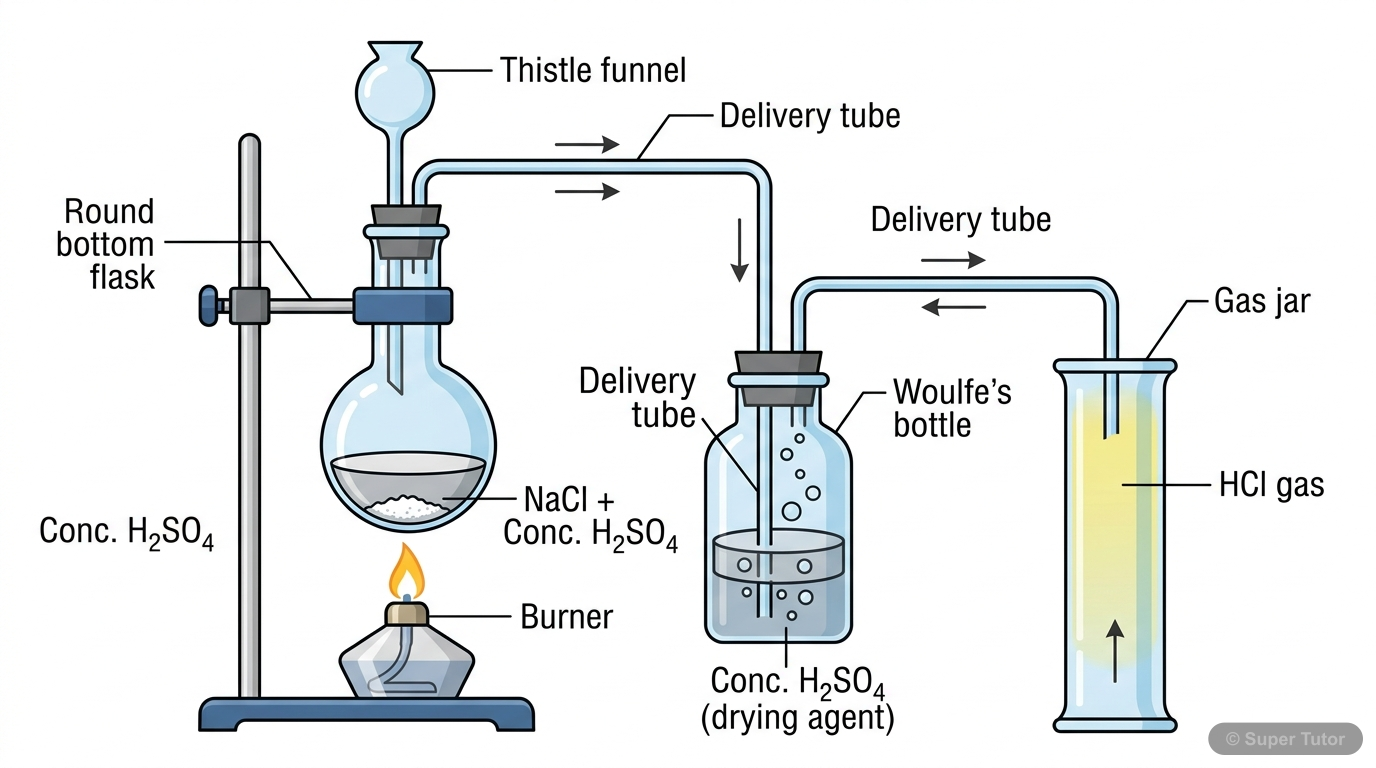
One of 18 illustrations for Study of Compounds in Super Tutor — alongside flashcards, concept maps and practice questions.
See them allQuick Quiz: Study of Compounds
0/4Tap an answer to check it instantly. No sign-up needed for these 4.
Which gas is used to prepare hydrogen chloride in the laboratory?
The fountain experiment demonstrates which property of HCl gas?
In Haber's process, ammonia is manufactured from:
Which drying agent is used for drying HCl gas?
Sample Questions
Which of the following are correct properties of ammonia gas?
Show answer
Colourless gas, Lighter than air, Highly soluble in water, Pungent smell
Ammonia is colourless, lighter than air (VD = 8.5), highly soluble in water, has a pungent smell, and is basic in nature, not acidic.
The brown ring test is used to identify:
Show answer
Nitrates
The brown ring test using FeSO4 and conc. H2SO4 is specific for nitrates. A brown ring of nitroso ferrous sulphate (FeSO4.NO) forms at the junction of two liquids.
Which of the following are products when copper reacts with concentrated nitric acid?
Show answer
Copper nitrate, Nitrogen dioxide, Water
When copper reacts with concentrated nitric acid: Cu + 4HNO3 → Cu(NO3)2 + 2NO2 + 2H2O. No hydrogen gas is produced as nitric acid acts as an oxidizing agent.
Aqua regia is a mixture of:
Show answer
1 part HNO3 + 3 parts HCl
Aqua regia is prepared by mixing one part by volume of concentrated nitric acid with three parts by volume of concentrated hydrochloric acid. This mixture is powerful enough to dissolve noble metals like gold and platinum because the nitric acid oxidises HCl to release highly reactive nascent chlorine. The reversed ratio or equal parts do not correspond to the actual composition of aqua regia.
+40 more questions on Study of Compounds (ICSE Class 10 Chemistry)
Practise AllFrequently Asked Questions
What are the important topics in Study of Compounds for ICSE Class 10 Chemistry?
How many practice questions are there for Study of Compounds?
Sources & Official References
Content is aligned to the official syllabus. Refer to the board website for the latest curriculum.
More resources for Study of Compounds
Important Questions
Exam-style questions with answers
Revision Notes
Key points for last-minute revision
Formula Sheet
The chapter's formulas in one place
Chapter Summary
Understand the chapter at a glance
Concept Maps
See how topics connect
Study Plan
Step-by-step plan for this chapter
Flashcards
Quick-fire cards for active recall
Syllabus
What topics to cover
For serious students
Get the full Study of Compounds chapter — start free.
Quizzes, flashcards, an AI doubt solver and a study plan for ICSE Class 10 Chemistry. Free to start, no card needed.