Electrolysis
ICSE · Class 10 · Chemistry
Flashcards for Electrolysis — ICSE Class 10 Chemistry. Quick Q&A cards covering key concepts, definitions, and formulas.
Interactive on Super Tutor
Studying Electrolysis? Get the full interactive chapter.
Quizzes, flashcards, AI doubt-solver and a step-by-step study plan — built for flashcards and more.
1,000+ Class 10 students started this chapter today
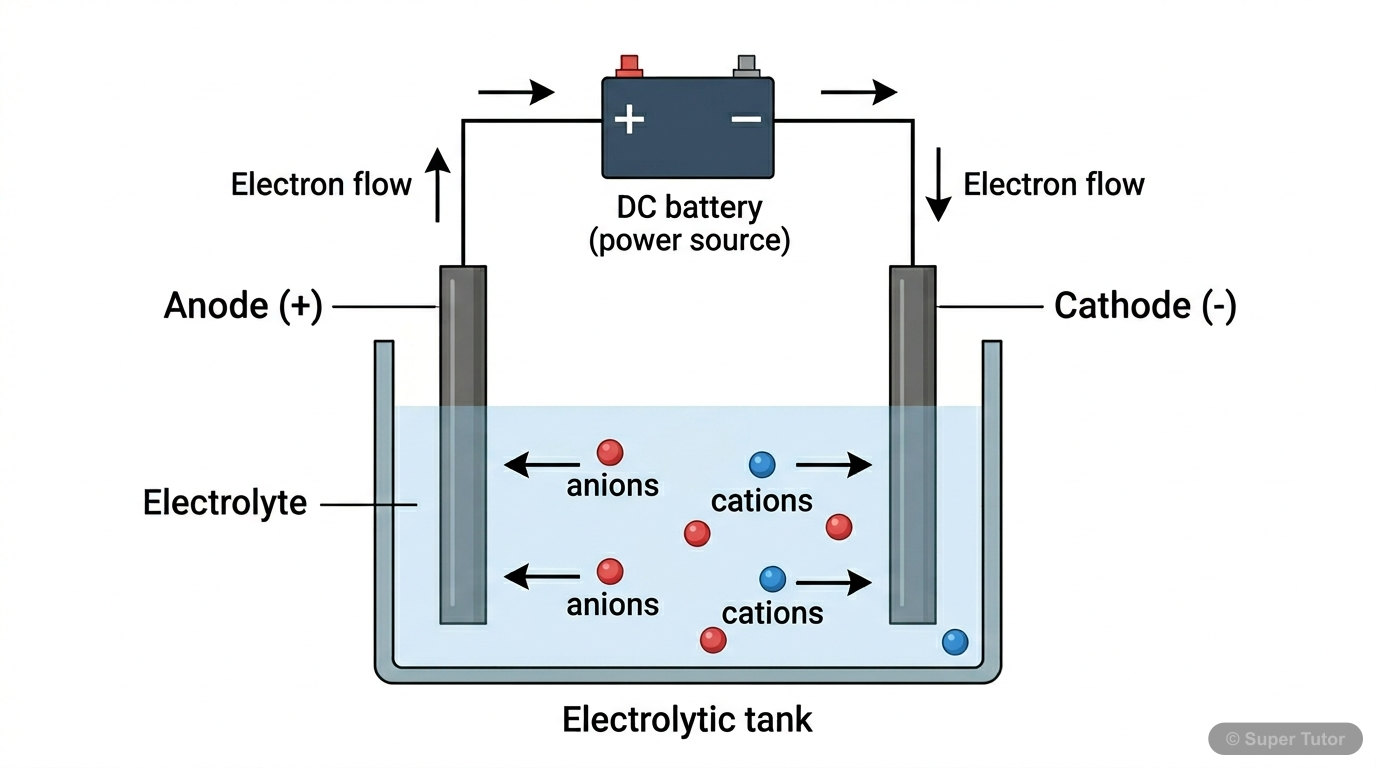
Learn better with visuals Super Tutor has hundreds of illustrations like this across every chapter — all free to try.
Get startedWhat is electrolysis?
Answer
Electrolysis is the process in which passage of electric current through an electrolyte causes chemical change. Electrical energy is converted into chemical energy. Example: electrolysis of molten sod…
What is an electrolytic cell?
Answer
An electrolytic cell is a device in which electrical energy is converted into chemical energy through electrolysis. It contains an electrolyte, electrodes, and a battery.
What is the difference between an electrolytic cell and an electrochemical cell?
Answer
An electrolytic cell converts electrical energy into chemical energy. An electrochemical cell converts chemical energy into electrical energy following redox change. They perform opposite functions.
Define anode and cathode in an electrolytic cell.
Answer
Anode: the electrode at which oxidation takes place; it is connected to the positive terminal of the battery. Cathode: the electrode at which reduction takes place; it is connected to the negative ter…
What are cations and anions?
Answer
Cations are positively charged ions formed by loss of electrons. Anions are negatively charged ions formed by gain of electrons. Cations move towards the cathode and anions move towards the anode duri…
Why do cations go to the cathode and anions go to the anode?
Answer
Cations are positively charged, so they are attracted to the negative cathode. Anions are negatively charged, so they are attracted to the positive anode. At the electrodes, cations gain electrons and…
What is oxidation and what is reduction?
Answer
Oxidation is loss of electrons. Reduction is gain of electrons. In electrolysis, oxidation occurs at the anode and reduction occurs at the cathode.
Why is electrolysis caused by direct current only?
Answer
Electrolysis is caused by direct current only because a steady current is needed for ions to move in one direction and get discharged at fixed electrodes. Alternating current does not cause electrolys…
+32 more flashcards available
Practice AllFrequently Asked Questions
What are the important topics in Electrolysis for ICSE Class 10 Chemistry?
How to score full marks in Electrolysis — ICSE Class 10 Chemistry?
How many flashcards are available for Electrolysis?
Sources & Official References
Content is aligned to the official syllabus. Refer to the board website for the latest curriculum.
More resources for Electrolysis
Practice Quiz
Test yourself with a quick quiz
Important Questions
Practice with board exam-style questions
Revision Notes
Key points for last-minute revision
Formula Sheet
All formulas in one place
Chapter Summary
Understand the chapter at a glance
Concept Maps
See how topics connect visually
Study Plan
Step-by-step plan to ace this chapter
Syllabus
What topics to cover
NCERT Solutions
Every textbook question solved step by step
For serious students
Get the full Electrolysis chapter — for free.
Quizzes, flashcards, AI doubt-solver and a step-by-step study plan for ICSE Class 10 Chemistry.