Analytical chemistry — Practice Quiz
ICSE · Class 10 · Chemistry
Try a 4-question quiz on Analytical chemistry for ICSE Class 10 Chemistry: tap an answer to check it and see why. 44 questions in the full chapter test.
Interactive on Super Tutor
Studying Analytical chemistry? Get the full interactive chapter.
Quizzes, flashcards, AI doubt-solver and a step-by-step study plan — built for practice quiz and more.
Free trial, no card needed.
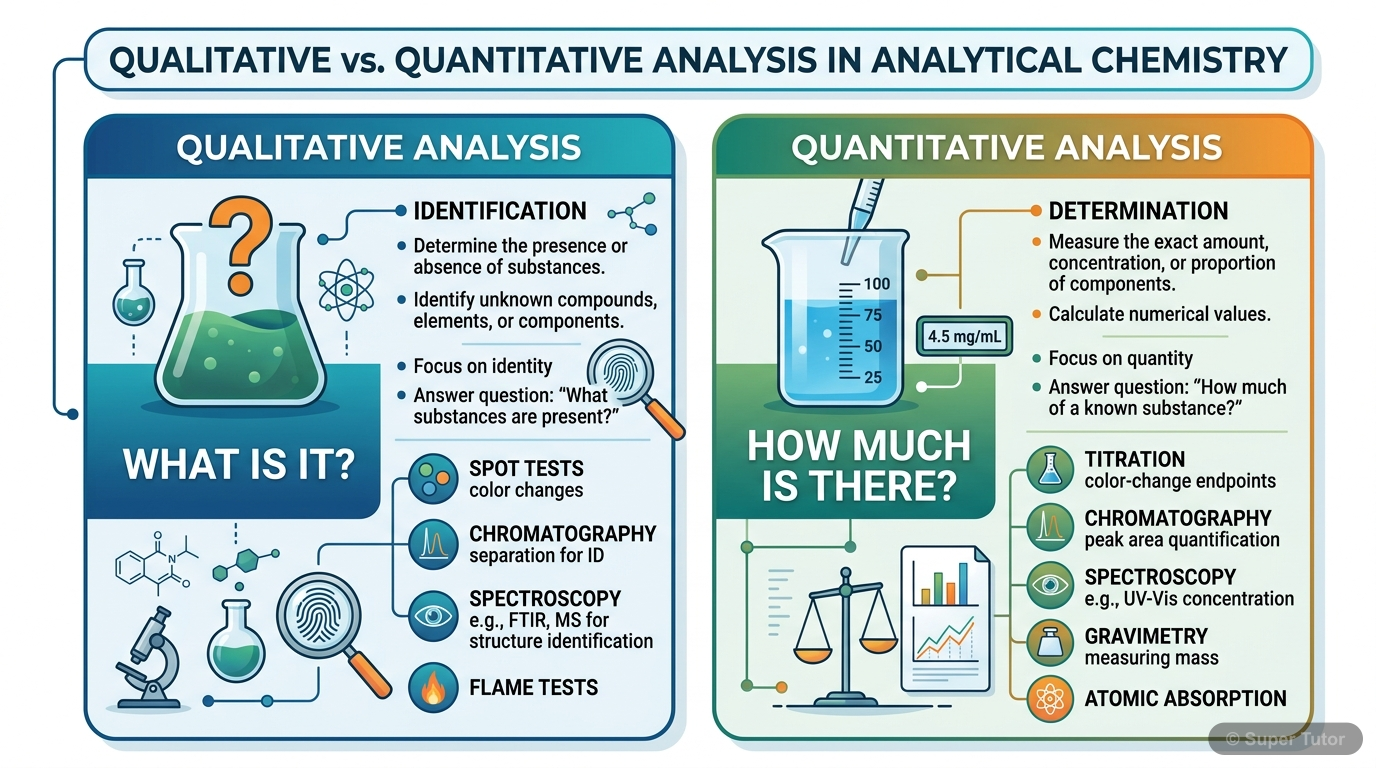
Learn better with visuals Super Tutor pairs illustrations like this with notes and quizzes for Analytical chemistry.
Get startedQuick Quiz: Analytical chemistry
0/4Tap an answer to check it instantly. No sign-up needed for these 4.
What is the color of Cu²⁺ ions in aqueous solution?
When NH₄OH is added to CuSO₄ solution, what color precipitate is initially formed?
What happens when excess NH₄OH is added to the pale blue precipitate of Cu(OH)₂?
What color is Fe(OH)₃ precipitate?
Sample Questions
Which of the following ions are colorless?
Show answer
Na⁺, Zn²⁺, Ca²⁺, Al³⁺
Ions of normal elements (groups IA-VIIA) are generally colorless. Na⁺, Zn²⁺, Ca²⁺, and Al³⁺ are colorless ions. Cu²⁺ is blue and Fe³⁺ is pale yellow, both being transition metal ions.
Which metal hydroxide precipitates are soluble in excess NH₄OH?
Show answer
Cu(OH)₂, Zn(OH)₂
Cu(OH)₂ and Zn(OH)₂ dissolve in excess NH₄OH to form soluble complexes. Fe(OH)₃, Pb(OH)₂, and Ca(OH)₂ remain insoluble in excess NH₄OH.
When NaOH is added to Pb(NO₃)₂ solution, what happens in excess NaOH?
Show answer
White precipitate dissolves to form colorless solution
Initially, white Pb(OH)₂ precipitate forms. In excess NaOH, it dissolves to form sodium plumbite (Na₂PbO₂), a colorless soluble complex.
Which of the following are amphoteric oxides?
Show answer
ZnO, Al₂O₃, PbO
ZnO, Al₂O₃, and PbO are amphoteric oxides that react with both acids and bases. CaO and Na₂O are basic oxides that only react with acids.
+40 more questions on Analytical chemistry (ICSE Class 10 Chemistry)
Practise AllFrequently Asked Questions
What are the important topics in Analytical chemistry for ICSE Class 10 Chemistry?
How many practice questions are there for Analytical chemistry?
Sources & Official References
Content is aligned to the official syllabus. Refer to the board website for the latest curriculum.
More resources for Analytical chemistry
Important Questions
Exam-style questions with answers
Revision Notes
Key points for last-minute revision
Formula Sheet
The chapter's formulas in one place
Chapter Summary
Understand the chapter at a glance
Concept Maps
See how topics connect
Study Plan
Step-by-step plan for this chapter
Flashcards
Quick-fire cards for active recall
Syllabus
What topics to cover
For serious students
Get the full Analytical chemistry chapter — start free.
Quizzes, flashcards, an AI doubt solver and a study plan for ICSE Class 10 Chemistry. Free to start, no card needed.