Adjectives: Order and Degrees of Comparison
ICSE · Class 10 · English Language - Archer
Quick revision notes for Adjectives: Order and Degrees of Comparison — ICSE Class 10 English Language - Archer. Key concepts, formulas, and definitions for last-minute revision.
Interactive on Super Tutor
Studying Adjectives: Order and Degrees of Comparison? Get the full interactive chapter.
Quizzes, flashcards, AI doubt-solver and a step-by-step study plan — built for revision notes and more.
1,000+ Class 10 students started this chapter today
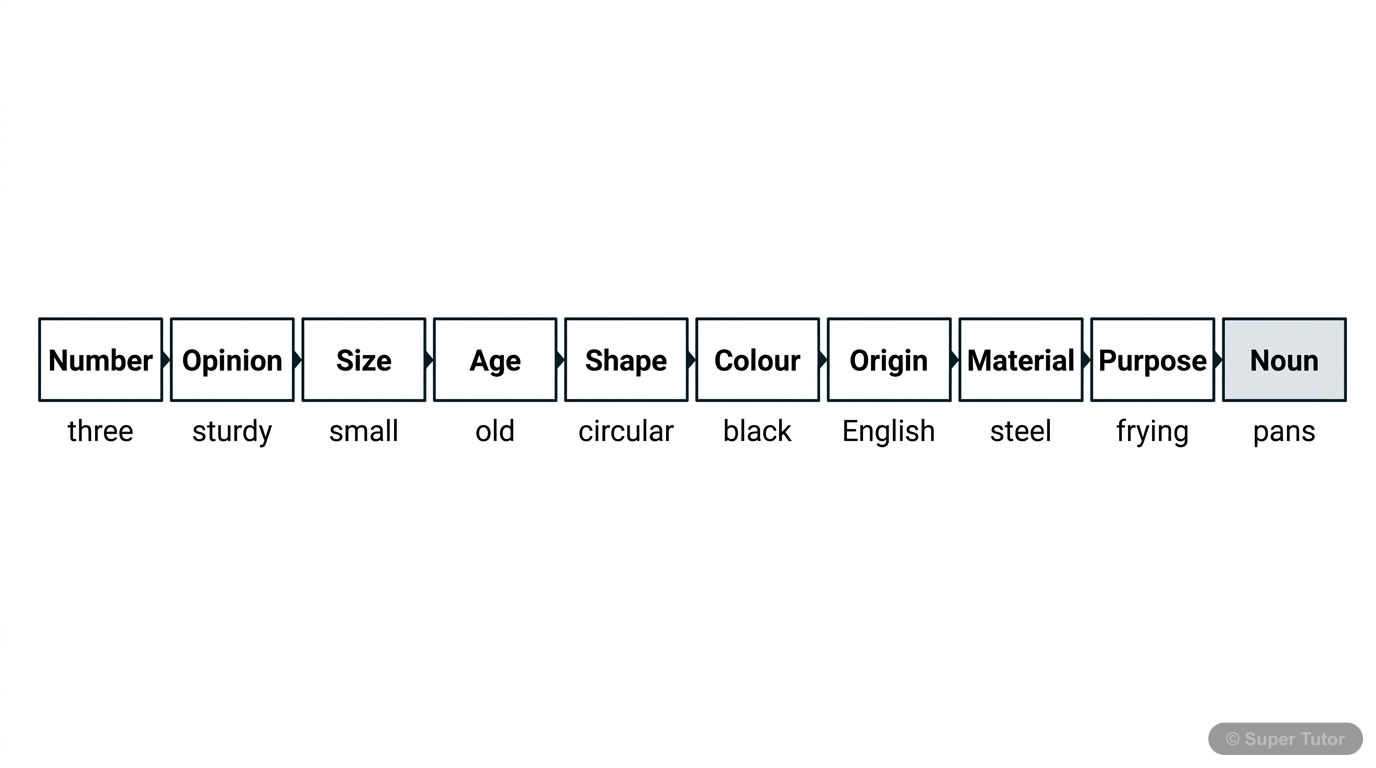
Super Tutor has 5+ illustrations like this for Adjectives: Order and Degrees of Comparison alone — flashcards, concept maps, and step-by-step visuals.
See them allKey Topics to Revise
Order of Adjectives
- When more than one adjective is used before a noun, the order must be correct.
- The order is: number, opinion, size, age, shape, colour, origin, material, purpose, noun.
- Examples of adjective types include: two, pretty, little, modern, round, white, Indian, wooden, serving.
Degrees of Comparison
- Adjectives change form when two or more nouns or pronouns are compared.
- In simple form, an adjective is in the positive degree.
- When two nouns or pronouns are compared, the adjective is in the comparative degree.
Using Degrees of Comparison
- The same idea can be expressed in different degrees of comparison.
- Esha is as strong as Pooja. shows the positive degree.
- Esha is stronger than Pooja. shows the comparative degree.
Adjectives Easily Confused
- Elder and eldest are used with people who are members of the same family.
- Older and oldest are used with people, animals, and things.
- Than should not be used with elder.
Get complete notes with diagrams and examples
Full NotesKey Concepts
Frequently Asked Questions
What are the important topics in Adjectives: Order and Degrees of Comparison for ICSE Class 10 English Language - Archer?
How to score full marks in Adjectives: Order and Degrees of Comparison — ICSE Class 10 English Language - Archer?
Sources & Official References
Content is aligned to the official syllabus. Refer to the board website for the latest curriculum.
More resources for Adjectives: Order and Degrees of Comparison
Practice Quiz
Test yourself with a quick quiz
Important Questions
Practice with board exam-style questions
Formula Sheet
All formulas in one place
Chapter Summary
Understand the chapter at a glance
Concept Maps
See how topics connect visually
Study Plan
Step-by-step plan to ace this chapter
Flashcards
Quick-fire cards for active recall
Syllabus
What topics to cover
NCERT Solutions
Every textbook question solved step by step
For serious students
Get the full Adjectives: Order and Degrees of Comparison chapter — for free.
Quizzes, flashcards, AI doubt-solver and a step-by-step study plan for ICSE Class 10 English Language - Archer.