Agreement of the Verb with Its Subject
ICSE · Class 10 · English Language - Archer
Quick revision notes for Agreement of the Verb with Its Subject — ICSE Class 10 English Language - Archer. Key concepts, formulas, and definitions for last-minute revision.
Interactive on Super Tutor
Studying Agreement of the Verb with Its Subject? Get the full interactive chapter.
Quizzes, flashcards, AI doubt-solver and a step-by-step study plan — built for revision notes and more.
1,000+ Class 10 students started this chapter today
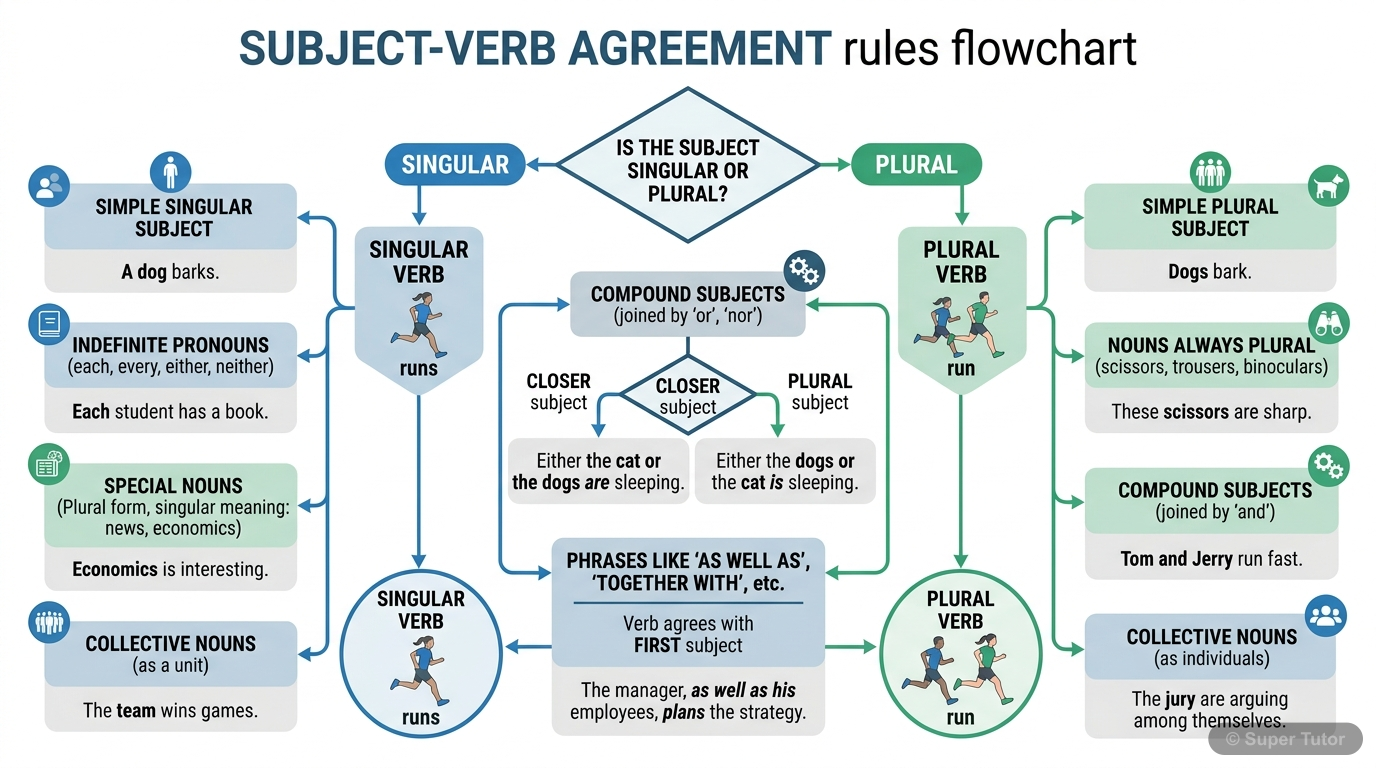
Super Tutor has 5+ illustrations like this for Agreement of the Verb with Its Subject alone — flashcards, concept maps, and step-by-step visuals.
See them allKey Topics to Revise
Core Rule
- A verb must agree with its subject in both number and person.
- Singular subjects take singular verbs and plural subjects take plural verbs.
- The basic rule is: if the subject is singular, the verb is singular; if the subject is plural, the verb is plural.
Compound Subjects and Shared Ideas
- Two or more singular nouns joined by and take a plural verb.
- Two or more nouns expressing one idea or referring to the same thing take a singular verb.
- Idli and sambar is an example of two nouns treated as one idea.
Collective Nouns
- Collective nouns generally take singular verbs.
- A collective noun takes a plural verb when it refers to the individual members of the group rather than the group as a whole.
- The mob is getting more violent by the minute is a singular-verb example.
Special Linking Phrases and Correlative Conjunctions
- When two subjects are joined by as well as, with, in addition to, along with, or together with, the verb agrees with the first subject.
- Rohan, as well as his cousins, is participating in the tournament follows this rule.
- The second subject does not control the verb in these cases.
Get complete notes with diagrams and examples
Full NotesKey Concepts
Frequently Asked Questions
What are the important topics in Agreement of the Verb with Its Subject for ICSE Class 10 English Language - Archer?
How to score full marks in Agreement of the Verb with Its Subject — ICSE Class 10 English Language - Archer?
Sources & Official References
Content is aligned to the official syllabus. Refer to the board website for the latest curriculum.
More resources for Agreement of the Verb with Its Subject
Practice Quiz
Test yourself with a quick quiz
Important Questions
Practice with board exam-style questions
Formula Sheet
All formulas in one place
Chapter Summary
Understand the chapter at a glance
Concept Maps
See how topics connect visually
Study Plan
Step-by-step plan to ace this chapter
Flashcards
Quick-fire cards for active recall
Syllabus
What topics to cover
NCERT Solutions
Every textbook question solved step by step
For serious students
Get the full Agreement of the Verb with Its Subject chapter — for free.
Quizzes, flashcards, AI doubt-solver and a step-by-step study plan for ICSE Class 10 English Language - Archer.