Mahatma Gandhi and the National Movement — Concept Maps
ICSE · Class 10 · History & Civics
4 mind maps of Mahatma Gandhi and the National Movement for ICSE Class 10 History & Civics, each also written out as a text outline.
Interactive on Super Tutor
Studying Mahatma Gandhi and the National Movement? Get the full interactive chapter.
Quizzes, flashcards, AI doubt-solver and a step-by-step study plan — built for concept maps and more.
Free trial, no card needed.
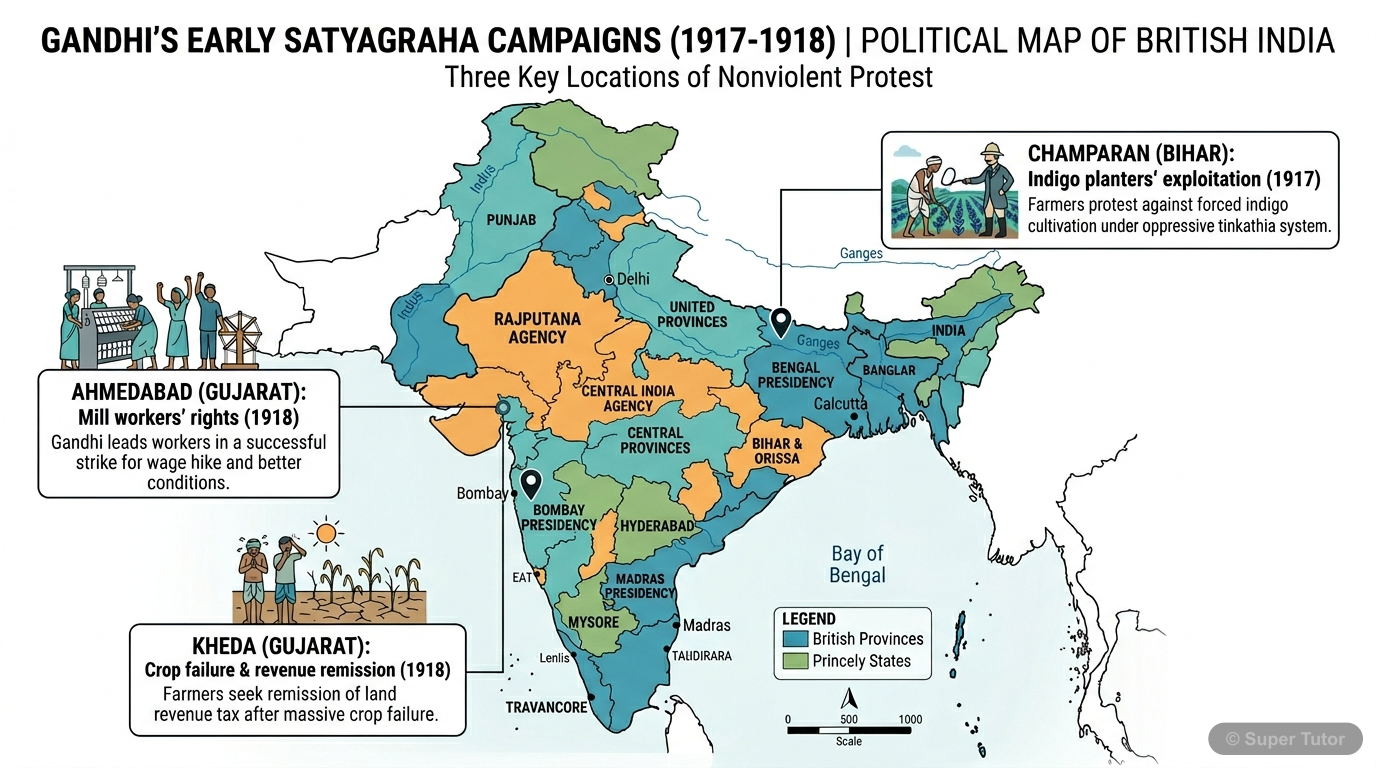
One of 5 illustrations for Mahatma Gandhi and the National Movement in Super Tutor — alongside flashcards, concept maps and practice questions.
See them allGandhi's Journey and Major Movements
The map in words
- 1869
- Birth in Porbandar
- 1893
- Goes to South Africa
- 1915
- Returns to India
- 1917-18
- Champaran Kheda Ahmedabad Satyagrahas
- 1919
- Rowlatt Act Jallianwala Bagh
- 1921-22
- Non-Cooperation Movement
- 1930
- Dandi March Civil Disobedience
- 1931
- Gandhi-Irwin Pact
- 1932
- Poona Pact
- 1947
- Indian Independence
Mahatma Gandhi and National Movement - Complete Overview
The map in words
- Gandhi Era 1919-1947
- Early Life
- Born 1869 Porbandar
- England Law Study
- South Africa 22 years
- Satyagraha Development
- Philosophy Methods
- Non Violence Ahimsa
- Satyagraha Truth Force
- Swadeshi Economic Freedom
- Social Reform Harijans
- Major Movements
- Non Cooperation 1921-22
- Rowlatt Act Protest
- Jallianwala Bagh Response
- Khilafat Unity
- Chauri Chaura End
- Civil Disobedience 1930-34
- Simon Commission Boycott
- Dandi March Salt Law
- Gandhi Irwin Pact
- Poona Pact Harijans
- Non Cooperation 1921-22
- Impact Legacy
- Mass Movement Creation
- Congress Transformation
- National Awakening
- Independence Preparation
- Early Life
Timeline of Gandhian Era (1915-1934)
The map in words
- 1915
- Gandhi returns to India
- 1917
- Champaran Satyagraha
- 1918
- Kheda and Ahmedabad Satyagraha
- 1919
- Rowlatt Act and Jallianwala Bagh
- 1920
- Khilafat Movement begins
- 1921
- Non-Cooperation Movement launched
- 1922
- Chauri Chaura incident
- 1928
- Simon Commission arrives
- 1929
- Lahore Congress Purna Swaraj
- 1930
- Dandi March begins
- 1931
- Gandhi-Irwin Pact
- 1932
- Poona Pact signed
- 1934
- Civil Disobedience withdrawn
Mahatma Gandhi’s leadership transformed the Indian national movement into a mass struggle based on truth, non-violence, Satyagraha, Swadeshi, and social reform.
The map in words
- Mahatma Gandhi’s leadership transformed the Indian national movement into a mass struggle based on truth, non-violence, Satyagraha, Swadeshi, and social reform.
- Mahatma Gandhi
- Early struggles in India
- Doctrine of Satyagraha
- Doctrine of non-violence
- Social ideals
- Swadeshi and Khadi
- Rowlatt Act and reaction
- Jallianwala Bagh Tragedy
Explore these maps interactively
Explore DiagramsFrequently Asked Questions
What are the important topics in Mahatma Gandhi and the National Movement for ICSE Class 10 History & Civics?
What do the concept maps for Mahatma Gandhi and the National Movement show?
How should I revise Mahatma Gandhi and the National Movement for the ICSE Class 10 board exam?
Sources & Official References
Content is aligned to the official syllabus. Refer to the board website for the latest curriculum.
More resources for Mahatma Gandhi and the National Movement
Practice Quiz
Test yourself with a quick quiz
Important Questions
Exam-style questions with answers
Revision Notes
Key points for last-minute revision
Chapter Summary
Understand the chapter at a glance
Study Plan
Step-by-step plan for this chapter
Flashcards
Quick-fire cards for active recall
Syllabus
What topics to cover
For serious students
Get the full Mahatma Gandhi and the National Movement chapter — start free.
Quizzes, flashcards, an AI doubt solver and a study plan for ICSE Class 10 History & Civics. Free to start, no card needed.