Mahatma Gandhi and the National Movement
ICSE · Class 10 · History & Civics
Flashcards for Mahatma Gandhi and the National Movement — ICSE Class 10 History & Civics. Quick Q&A cards covering key concepts, definitions, and formulas.
Interactive on Super Tutor
Studying Mahatma Gandhi and the National Movement? Get the full interactive chapter.
Quizzes, flashcards, AI doubt-solver and a step-by-step study plan — built for flashcards and more.
1,000+ Class 10 students started this chapter today
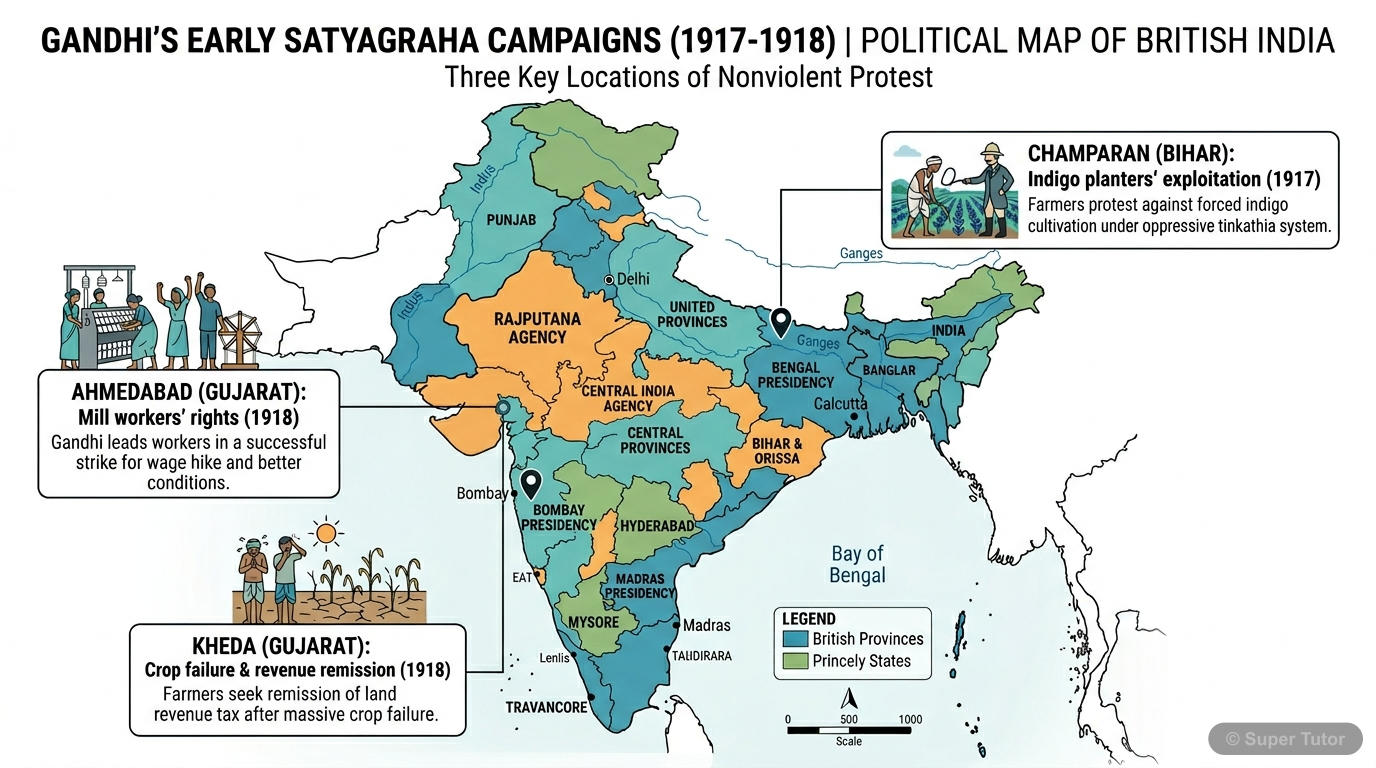
Learn better with visuals Super Tutor has hundreds of illustrations like this across every chapter — all free to try.
Get startedWho was Mahatma Gandhi and why is he important in Indian history?
Answer
Mahatma Gandhi was the greatest national leader of India. He was also a politician, organiser, reformer, author, and speaker. He guided the national movement, led major agitations, and is called the F…
What was Mahatma Gandhi's full name and when and where was he born?
Answer
His full name was Mohandas Karamchand Gandhi. He was born on October 2, 1869 in Porbandar, Kathiawar.
At what age was Gandhi married to Kasturba, and why is this fact often remembered?
Answer
Gandhi married Kasturba at the age of 13. This fact is often remembered because it shows the social customs of that period in India.
How did Gandhi's South Africa experience shape his political life?
Answer
Gandhi went to South Africa in 1893 as a legal advisor on behalf of a Muslim's firm and stayed there for about 22 years. There he faced racial discrimination against Indians. His fight against unjust …
What is the meaning of Satyagraha according to Gandhi?
Answer
Satyagraha was Gandhi's great weapon for fighting injustice with truth, moral strength, and non-violence. He saw it as the weapon of the strong, not the weak. It was meant for peaceful struggle agains…
What is passive resistance, and how is it different from Satyagraha?
Answer
Passive resistance is the weapon of the weak. Satyagraha is the weapon of the strong. Passive resistance suggests avoiding direct struggle, while satyagraha is active moral resistance based on truth a…
Why is the period 1919 to 1947 called the Gandhian Era?
Answer
This period is called the Gandhian Era because Gandhi dominated the freedom movement during these years. His leadership shaped the national struggle and made him the central figure in politics.
What was the Champaran Satyagraha of 1917?
Answer
The Champaran Satyagraha was a struggle of indigo cultivators in Bihar. They were forced to grow indigo on 3/20th of their land and sell it at prices fixed by British planters. Gandhi’s satyagraha led…
+33 more flashcards available
Practice AllFrequently Asked Questions
What are the important topics in Mahatma Gandhi and the National Movement for ICSE Class 10 History & Civics?
How to score full marks in Mahatma Gandhi and the National Movement — ICSE Class 10 History & Civics?
How many flashcards are available for Mahatma Gandhi and the National Movement?
Sources & Official References
Content is aligned to the official syllabus. Refer to the board website for the latest curriculum.
More resources for Mahatma Gandhi and the National Movement
Practice Quiz
Test yourself with a quick quiz
Important Questions
Practice with board exam-style questions
Revision Notes
Key points for last-minute revision
Formula Sheet
All formulas in one place
Chapter Summary
Understand the chapter at a glance
Concept Maps
See how topics connect visually
Study Plan
Step-by-step plan to ace this chapter
Syllabus
What topics to cover
NCERT Solutions
Every textbook question solved step by step
For serious students
Get the full Mahatma Gandhi and the National Movement chapter — for free.
Quizzes, flashcards, AI doubt-solver and a step-by-step study plan for ICSE Class 10 History & Civics.