Mahatma Gandhi and the National Movement
ICSE · Class 10 · History & Civics
Summary of Mahatma Gandhi and the National Movement for ICSE Class 10 History & Civics. Key concepts, important points, and chapter overview.
Interactive on Super Tutor
Studying Mahatma Gandhi and the National Movement? Get the full interactive chapter.
Quizzes, flashcards, AI doubt-solver and a step-by-step study plan — built for chapter summary and more.
1,000+ Class 10 students started this chapter today
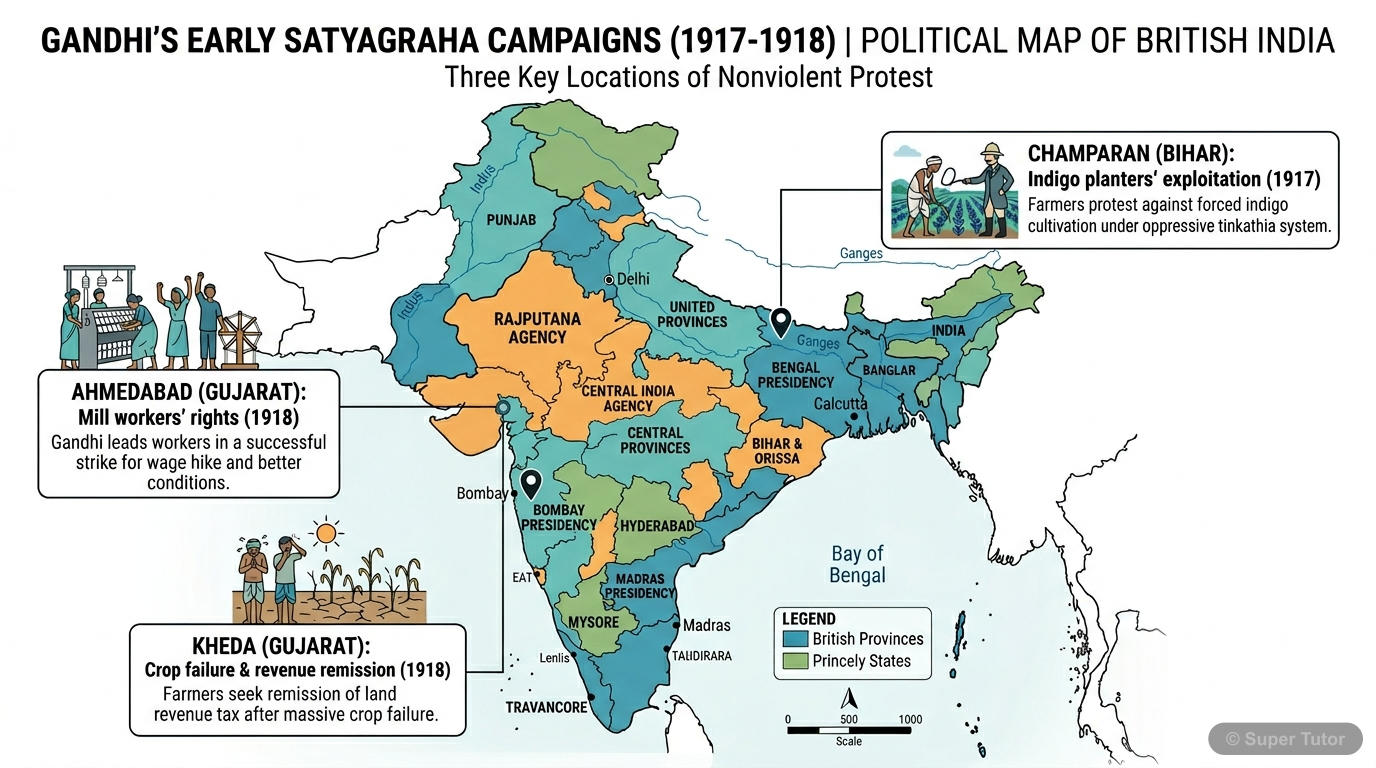
Learn better with visuals Super Tutor has hundreds of illustrations like this across every chapter — all free to try.
Get startedOverview
Mahatma Gandhi emerged as the greatest national leader of India and gave the freedom struggle a mass character. His political work was based on truth, non-violence, Satyagraha, Swadeshi, and social reform. He linked political freedom with social and economic change, and mobilised peasants, workers,
Key Concepts
Mahatma Gandhi
Mahatma Gandhi, born as Mohandas Karamchand Gandhi on October 2, 1869 in Porbandar, Kathiawar, became the central figure of the freedom struggle. The
Satyagraha was Gandhi's method of fighting
Satyagraha was Gandhi's method of fighting injustice through moral strength, truth, and non-violence. Passive resistance was called the weapon of the
Champaran Satyagraha in 1917 was
Champaran Satyagraha in 1917 was a struggle of indigo cultivators in Bihar who were forced to grow indigo on 3/20th of their land. Ahmedabad Satyagrah
The Rowlatt Act was passed
The Rowlatt Act was passed in March 1919 to crush popular movements. It gave the Government powers to arrest, detain, search, and imprison people with
On April 13
On April 13, 1919, General Dyer ordered troops to fire on an unarmed crowd at Jallianwala Bagh, Amritsar. About 1,000 persons were shot dead. The trag
Learning Objectives
- Understand Gandhiji's life and leadership in the Indian national movement
- Explain the ideas of Satyagraha, non-violence, Swadeshi, and social reform
- Describe the causes and significance of the Rowlatt Act and Jallianwala Bagh tragedy
- Analyse the Non-Cooperation Movement and its programme, achievements, and withdrawal
- Examine the Khilafat Movement and Hindu-Muslim unity during the national struggle
Frequently Asked Questions
What are the important topics in Mahatma Gandhi and the National Movement for ICSE Class 10 History & Civics?
How to score full marks in Mahatma Gandhi and the National Movement — ICSE Class 10 History & Civics?
Sources & Official References
Content is aligned to the official syllabus. Refer to the board website for the latest curriculum.
More resources for Mahatma Gandhi and the National Movement
Practice Quiz
Test yourself with a quick quiz
Important Questions
Practice with board exam-style questions
Revision Notes
Key points for last-minute revision
Formula Sheet
All formulas in one place
Concept Maps
See how topics connect visually
Study Plan
Step-by-step plan to ace this chapter
Flashcards
Quick-fire cards for active recall
Syllabus
What topics to cover
NCERT Solutions
Every textbook question solved step by step
For serious students
Get the full Mahatma Gandhi and the National Movement chapter — for free.
Quizzes, flashcards, AI doubt-solver and a step-by-step study plan for ICSE Class 10 History & Civics.