Mahatma Gandhi and the National Movement
ICSE · Class 10 · History & Civics
Complete topic list for Mahatma Gandhi and the National Movement in ICSE Class 10 History & Civics. Key concepts, sub-topics, and what to focus on for board exams.
Interactive on Super Tutor
Studying Mahatma Gandhi and the National Movement? Get the full interactive chapter.
Quizzes, flashcards, AI doubt-solver and a step-by-step study plan — built for syllabus and more.
1,000+ Class 10 students started this chapter today
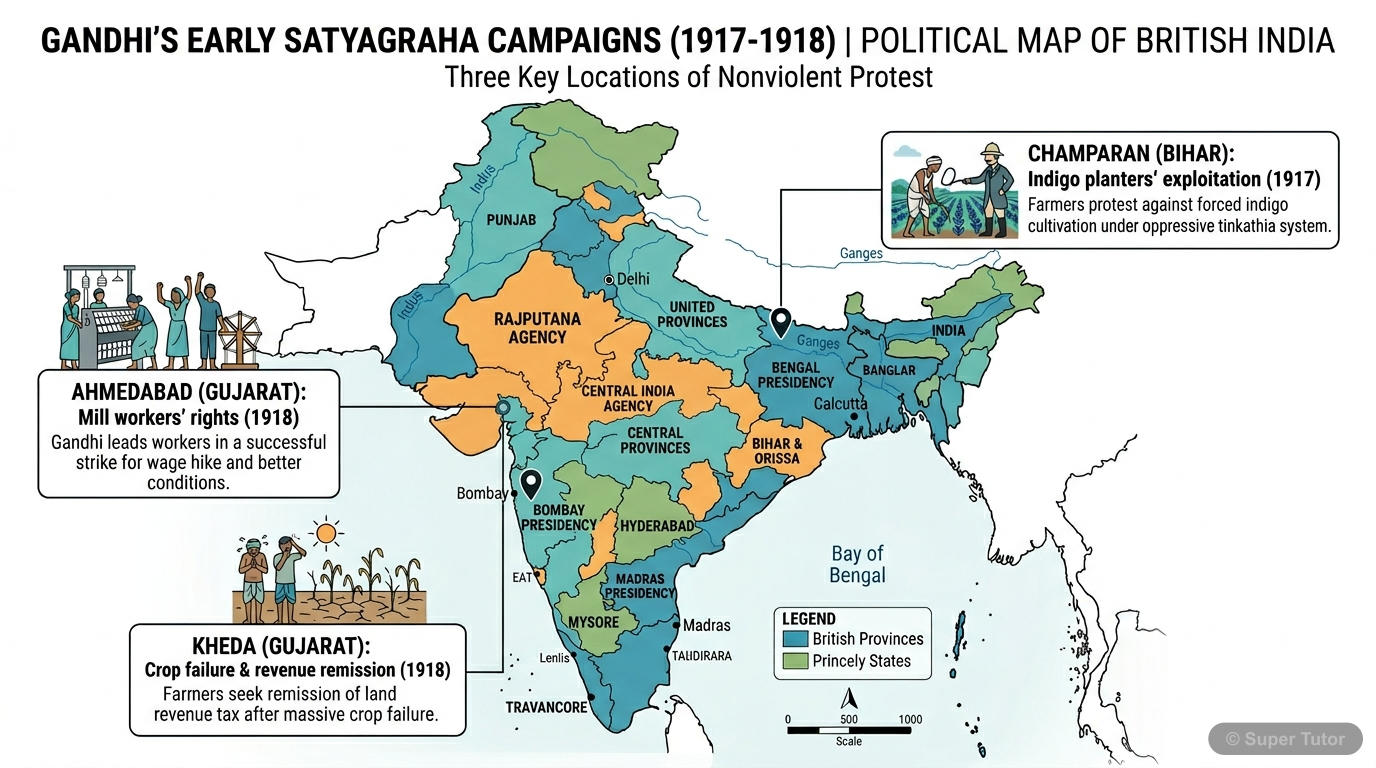
Learn better with visuals Super Tutor has hundreds of illustrations like this across every chapter — all free to try.
Get startedTopics in Mahatma Gandhi and the National Movement
1. Mahatma Gandhi: Life and Early Political Growth
- Mahatma Gandhi was born on October 2, 1869 in Porbandar, Kathiawar.
- His full name was Mohandas Karamchand Gandhi.
- He married Kasturba at the age of 13.
2. First Satyagrahas: Champaran, Ahmedabad, and Kheda
- Gandhi launched movements in favour of peasants of Champaran and Kheda and the labourers of Ahmedabad.
- Champaran Satyagraha occurred in 1917.
- The indigo cultivators of Champaran were bound to grow indigo on 3/20th of their land and sell it to British planters at prices fixed by them.
3. Gandhi's Social Ideals and Methods
- Gandhi was a great social reformer and opposed the caste system.
- He considered untouchability a curse to Hindu society.
- He called untouchables Harijans and worked for their upliftment.
4. The Rowlatt Act and the Jallianwala Bagh Tragedy
- The Rowlatt Act was passed in March 1919 to crush popular movements.
- Under the Act, accused persons had no right to Appeal, Vakil, or Dalil.
- The Rowlatt Act was called the Black Bill.
Key Concepts
Central concept: Mahatma Gandhi’s leadership transformed the Indian national movement into a mass struggle based on truth, non-violence, Satyagraha, Swadeshi, and social reform.
Frequently Asked Questions
What are the important topics in Mahatma Gandhi and the National Movement for ICSE Class 10 History & Civics?
How to score full marks in Mahatma Gandhi and the National Movement — ICSE Class 10 History & Civics?
Sources & Official References
Content is aligned to the official syllabus. Refer to the board website for the latest curriculum.
More resources for Mahatma Gandhi and the National Movement
Practice Quiz
Test yourself with a quick quiz
Important Questions
Practice with board exam-style questions
Revision Notes
Key points for last-minute revision
Formula Sheet
All formulas in one place
Chapter Summary
Understand the chapter at a glance
Concept Maps
See how topics connect visually
Study Plan
Step-by-step plan to ace this chapter
Flashcards
Quick-fire cards for active recall
NCERT Solutions
Every textbook question solved step by step
For serious students
Get the full Mahatma Gandhi and the National Movement chapter — for free.
Quizzes, flashcards, AI doubt-solver and a step-by-step study plan for ICSE Class 10 History & Civics.