The Partition of Bengal-The Rise of Assertive Radical Nationalism — Concept Maps
ICSE · Class 10 · History & Civics
4 concept maps of The Partition of Bengal-The Rise of Assertive Radical Nationalism for ICSE Class 10 History & Civics, each also written out as a text.
Interactive on Super Tutor
Studying The Partition of Bengal-The Rise of Assertive Radical Nationalism? Get the full interactive chapter.
Quizzes, flashcards, AI doubt-solver and a step-by-step study plan — built for concept maps and more.
Free trial, no card needed.
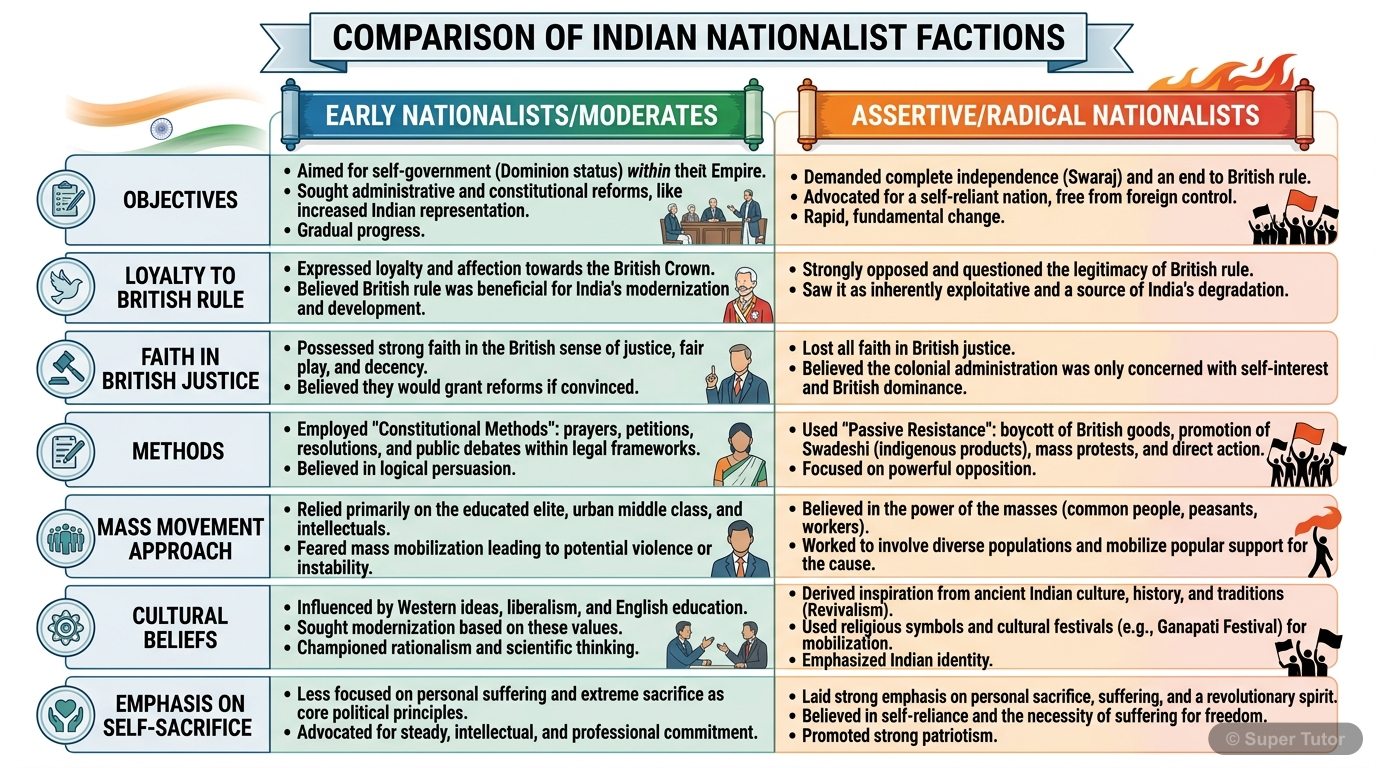
One of 5 illustrations for The Partition of Bengal-The Rise of Assertive Radical Nationalism in Super Tutor — alongside flashcards, concept maps and practice questions.
See them allKey Events in Assertive Nationalism (1903-1911)
The map in words
- 1903
- Partition of Bengal Announced
- 1905
- Partition Implemented
- Swadeshi Movement Begins
- 1906
- Calcutta Congress Session
- Swaraj Resolution Passed
- 1907
- Surat Split
- Congress Divides
- 1908
- Tilak Imprisoned
- Repressive Measures
- 1911
- Partition Annulled
- Capital Shifted to Delhi
The Rise of Assertive Radical Nationalism - Complete Overview
The map in words
- Assertive Radical Nationalism 1905-1919
- Leaders
- Bal Gangadhar Tilak
- Father of Radical Nationalism
- Swaraj is my birthright
- Home Rule Movement 1916
- Lala Lajpat Rai
- Punjab Kesari
- Died protesting Simon Commission
- DAV College founder
- Bipin Chandra Pal
- Great orator
- Editor New India
- Bengal Swadeshi leader
- Bal Gangadhar Tilak
- Methods
- Swadeshi
- Indigenous production
- Self reliance
- Boycott
- Foreign goods rejection
- Economic weapon
- National Education
- Vernacular languages
- Independent of British
- Passive Resistance
- Non cooperation
- Boycott institutions
- Revivalism
- Shivaji festivals
- Cultural pride
- Swadeshi
- Bengal Partition 1905
- Lord Curzon
- Administrative excuse
- Divide and Rule reality
- Two Provinces
- East Bengal and Assam
- West Bengal Bihar Orissa
- Anti Partition Movement
- Day of Mourning Oct 16
- Bande Mataram slogan
- Hindu Muslim unity
- Lord Curzon
- Impact
- Mass participation
- Students women workers
- All India spread
- Surat Split 1907
- Congress division
- Moderate vs Radical
- Foundation for Gandhi
- Methods adopted later
- Mass movement legacy
- Mass participation
- Leaders
Timeline of Assertive Nationalism and Partition of Bengal
The map in words
- 1895
- Tilak starts Ganapati Festival
- 1903
- Partition of Bengal announced
- 1905
- Partition implemented
- Swadeshi Movement begins
- 1906
- Calcutta Congress Session
- Swaraj resolution passed
- 1907
- Surat Split occurs
- 1908
- Tilak imprisoned in Mandalay
- 1911
- Partition of Bengal revoked
- 1916
- Home Rule Movement starts
- 1920
- Lajpat Rai becomes Congress President
The Partition of Bengal became the turning point that pushed Indian nationalism from constitutional protest to Assertive Radical Nationalism, led by Tilak, Lajpat Rai and Bipin Chandra Pal through Swadeshi, Boycott, National Education, Passive Resistance and Revivalism.
The map in words
- The Partition of Bengal became the turning point that pushed Indian nationalism from constitutional protest to Assertive Radical Nationalism, led by Tilak, Lajpat Rai and Bipin Chandra Pal through Swadeshi, Boycott, National Education, Passive Resistance and Revivalism.
- Early Nationalists
- Assertive Radical Nationalists
- Bal Gangadhar Tilak
- Lala Lajpat Rai
- Bipin Chandra Pal
- Lord Curzon
- Partition of Bengal
- Swadeshi and Boycott
Explore these maps interactively
Explore DiagramsFrequently Asked Questions
What are the important topics in The Partition of Bengal-The Rise of Assertive Radical Nationalism for ICSE Class 10 History & Civics?
What do the concept maps for The Partition of Bengal-The Rise of Assertive Radical Nationalism show?
How should I revise The Partition of Bengal-The Rise of Assertive Radical Nationalism for the ICSE Class 10 board exam?
Sources & Official References
Content is aligned to the official syllabus. Refer to the board website for the latest curriculum.
More resources for The Partition of Bengal-The Rise of Assertive Radical Nationalism
Practice Quiz
Test yourself with a quick quiz
Important Questions
Exam-style questions with answers
Revision Notes
Key points for last-minute revision
Chapter Summary
Understand the chapter at a glance
Study Plan
Step-by-step plan for this chapter
Flashcards
Quick-fire cards for active recall
Syllabus
What topics to cover
For serious students
Get the full The Partition of Bengal-The Rise of Assertive Radical Nationalism chapter — start free.
Quizzes, flashcards, an AI doubt solver and a study plan for ICSE Class 10 History & Civics. Free to start, no card needed.