Mahatma Gandhi and the National Movement
ICSE · Class 10 · History & Civics
Practice quiz for Mahatma Gandhi and the National Movement — ICSE Class 10 History & Civics. MCQs and questions with answers to test your preparation.
Interactive on Super Tutor
Studying Mahatma Gandhi and the National Movement? Get the full interactive chapter.
Quizzes, flashcards, AI doubt-solver and a step-by-step study plan — built for practice quiz and more.
1,000+ Class 10 students started this chapter today
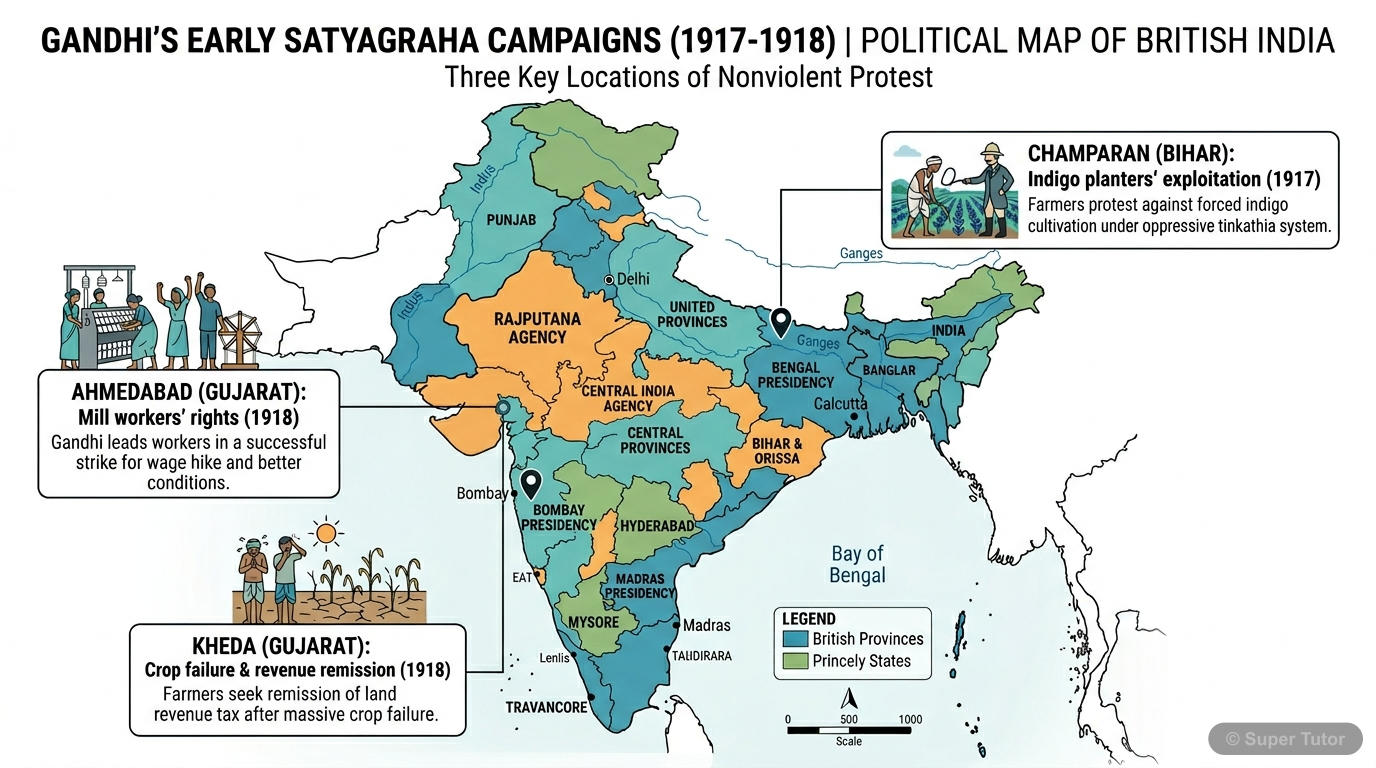
Learn better with visuals Super Tutor has hundreds of illustrations like this across every chapter — all free to try.
Get startedQuick Quiz: Mahatma Gandhi and the National Movement
0/4Tap an answer to check it instantly. No sign-up needed for these 4.
When and where was Mahatma Gandhi born?
How long did Gandhi stay in South Africa?
What was the Rowlatt Act also known as?
When did the Jallianwala Bagh massacre take place?
Sample Questions
Who were known as the Ali Brothers?
Show answer
Mohammed Ali and Shaukat Ali
Step 1: The Ali Brothers were Mohammed Ali and Shaukat Ali, who led the Khilafat Movement. Step 2: They started a powerful agitation against the British policy towards the Sultan of Turkey. Step 3: Gandhi supported their movement, which helped bring Hindu-Muslim unity in the freedom struggle. Step 4: They were arrested on charges of sedition for spreading discontent among people. Step 5: Options A, C, and D contain incorrect names - the actual leaders of the Khilafat Movement were specifically Mohammed Ali and Shaukat Ali.
What was Gandhi's famous march to Dandi also known as?
Show answer
Salt March
Step 1: Gandhi's march from Sabarmati Ashram to Dandi is famously known as the Salt March or Dandi March. Step 2: He started this march on March 12, 1930, with 78 followers to break the Salt Law. Step 3: At Dandi, he made salt from seawater, symbolically breaking the British monopoly on salt production. Step 4: This act launched the Civil Disobedience Movement and became a powerful symbol of resistance against British rule. Step 5: Options B, C, and D are incorrect - while the march was about freedom and independence, it is specifically called the Salt March because its primary purpose was to
Which incident led to the withdrawal of the Non-Cooperation Movement?
Show answer
Chauri Chaura incident
Step 1: The Chauri Chaura incident occurred on February 4, 1922, in a village in Gorakhpur district, UP. Step 2: About 3,000 peasants were in a procession when police opened fire on them. Step 3: In anger, the crowd attacked and burnt the police station, killing 22 policemen. Step 4: Gandhi was so shocked by this violence that he immediately suspended the Non-Cooperation Movement. Step 5: Options B, C, and D are incorrect - these events were causes that led to various movements, but only the Chauri Chaura incident led to the withdrawal of the Non-Cooperation Movement.
What did Gandhi call the untouchables?
Show answer
Harijans
Gandhiji called the untouchables 'Harijans', meaning children of God, and asked people to treat them with the respect due to human beings. This term reflected his effort to remove the stigma of untouchability and bring them into the mainstream of Hindu society. Terms like 'Scheduled Castes' and 'Dalits' are modern or official classifications, not the name Gandhi himself used.
+39 more questions available
Practice AllFrequently Asked Questions
What are the important topics in Mahatma Gandhi and the National Movement for ICSE Class 10 History & Civics?
How to score full marks in Mahatma Gandhi and the National Movement — ICSE Class 10 History & Civics?
Sources & Official References
Content is aligned to the official syllabus. Refer to the board website for the latest curriculum.
More resources for Mahatma Gandhi and the National Movement
Important Questions
Practice with board exam-style questions
Revision Notes
Key points for last-minute revision
Formula Sheet
All formulas in one place
Chapter Summary
Understand the chapter at a glance
Concept Maps
See how topics connect visually
Study Plan
Step-by-step plan to ace this chapter
Flashcards
Quick-fire cards for active recall
Syllabus
What topics to cover
NCERT Solutions
Every textbook question solved step by step
For serious students
Get the full Mahatma Gandhi and the National Movement chapter — for free.
Quizzes, flashcards, AI doubt-solver and a step-by-step study plan for ICSE Class 10 History & Civics.