The Partition of Bengal-The Rise of Assertive Radical Nationalism
ICSE · Class 10 · History & Civics
Complete topic list for The Partition of Bengal-The Rise of Assertive Radical Nationalism in ICSE Class 10 History & Civics. Key concepts, sub-topics, and what to focus on for board exams.
Interactive on Super Tutor
Studying The Partition of Bengal-The Rise of Assertive Radical Nationalism? Get the full interactive chapter.
Quizzes, flashcards, AI doubt-solver and a step-by-step study plan — built for syllabus and more.
1,000+ Class 10 students started this chapter today
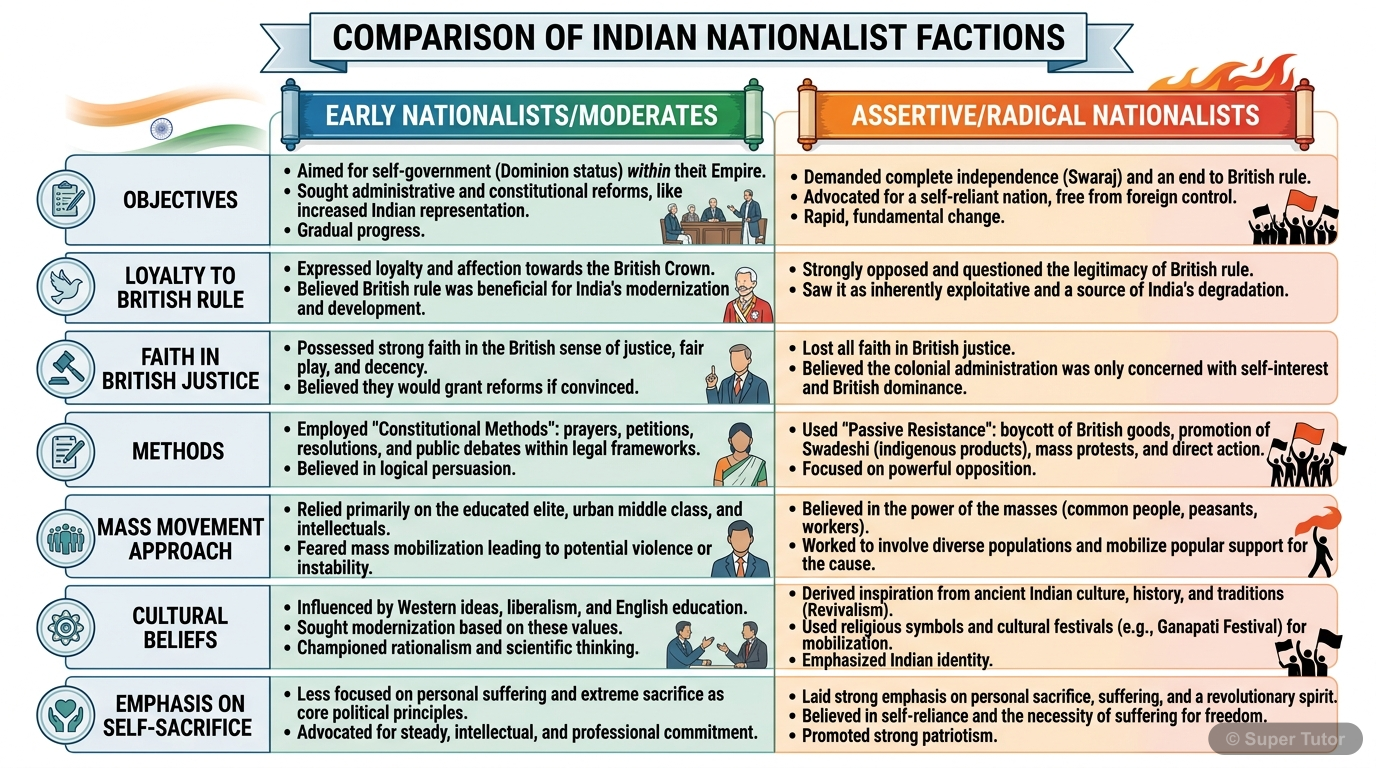
Learn better with visuals Super Tutor has hundreds of illustrations like this across every chapter — all free to try.
Get startedTopics in The Partition of Bengal-The Rise of Assertive Radical Nationalism
1. Background: From constitutional politics to assertive nationalism
- From 1885 to 1905, the Congress relied on constitutional means such as appeals and prayers.
- These methods were based on faith in British justice and fair play, but they brought no concrete result.
- Many young leaders felt that loyalty and political beggary were useless.
2. Causes and aims of Assertive/Radical Nationalism
- The new leaders were dissatisfied with the Early Nationalists.
- They believed that the British would not grant freedom willingly.
- They wanted complete Swaraj, not mere reform.
3. Methods of the Assertive/Radical Nationalists
- Swadeshi meant producing necessary goods in the country itself.
- Boycott meant giving up foreign goods.
- Swadeshi and boycott were complementary and supported each other.
4. Bal Gangadhar Tilak
- Bal Gangadhar Tilak was born on July 23, 1856 in a Brahmin family of Ratnagiri in Maharashtra.
- He is known as the Father of Assertive/Radical Nationalism in India.
- He started the Kesari and the Mahratta newspapers.
Key Concepts
Central concept: The Partition of Bengal became the turning point that pushed Indian nationalism from constitutional protest to Assertive Radical Nationalism, led by Tilak, Lajpat Rai and Bipin Chandra Pal through Swadeshi, Boycott, National Education, Passive Resistance and Revivalism.
Frequently Asked Questions
What are the important topics in The Partition of Bengal-The Rise of Assertive Radical Nationalism for ICSE Class 10 History & Civics?
How to score full marks in The Partition of Bengal-The Rise of Assertive Radical Nationalism — ICSE Class 10 History & Civics?
Sources & Official References
Content is aligned to the official syllabus. Refer to the board website for the latest curriculum.
More resources for The Partition of Bengal-The Rise of Assertive Radical Nationalism
Practice Quiz
Test yourself with a quick quiz
Important Questions
Practice with board exam-style questions
Revision Notes
Key points for last-minute revision
Formula Sheet
All formulas in one place
Chapter Summary
Understand the chapter at a glance
Concept Maps
See how topics connect visually
Study Plan
Step-by-step plan to ace this chapter
Flashcards
Quick-fire cards for active recall
NCERT Solutions
Every textbook question solved step by step
For serious students
Get the full The Partition of Bengal-The Rise of Assertive Radical Nationalism chapter — for free.
Quizzes, flashcards, AI doubt-solver and a step-by-step study plan for ICSE Class 10 History & Civics.