The Partition of Bengal-The Rise of Assertive Radical Nationalism
ICSE · Class 10 · History & Civics
Practice quiz for The Partition of Bengal-The Rise of Assertive Radical Nationalism — ICSE Class 10 History & Civics. MCQs and questions with answers to test your preparation.
Interactive on Super Tutor
Studying The Partition of Bengal-The Rise of Assertive Radical Nationalism? Get the full interactive chapter.
Quizzes, flashcards, AI doubt-solver and a step-by-step study plan — built for practice quiz and more.
1,000+ Class 10 students started this chapter today
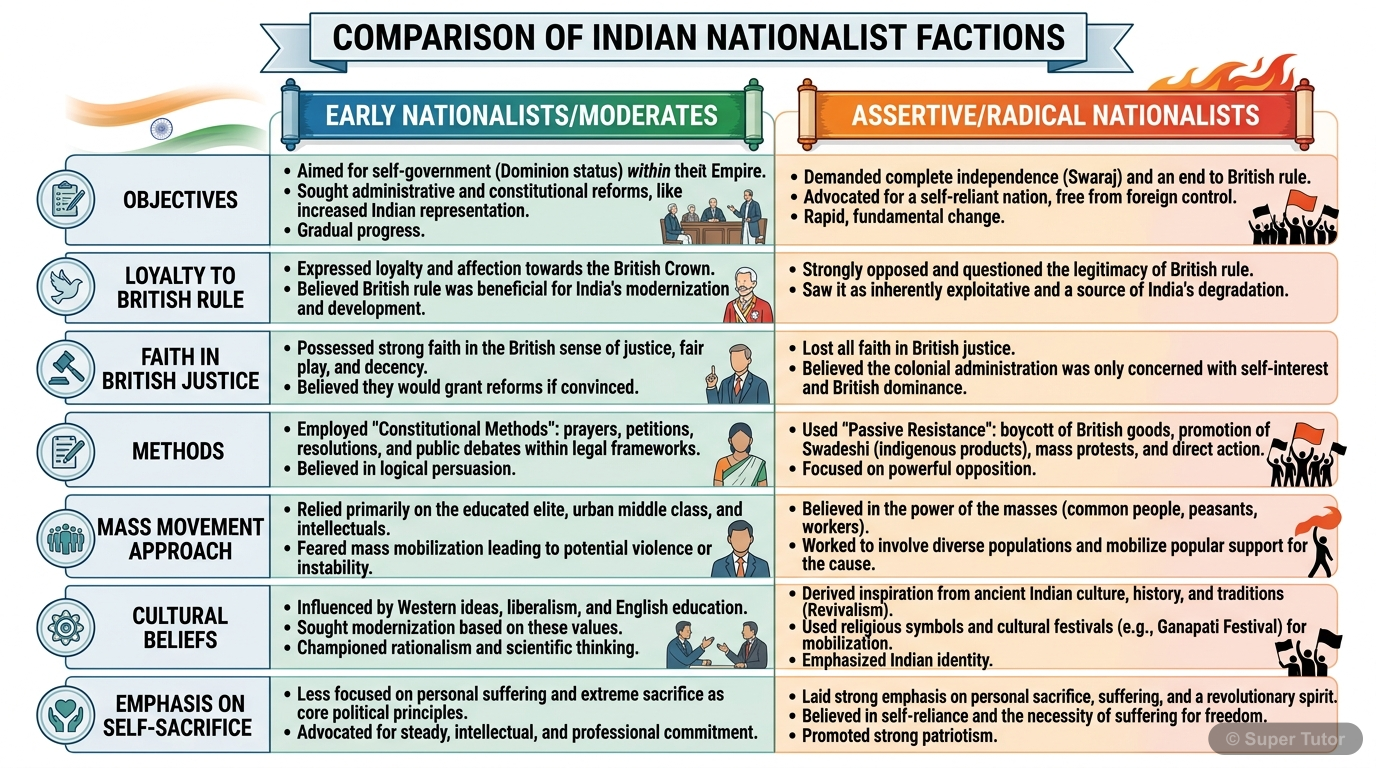
Learn better with visuals Super Tutor has hundreds of illustrations like this across every chapter — all free to try.
Get startedQuick Quiz: The Partition of Bengal-The Rise of Assertive Radical Nationalism
0/4Tap an answer to check it instantly. No sign-up needed for these 4.
Who is known as the Father of Assertive/Radical Nationalism in India?
In which year was the Partition of Bengal implemented?
What does 'Swadeshi' mean?
Who was the Viceroy of India during the Partition of Bengal?
Sample Questions
Which three leaders formed the famous triumvirate of Assertive Nationalism?
Show answer
Tilak, Lajpat Rai, Bipin Chandra Pal
The famous triumvirate (team of three) of Assertive Nationalism consisted of Bal Gangadhar Tilak, Lala Lajpat Rai, and Bipin Chandra Pal. They were also known as 'Lal-Bal-Pal' and dominated the National Movement from 1905 to 1919. These leaders believed in more assertive methods compared to the Early Nationalists who relied on constitutional means. They wanted complete Swaraj and were willing to use methods like boycott, Swadeshi, and passive resistance. Gandhi and Nehru came later in the freedom struggle, while Gokhale, Naoroji, and Ranade were Early Nationalists.
What was the capital of East Bengal and Assam after the partition?
Show answer
Dacca
After the Partition of Bengal in 1905, the new province of East Bengal and Assam had its capital at Dacca (now Dhaka in Bangladesh) with subsidiary headquarters at Chittagong. The province comprised an area of 1,06,540 square miles with a population of 31 million (18 million Muslims and 12 million Hindus). Calcutta remained the capital of the remaining West Bengal province which was combined with Bihar and Orissa. The choice of Dacca as capital was part of the British strategy to create a Muslim-majority province and weaken Bengali Hindu influence.
In which year did the Surat Split in Congress occur?
Show answer
1907
The Surat Split occurred in 1907 during the annual Congress session held at Surat. The split happened due to fundamental differences between the Early Nationalists (Moderates) and the Assertive/Radical Nationalists. The Moderates wanted to undo the resolutions passed at the 1906 Calcutta session regarding Swaraj, Swadeshi, and boycott, while the Radicals wanted to continue with assertive methods. When conflicts erupted in the session with physical altercations involving lathis and chairs, the session was suspended. This led to the permanent division of the Congress into two groups.
Which newspaper was started by Bal Gangadhar Tilak to spread nationalism?
Show answer
Kesari
Bal Gangadhar Tilak started two well-known newspapers - 'Kesari' (in Marathi) and 'Mahratta' (in English). Through these newspapers, he preached nationalism and taught people to become courageous, self-reliant, and selfless fighters for freedom. Kesari became a powerful medium for spreading assertive nationalist ideas and mobilizing public opinion against British rule. 'Young India' was associated with Lala Lajpat Rai and later Mahatma Gandhi, while 'New India' was edited by Bipin Chandra Pal, and 'Bengalee' was Surendranath Banerjee's newspaper.
+40 more questions available
Practice AllFrequently Asked Questions
What are the important topics in The Partition of Bengal-The Rise of Assertive Radical Nationalism for ICSE Class 10 History & Civics?
How to score full marks in The Partition of Bengal-The Rise of Assertive Radical Nationalism — ICSE Class 10 History & Civics?
Sources & Official References
Content is aligned to the official syllabus. Refer to the board website for the latest curriculum.
More resources for The Partition of Bengal-The Rise of Assertive Radical Nationalism
Important Questions
Practice with board exam-style questions
Revision Notes
Key points for last-minute revision
Formula Sheet
All formulas in one place
Chapter Summary
Understand the chapter at a glance
Concept Maps
See how topics connect visually
Study Plan
Step-by-step plan to ace this chapter
Flashcards
Quick-fire cards for active recall
Syllabus
What topics to cover
NCERT Solutions
Every textbook question solved step by step
For serious students
Get the full The Partition of Bengal-The Rise of Assertive Radical Nationalism chapter — for free.
Quizzes, flashcards, AI doubt-solver and a step-by-step study plan for ICSE Class 10 History & Civics.