The Partition of Bengal-The Rise of Assertive Radical Nationalism
ICSE · Class 10 · History & Civics
Summary of The Partition of Bengal-The Rise of Assertive Radical Nationalism for ICSE Class 10 History & Civics. Key concepts, important points, and chapter overview.
Interactive on Super Tutor
Studying The Partition of Bengal-The Rise of Assertive Radical Nationalism? Get the full interactive chapter.
Quizzes, flashcards, AI doubt-solver and a step-by-step study plan — built for chapter summary and more.
1,000+ Class 10 students started this chapter today
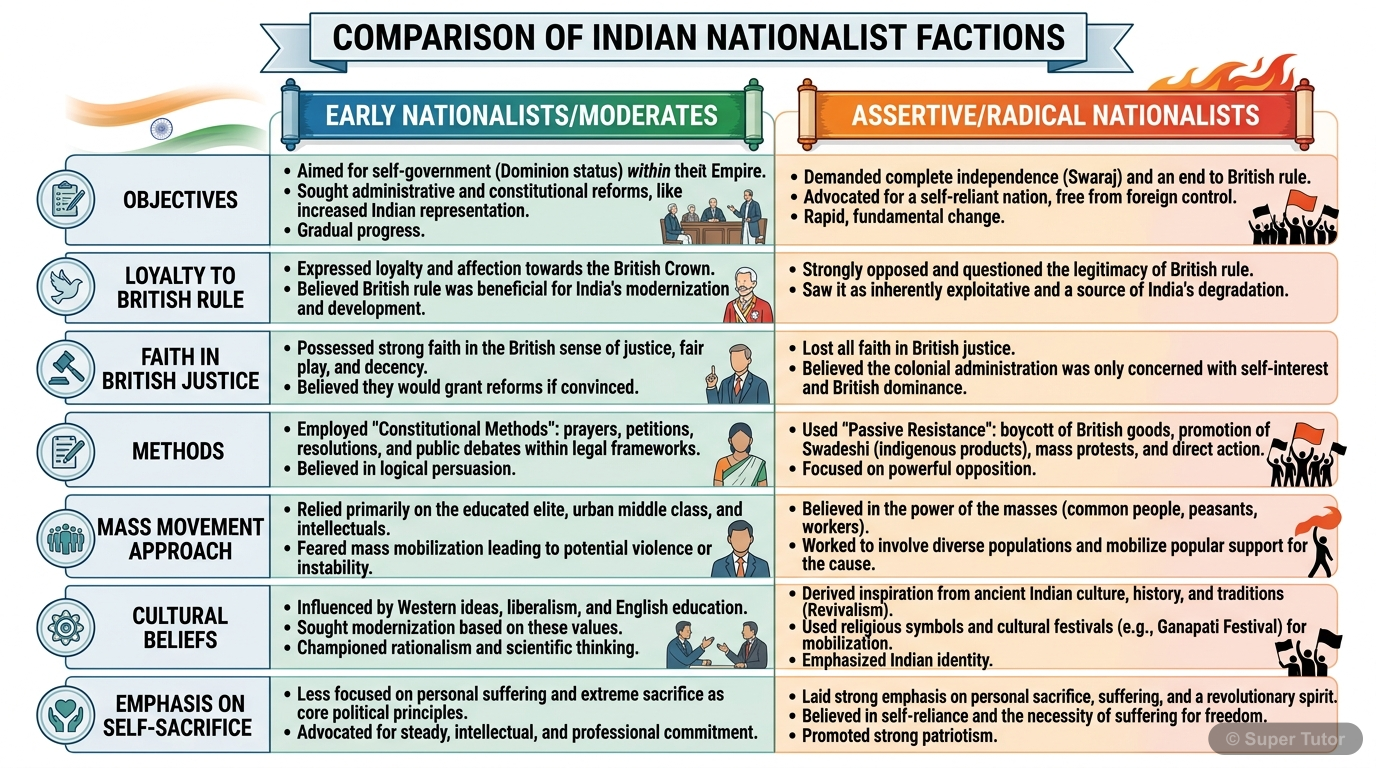
Learn better with visuals Super Tutor has hundreds of illustrations like this across every chapter — all free to try.
Get startedOverview
The Partition of Bengal in 1905 became a turning point in Indian nationalism. It created strong opposition to British policy and gave new strength to Assertive Radical Nationalism. Early Nationalist methods of petitions, appeals, and prayers were felt to be ineffective, so a new approach based on Sw
Key Concepts
Early Nationalists believed in constitutional
Early Nationalists believed in constitutional and peaceful methods such as appeals, prayers, meetings, resolutions, and petitions. They were loyal to
These leaders rejected loyalty to British
These leaders rejected loyalty to British rule and the policy of political beggary. They wanted complete Swaraj and believed in continuous struggle, a
Lord Curzon announced the partition
Lord Curzon announced the partition in 1903 and carried it out in 1905. It divided Bengal into two provinces and was widely seen as a step to weaken B
Swadeshi means producing and using goods
Swadeshi means producing and using goods made in one's own country. It encouraged indigenous industry and self-reliance.
Boycott meant giving up the use
Boycott meant giving up the use of foreign goods. It was closely linked with Swadeshi and aimed at harming British trade.
Learning Objectives
- Understand why the Partition of Bengal caused widespread anger
- Explain the difference between Early Nationalists and Assertive Radical Nationalists
- Describe the main methods of Swadeshi, Boycott, National Education, Passive Resistance, and Revivalism
- Learn the roles of Tilak, Lajpat Rai, Bipin Chandra Pal, Aurobindo Ghosh, and Rabindranath Tagore
- Trace how the anti-partition movement led to the Surat Split of 1907
Frequently Asked Questions
What are the important topics in The Partition of Bengal-The Rise of Assertive Radical Nationalism for ICSE Class 10 History & Civics?
How to score full marks in The Partition of Bengal-The Rise of Assertive Radical Nationalism — ICSE Class 10 History & Civics?
Sources & Official References
Content is aligned to the official syllabus. Refer to the board website for the latest curriculum.
More resources for The Partition of Bengal-The Rise of Assertive Radical Nationalism
Practice Quiz
Test yourself with a quick quiz
Important Questions
Practice with board exam-style questions
Revision Notes
Key points for last-minute revision
Formula Sheet
All formulas in one place
Concept Maps
See how topics connect visually
Study Plan
Step-by-step plan to ace this chapter
Flashcards
Quick-fire cards for active recall
Syllabus
What topics to cover
NCERT Solutions
Every textbook question solved step by step
For serious students
Get the full The Partition of Bengal-The Rise of Assertive Radical Nationalism chapter — for free.
Quizzes, flashcards, AI doubt-solver and a step-by-step study plan for ICSE Class 10 History & Civics.