The Partition of Bengal-The Rise of Assertive Radical Nationalism
ICSE · Class 10 · History & Civics
Quick revision notes for The Partition of Bengal-The Rise of Assertive Radical Nationalism — ICSE Class 10 History & Civics. Key concepts, formulas, and definitions for last-minute revision.
Interactive on Super Tutor
Studying The Partition of Bengal-The Rise of Assertive Radical Nationalism? Get the full interactive chapter.
Quizzes, flashcards, AI doubt-solver and a step-by-step study plan — built for revision notes and more.
1,000+ Class 10 students started this chapter today
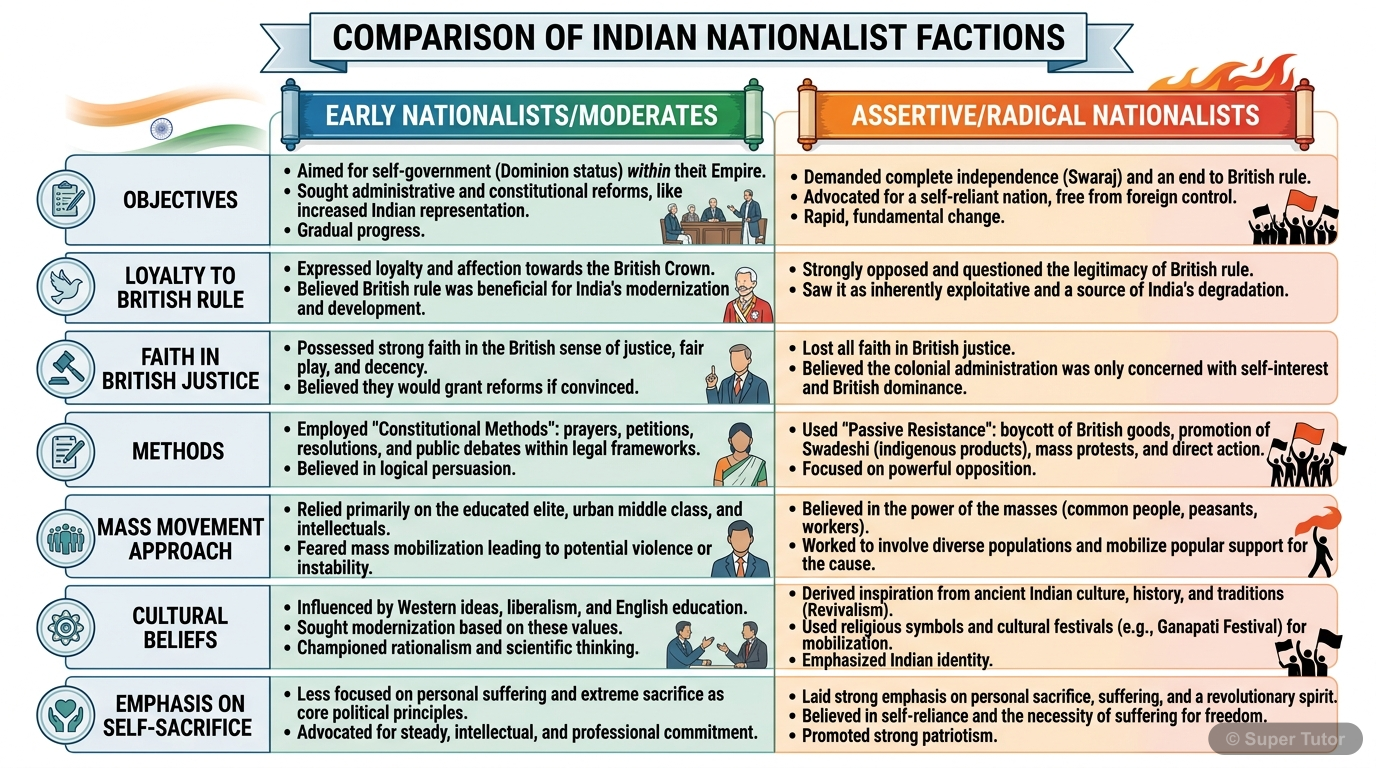
Learn better with visuals Super Tutor has hundreds of illustrations like this across every chapter — all free to try.
Get startedKey Topics to Revise
1. Background: From constitutional politics to assertive nationalism
- From 1885 to 1905, the Congress relied on constitutional means such as appeals and prayers.
- These methods were based on faith in British justice and fair play, but they brought no concrete result.
- Many young leaders felt that loyalty and political beggary were useless.
2. Causes and aims of Assertive/Radical Nationalism
- The new leaders were dissatisfied with the Early Nationalists.
- They believed that the British would not grant freedom willingly.
- They wanted complete Swaraj, not mere reform.
3. Methods of the Assertive/Radical Nationalists
- Swadeshi meant producing necessary goods in the country itself.
- Boycott meant giving up foreign goods.
- Swadeshi and boycott were complementary and supported each other.
4. Bal Gangadhar Tilak
- Bal Gangadhar Tilak was born on July 23, 1856 in a Brahmin family of Ratnagiri in Maharashtra.
- He is known as the Father of Assertive/Radical Nationalism in India.
- He started the Kesari and the Mahratta newspapers.
Get complete notes with diagrams and examples
Full NotesKey Concepts
Frequently Asked Questions
What are the important topics in The Partition of Bengal-The Rise of Assertive Radical Nationalism for ICSE Class 10 History & Civics?
How to score full marks in The Partition of Bengal-The Rise of Assertive Radical Nationalism — ICSE Class 10 History & Civics?
Sources & Official References
Content is aligned to the official syllabus. Refer to the board website for the latest curriculum.
More resources for The Partition of Bengal-The Rise of Assertive Radical Nationalism
Practice Quiz
Test yourself with a quick quiz
Important Questions
Practice with board exam-style questions
Formula Sheet
All formulas in one place
Chapter Summary
Understand the chapter at a glance
Concept Maps
See how topics connect visually
Study Plan
Step-by-step plan to ace this chapter
Flashcards
Quick-fire cards for active recall
Syllabus
What topics to cover
NCERT Solutions
Every textbook question solved step by step
For serious students
Get the full The Partition of Bengal-The Rise of Assertive Radical Nationalism chapter — for free.
Quizzes, flashcards, AI doubt-solver and a step-by-step study plan for ICSE Class 10 History & Civics.