The Partition of Bengal-The Rise of Assertive Radical Nationalism
ICSE · Class 10 · History & Civics
Flashcards for The Partition of Bengal-The Rise of Assertive Radical Nationalism — ICSE Class 10 History & Civics. Quick Q&A cards covering key concepts, definitions, and formulas.
Interactive on Super Tutor
Studying The Partition of Bengal-The Rise of Assertive Radical Nationalism? Get the full interactive chapter.
Quizzes, flashcards, AI doubt-solver and a step-by-step study plan — built for flashcards and more.
1,000+ Class 10 students started this chapter today
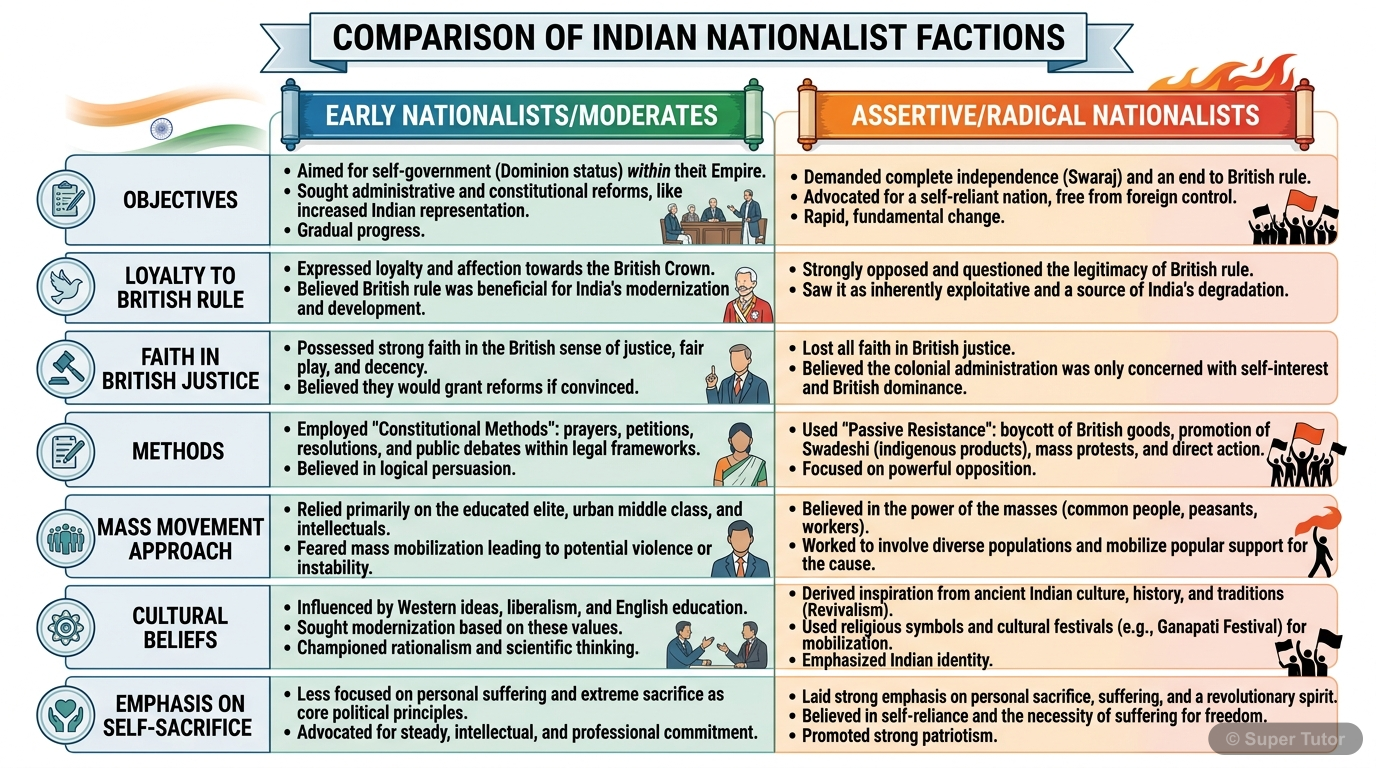
Learn better with visuals Super Tutor has hundreds of illustrations like this across every chapter — all free to try.
Get startedWhy did Assertive Radical Nationalism emerge in Indian politics?
Answer
It emerged because many leaders became dissatisfied with the constitutional methods used by the Early Nationalists. From 1885 to 1905, the Congress depended on appeals and prayers, but the Government …
Who were the famous trio of Assertive Radical Nationalism?
Answer
Bipin Chandra Pal, Bal Gangadhar Tilak and Lala Lajpat Rai formed the famous trio. They were seen as the shining symbol of emotional self-assertion and national self-respect.
What was the main aim of Assertive Radical Nationalists?
Answer
Their central aim was complete Swaraj. They believed that freedom was the birthright of every Indian and that Indians should drive the British out and form a government of their own.
What methods did Assertive Radical Nationalists use?
Answer
Their methods included Swadeshi, Boycott, National Education, Passive Resistance and Revivalism. They wanted to weaken British rule through mass action, self-reliance and patriotic awakening.
What is Swadeshi?
Answer
Swadeshi means producing and using goods made in one's own country instead of depending on imported goods. It aimed to strengthen Indian industries and reduce dependence on British trade.
What is Boycott and how is it linked to Swadeshi?
Answer
Boycott means giving up foreign goods. Swadeshi and Boycott are two sides of the same coin because using home-made goods naturally requires rejecting foreign goods. Together, they helped promote India…
Explain the meaning of the Boycott movement as expressed by Lala Lajpat Rai.
Answer
Lala Lajpat Rai said, "We desire to turn our faces away from government house and turn them to huts of people. This is the spiritual significance of the boycott movement." This means the movement was …
What is National Education in the context of Assertive Radical Nationalism?
Answer
National Education was the plan to replace government-controlled universities and colleges with institutions that gave education a national outlook. It aimed to build patriotic feeling and train stude…
+28 more flashcards available
Practice AllFrequently Asked Questions
What are the important topics in The Partition of Bengal-The Rise of Assertive Radical Nationalism for ICSE Class 10 History & Civics?
How to score full marks in The Partition of Bengal-The Rise of Assertive Radical Nationalism — ICSE Class 10 History & Civics?
How many flashcards are available for The Partition of Bengal-The Rise of Assertive Radical Nationalism?
Sources & Official References
Content is aligned to the official syllabus. Refer to the board website for the latest curriculum.
More resources for The Partition of Bengal-The Rise of Assertive Radical Nationalism
Practice Quiz
Test yourself with a quick quiz
Important Questions
Practice with board exam-style questions
Revision Notes
Key points for last-minute revision
Formula Sheet
All formulas in one place
Chapter Summary
Understand the chapter at a glance
Concept Maps
See how topics connect visually
Study Plan
Step-by-step plan to ace this chapter
Syllabus
What topics to cover
NCERT Solutions
Every textbook question solved step by step
For serious students
Get the full The Partition of Bengal-The Rise of Assertive Radical Nationalism chapter — for free.
Quizzes, flashcards, AI doubt-solver and a step-by-step study plan for ICSE Class 10 History & Civics.