Heights and Distances — Chapter Summary
ICSE · Class 10 · Mathematics
Summary of Heights and Distances for ICSE Class 10 Mathematics. Part of the ICSE Class 10 Mathematics syllabus.
Interactive on Super Tutor
Studying Heights and Distances? Get the full interactive chapter.
Quizzes, flashcards, AI doubt-solver and a step-by-step study plan — built for chapter summary and more.
Free trial, no card needed.
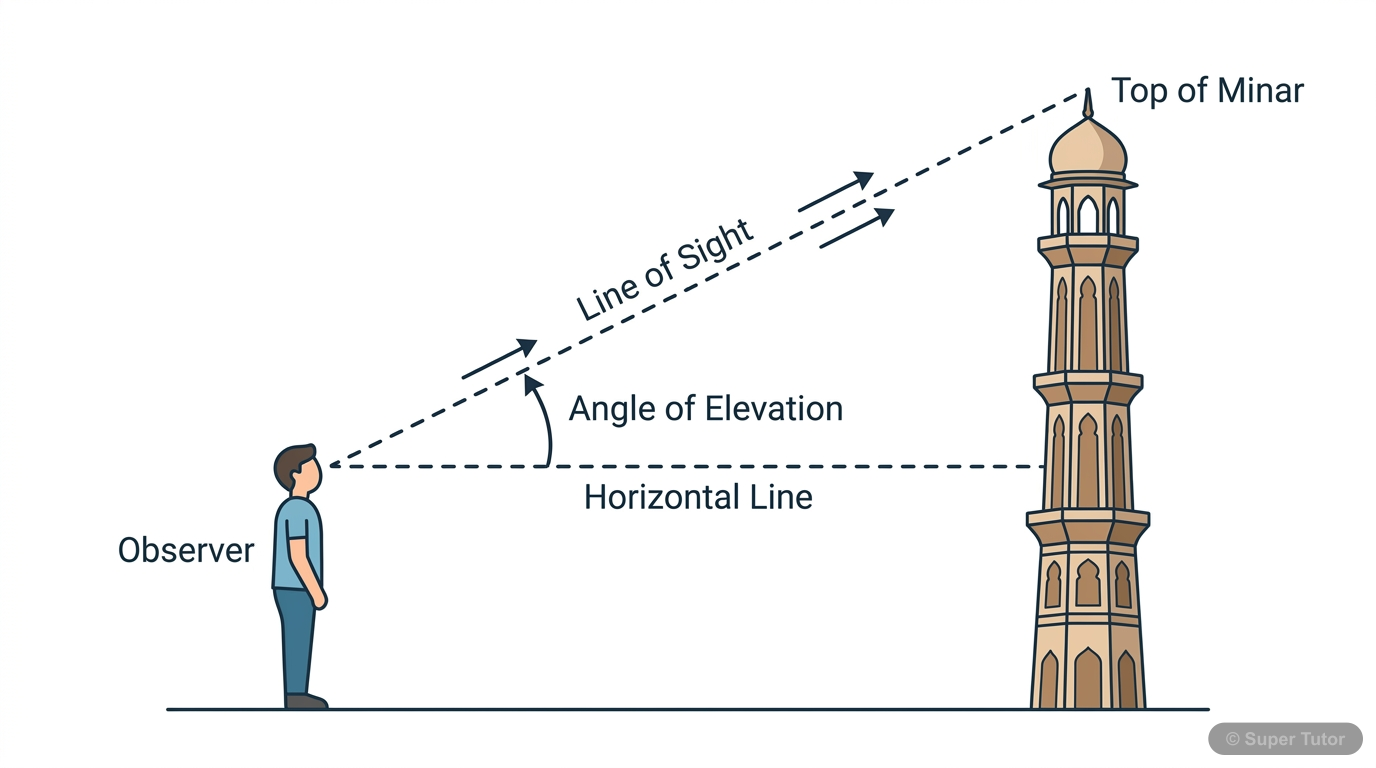
One of 3 illustrations for Heights and Distances in Super Tutor — alongside flashcards, concept maps and practice questions.
See them allOverview
Heights and distances uses trigonometric ratios to find measurements that are difficult to take directly, such as the height of a building, tower, electric pole, telephone pole, tree, the width of a river, and the distance of a ship from a lighthouse. The chapter begins with the idea of an angle of
Key Concepts
When P is above the horizontal
When P is above the horizontal line OX, then angle POX is called the angle of elevation of P as seen from O. It is the angle formed by the line of sig
When Q is below the horizontal
When Q is below the horizontal line OX, then angle QOX is called the angle of depression of Q as seen from O. It is the angle formed by the line of si
The horizontal line OX is drawn
The horizontal line OX is drawn through the observation point O in the same vertical plane as the object. Angles of elevation and depression are measu
The object and the observation point
The object and the observation point must lie in the same vertical plane as the horizontal reference line for these angles to apply.
First make all possible right angles
First make all possible right angles. Then mark all given quantities and angles. If the figure has more than one triangle, assume the common side, oft
Learning Objectives
- Understand the meaning of angle of elevation and angle of depression
- Identify the horizontal line and observation point in a diagram
- Use trigonometric ratios to solve 2-D problems involving heights and distances
- Apply the working rule for right-angled triangle problems
- Set up equations correctly when more than one right triangle is present
Frequently Asked Questions
What are the important topics in Heights and Distances for ICSE Class 10 Mathematics?
How should I revise Heights and Distances for the ICSE Class 10 board exam?
Sources & Official References
Content is aligned to the official syllabus. Refer to the board website for the latest curriculum.
More resources for Heights and Distances
Practice Quiz
Test yourself with a quick quiz
Important Questions
Exam-style questions with answers
Revision Notes
Key points for last-minute revision
Formula Sheet
The chapter's formulas in one place
Concept Maps
See how topics connect
Study Plan
Step-by-step plan for this chapter
Flashcards
Quick-fire cards for active recall
Syllabus
What topics to cover
For serious students
Get the full Heights and Distances chapter — start free.
Quizzes, flashcards, an AI doubt solver and a study plan for ICSE Class 10 Mathematics. Free to start, no card needed.