Factorisation of Polynomials — Chapter Summary
ICSE · Class 10 · Mathematics
Summary of Factorisation of Polynomials for ICSE Class 10 Mathematics. Key concepts: Polynomials are classified by, If f(x) is divided by and A non.
Interactive on Super Tutor
Studying Factorisation of Polynomials? Get the full interactive chapter.
Quizzes, flashcards, AI doubt-solver and a step-by-step study plan — built for chapter summary and more.
Free trial, no card needed.
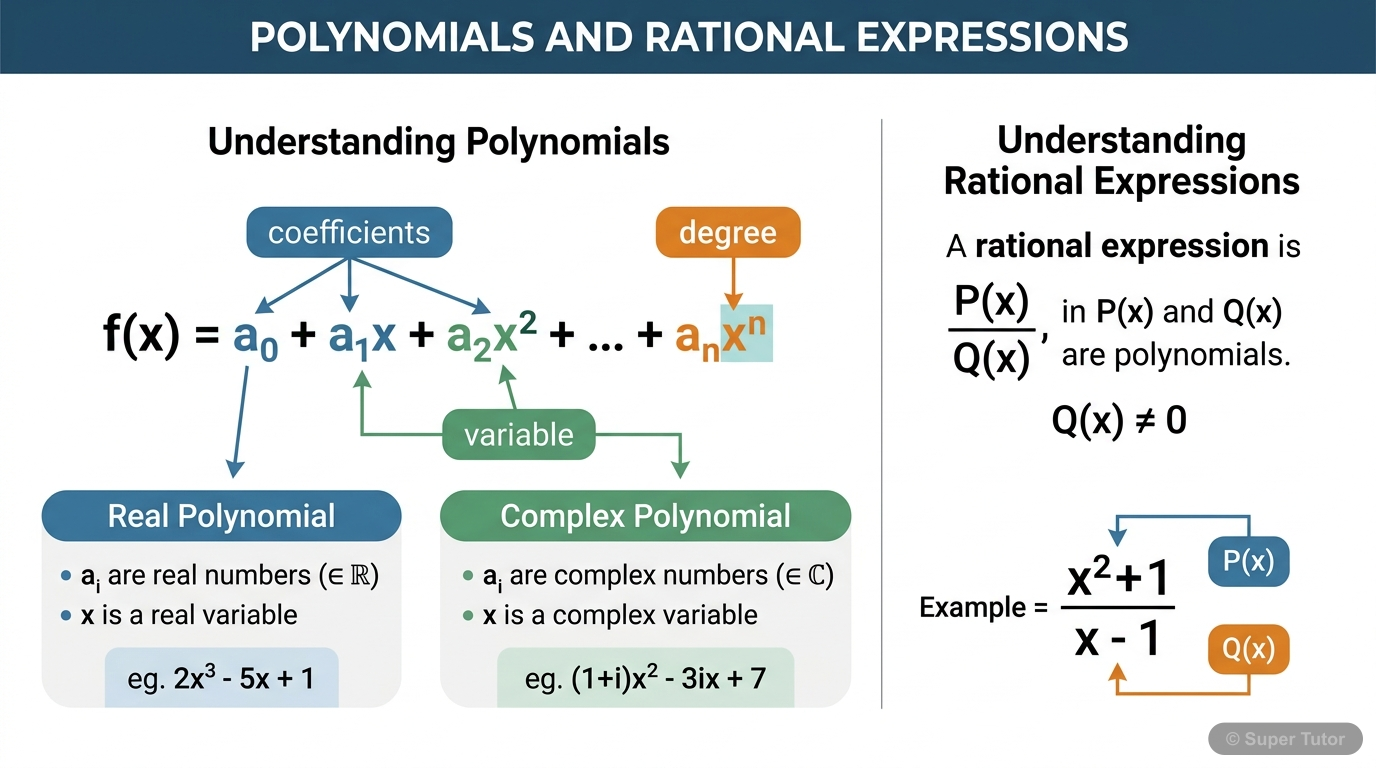
One of 6 illustrations for Factorisation of Polynomials in Super Tutor — alongside flashcards, concept maps and practice questions.
See them allOverview
Factorisation of polynomials is the process of writing a polynomial as a product of simpler polynomials. It is closely connected with the Division Algorithm, Remainder Theorem, and Factor Theorem. A polynomial in this chapter is limited to degree 3. The main idea is to find factors, verify them usin
Key Concepts
Polynomials are classified by number
Polynomials are classified by number of terms and by degree. A polynomial of one term is called a monomial, of two terms a binomial, and of three term
If f(x) is divided by
If f(x) is divided by a non-zero polynomial g(x), then there exist unique polynomials q(x) and r(x) such that f(x)=g(x)q(x)+r(x), where r(x)=0 or deg
A non
A non-zero polynomial g(x) is a factor of f(x) if and only if there exists a polynomial q(x) such that f(x)=q(x)·g(x). In this case, the remainder is
The value of a polynomial at
The value of a polynomial at x=α is found by substituting α for x throughout the polynomial. For example, for f(x)=x^2+5x+4, the value at x=3 is found
If a polynomial f(x) is divided
If a polynomial f(x) is divided by (x-a), then the remainder is f(a). This is proved using the Division Algorithm by writing f(x)=(x-a)·q(x)+c and the
Learning Objectives
- Understand how polynomials are classified by number of terms and by degree.
- Use the Division Algorithm for Polynomials to relate dividend, divisor, quotient, and remainder.
- Identify when a polynomial is a factor of another polynomial.
- Find the value of a polynomial at a given value of x by substitution.
- Use the Remainder Theorem to find remainders quickly.
Frequently Asked Questions
What are the important topics in Factorisation of Polynomials for ICSE Class 10 Mathematics?
How should I revise Factorisation of Polynomials for the ICSE Class 10 board exam?
Sources & Official References
Content is aligned to the official syllabus. Refer to the board website for the latest curriculum.
More resources for Factorisation of Polynomials
Practice Quiz
Test yourself with a quick quiz
Important Questions
Exam-style questions with answers
Revision Notes
Key points for last-minute revision
Formula Sheet
The chapter's formulas in one place
Concept Maps
See how topics connect
Study Plan
Step-by-step plan for this chapter
Flashcards
Quick-fire cards for active recall
Syllabus
What topics to cover
For serious students
Get the full Factorisation of Polynomials chapter — start free.
Quizzes, flashcards, an AI doubt solver and a study plan for ICSE Class 10 Mathematics. Free to start, no card needed.