Ratio and Proportion — Chapter Summary
ICSE · Class 10 · Mathematics
Summary of Ratio and Proportion for ICSE Class 10 Mathematics. Key concepts: The ratio of a to b, Four quantities and Quantities.
Interactive on Super Tutor
Studying Ratio and Proportion? Get the full interactive chapter.
Quizzes, flashcards, AI doubt-solver and a step-by-step study plan — built for chapter summary and more.
Free trial, no card needed.
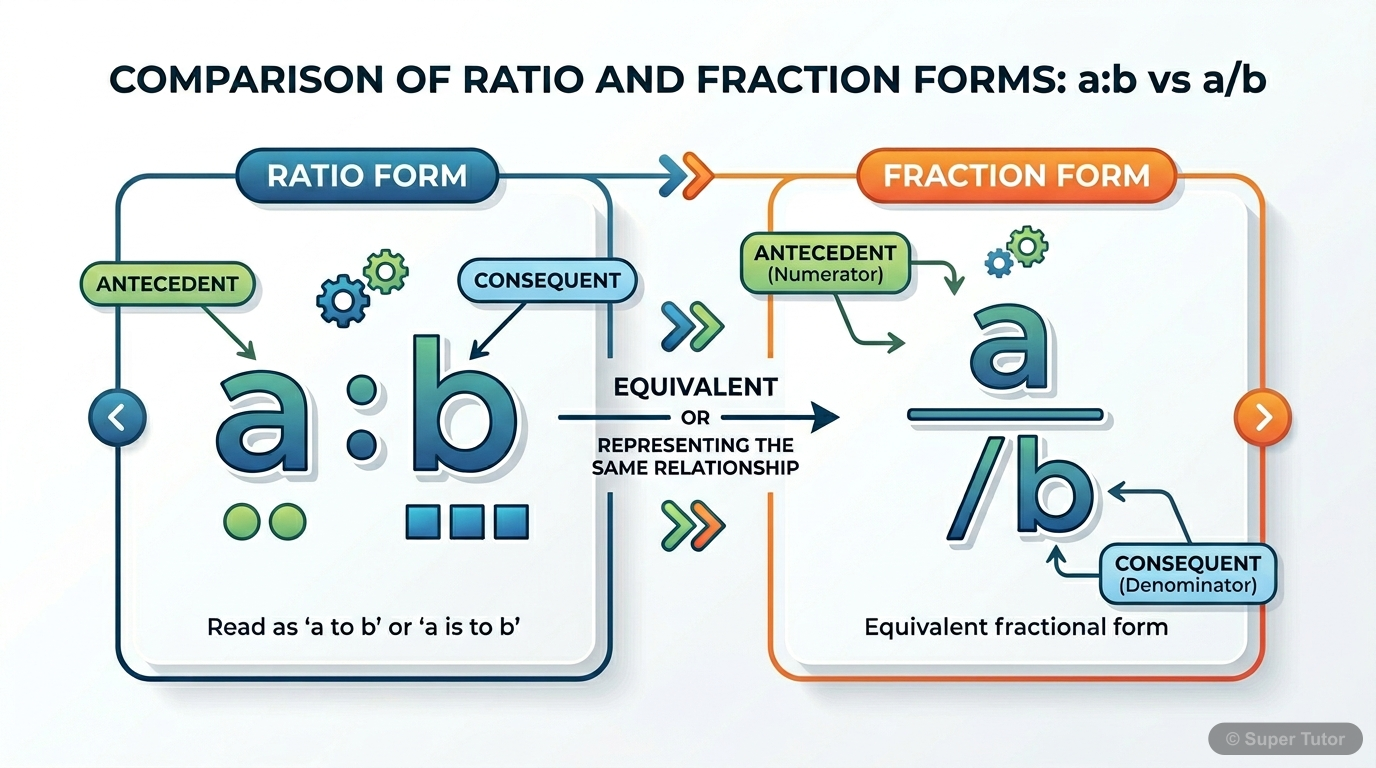
One of 6 illustrations for Ratio and Proportion in Super Tutor — alongside flashcards, concept maps and practice questions.
See them allOverview
Ratio compares two quantities of the same kind by writing them as a:b or a/b, where a is the antecedent and b is the consequent. Proportion states that two ratios are equal, written as a:b = c:d or a:b::c:d. The chapter also includes continued proportion, mean proportional, third proportional, compo
Key Concepts
The ratio of a to b
The ratio of a to b is the fraction a/b, written as a:b. The first term is the antecedent and the second term is the consequent. A ratio is formed onl
Four quantities
Four quantities a, b, c, d are in proportion if a:b = c:d, written as a:b::c:d. In this form, a and d are the extremes, while b and c are the means.
Quantities
Quantities a, b, c, d, e, f etc. are in continued proportion if a/b = b/c = c/d = d/e = e/f. In this case, b is the mean proportional. If a:b = b:c, t
The compounded ratio of
The compounded ratio of a:b and c:d is ac:bd. It is formed by multiplying the antecedents together and the consequents together.
The duplicate ratio of
The duplicate ratio of a:b is a^2:b^2. The triplicate ratio of a:b is a^3:b^3.
Learning Objectives
- Understand the meaning of ratio and proportion.
- Identify antecedent, consequent, extremes, means, fourth proportional, mean proportional, and third proportional.
- Use the properties of ratio correctly, including invariance under multiplication or division by a non-zero number.
- Find compounded, duplicate, triplicate, sub-duplicate, sub-triplicate, and reciprocal ratios.
- Apply the product of extremes and means in proportion.
Frequently Asked Questions
What are the important topics in Ratio and Proportion for ICSE Class 10 Mathematics?
How should I revise Ratio and Proportion for the ICSE Class 10 board exam?
Sources & Official References
Content is aligned to the official syllabus. Refer to the board website for the latest curriculum.
More resources for Ratio and Proportion
Practice Quiz
Test yourself with a quick quiz
Important Questions
Exam-style questions with answers
Revision Notes
Key points for last-minute revision
Formula Sheet
The chapter's formulas in one place
Concept Maps
See how topics connect
Study Plan
Step-by-step plan for this chapter
Flashcards
Quick-fire cards for active recall
Syllabus
What topics to cover
For serious students
Get the full Ratio and Proportion chapter — start free.
Quizzes, flashcards, an AI doubt solver and a study plan for ICSE Class 10 Mathematics. Free to start, no card needed.