Calorimetry — Flashcards
ICSE · Class 10 · Physics
34 flashcards for Calorimetry (ICSE Class 10 Physics) to test yourself on key terms and facts. Sample: "State the meaning of heat."
Interactive on Super Tutor
Studying Calorimetry? Get the full interactive chapter.
Quizzes, flashcards, AI doubt-solver and a step-by-step study plan — built for flashcards and more.
Free trial, no card needed.
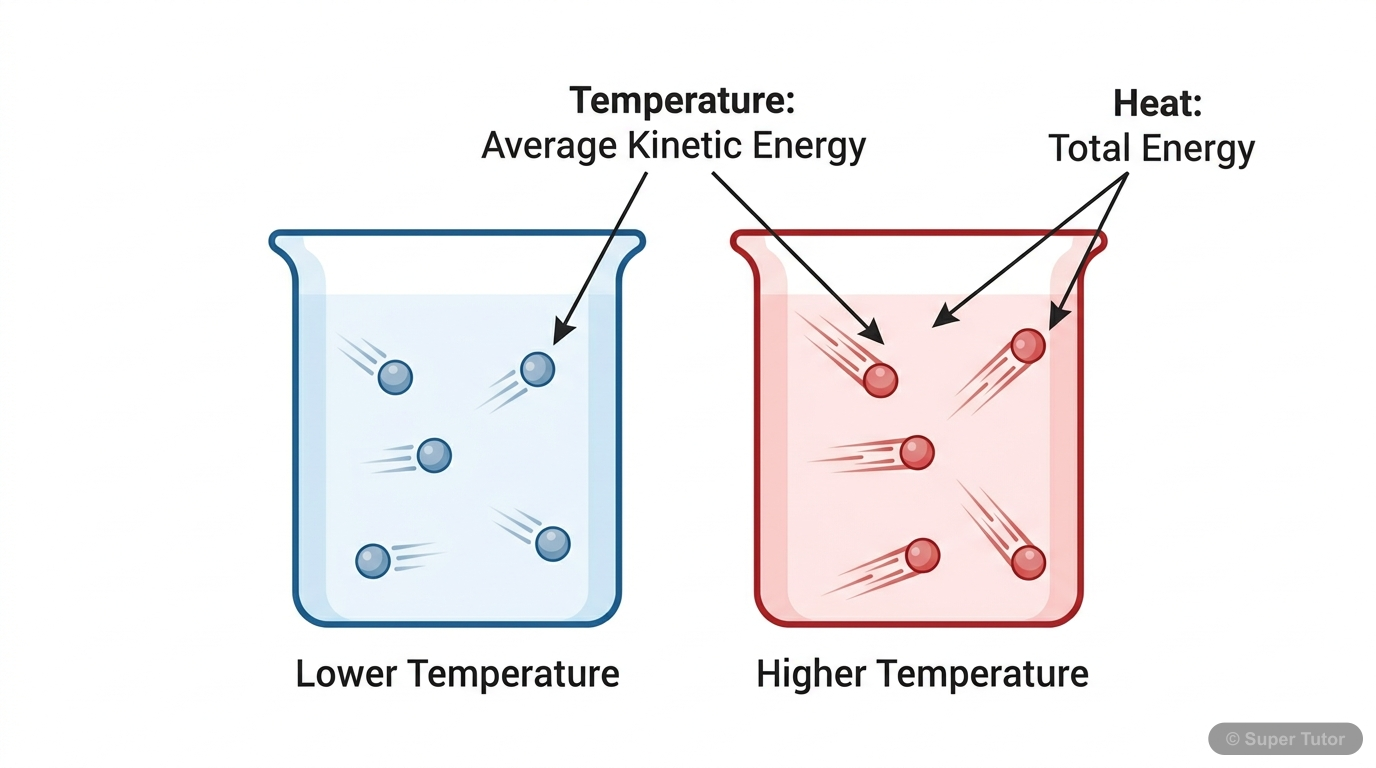
One of 13 illustrations for Calorimetry in Super Tutor — alongside flashcards, concept maps and practice questions.
See them allState the meaning of heat.
Answer
Heat is energy in transit due to random molecular motion. It flows from a body at higher temperature to a body at lower temperature. SI unit: joule (J).
What is temperature?
Answer
Temperature is the degree of hotness or coldness of a body. It measures the average internal kinetic energy of the molecules of a substance and determines the direction of heat flow.
State the SI unit of heat and the relation between calorie and joule.
Answer
The SI unit of heat is joule. 1 calorie = 4.186 joule, approximately 1 cal = 4.2 J.
A body requires 840 J of heat to raise its temperature by 20 K. Find its heat capacity.
Answer
Given: Q = 840 J, Δt = 20 K Formula: c' = Q/Δt Step 1: c' = 840/20 Step 2: c' = 42 J/K Answer: Heat capacity = 42 J/K…
What is heat capacity?
Answer
Heat capacity is the amount of heat required to raise the temperature of the whole mass of a body by 1°C or 1 K. It depends on mass and material both. Unit: cal/°C, J/°C, J/K, or kilocalorie/K.
What is specific heat capacity?
Answer
Specific heat capacity is the amount of heat required to raise the temperature of unit mass of a body by 1°C or 1 K. It depends only on the material. Unit: cal/g°C or J/kgK.
A 2 kg substance has specific heat capacity 500 J/kgK. Find its heat capacity.
Answer
Given: m = 2 kg, c = 500 J/kgK Formula: c' = mc Step 1: c' = 2 × 500 Step 2: c' = 1000 J/K Answer: Heat capacity = 1000 J/K…
State the relation between heat capacity and specific heat capacity.
Answer
Heat capacity = mass × specific heat capacity Formula: c' = mc Meaning: c' depends on the whole body, while c depends only on the material.
+26 more flashcards
Practise AllFrequently Asked Questions
What are the important topics in Calorimetry for ICSE Class 10 Physics?
How many flashcards are available for Calorimetry?
How should I revise Calorimetry for the ICSE Class 10 board exam?
Sources & Official References
Content is aligned to the official syllabus. Refer to the board website for the latest curriculum.
More resources for Calorimetry
Practice Quiz
Test yourself with a quick quiz
Important Questions
Exam-style questions with answers
Revision Notes
Key points for last-minute revision
Formula Sheet
The chapter's formulas in one place
Chapter Summary
Understand the chapter at a glance
Concept Maps
See how topics connect
Study Plan
Step-by-step plan for this chapter
Syllabus
What topics to cover
For serious students
Get the full Calorimetry chapter — start free.
Quizzes, flashcards, an AI doubt solver and a study plan for ICSE Class 10 Physics. Free to start, no card needed.