Classification of Elements and Periodicity in Properties
ICSE · Class 11 · Chemistry
Most important questions from Classification of Elements and Periodicity in Properties for ICSE Class 11 Chemistry board exam 2026. MCQs, short answer, and long answer questions with marks.
Interactive on Super Tutor
Studying Classification of Elements and Periodicity in Properties? Get the full interactive chapter.
Quizzes, flashcards, AI doubt-solver and a step-by-step study plan — built for important questions and more.
1,000+ Class 11 students started this chapter today
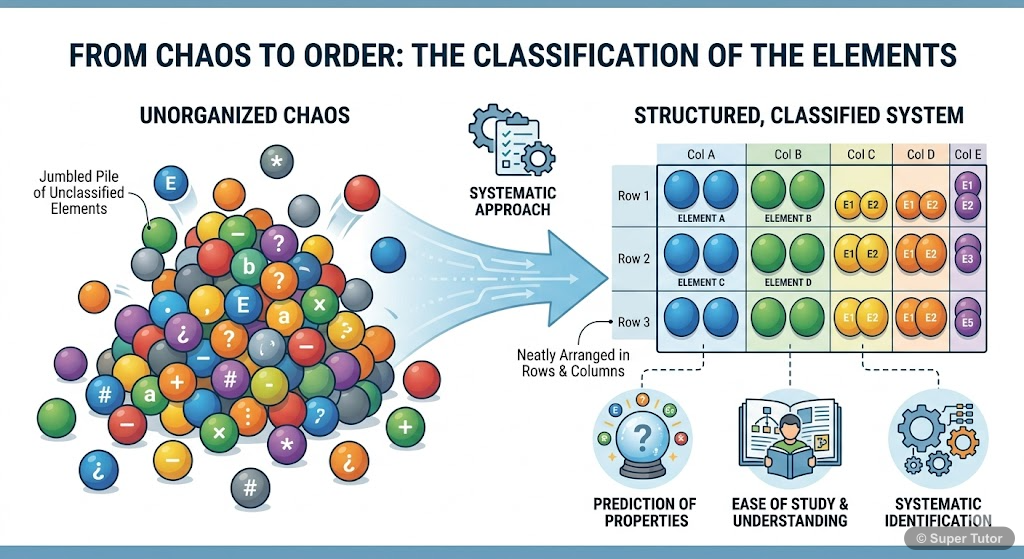
This is just one of 20+ visuals inside Super Tutor's Classification of Elements and Periodicity in Properties chapter
Explore the full setSample Questions
Electron gain enthalpy of fluorine (–328 kJ/mol) is LESS negative than that of chlorine (–349 kJ/mol), contrary to the expected periodic trend. Which explanation is most accurate?
Show answer
The very small size of fluorine (2p subshell) causes high electron-electron repulsion in the compact 2p orbital when an electron is added, making the process less exothermic than for chlorine (3p subshell).
Step 1: The general trend in a group is that electron gain enthalpy becomes less negative going down. So F should have more negative EGE than Cl — but it doesn't. Step 2: Fluorine is extremely small (atomic radius = 0.72 Å). When an incoming electron enters the 2p subshell of fluorine, it encounters intense inter-electronic repulsion from the existing 2p electrons in this very compact subshell. Step 3: In chlorine, the added electron goes into the larger, more diffuse 3p subshell, where electron-electron repulsion is much smaller. Step 4: This reduced repulsion in Cl makes the electron additio
Using Mendeleev's predictions, ekasilicon was predicted to have an oxide formula of MO₂ and a chloride of MCl₄. When the element was discovered as Germanium (Z=32), these predictions were confirmed. What is the IUPAC systematic name for the element with atomic number 115, as per IUPAC nomenclature r
Show answer
Ununpentium
Step 1: The IUPAC systematic name is built from numerical roots for each digit of the atomic number. Step 2: Atomic number 115 has digits 1, 1, and 5. Step 3: Numerical roots: 1 = 'un', 1 = 'un', 5 = 'pent'. Step 4: Combining: un + un + pent + ium = Ununpentium. The symbol would be Uup. Step 5: This element has now been officially named Moscovium (Mc) by IUPAC. Option B 'Unquadpentium' incorrectly uses 'quad' for digit 1. Option C 'Unnilpentium' would be for Z=105 (digits 1,0,5). Option D 'Unununpentium' would suggest Z=111+5 = wrong interpretation. The IUPAC official name is Moscovium (Mc).
Which of the following correctly explains why the ionic radius of Mg²⁺ (0.65 Å) is smaller than that of Na⁺ (0.95 Å), given that both ions are isoelectronic with 10 electrons?
Show answer
Mg²⁺ has a higher nuclear charge (+12) compared to Na⁺ (+11), so the same 10 electrons experience a stronger nuclear pull, reducing the ionic radius.
Step 1: Both Na⁺ and Mg²⁺ have 10 electrons (isoelectronic — same as Ne). Step 2: Na has Z=11, so Na⁺ has nuclear charge +11 pulling 10 electrons. Z/e ratio = 11/10 = 1.1. Step 3: Mg has Z=12, so Mg²⁺ has nuclear charge +12 pulling 10 electrons. Z/e ratio = 12/10 = 1.2. Step 4: Higher Z/e for Mg²⁺ means each electron is pulled more strongly toward the nucleus → smaller size. Step 5: Option A is wrong — electron-electron repulsion plays a minor role; the key factor is nuclear charge. Option C confuses the number of electrons lost with radius determination. Option D is completely wrong — nuclear
An element has the following ionisation energies (in kJ/mol): IE₁ = 577, IE₂ = 1817, IE₃ = 2745, IE₄ = 11,578, IE₅ = 14,831. To which group of the periodic table does this element most likely belong?
Show answer
Group 13
Step 1: The key to identifying the group is to find the large jump in successive ionisation energies — this jump occurs when we go from removing valence electrons to removing core (inner shell) electrons. Step 2: Looking at the data: IE₁=577, IE₂=1817, IE₃=2745 — these increase gradually (removing valence electrons). Step 3: From IE₃ to IE₄ there is a HUGE jump: 2745 → 11,578 kJ/mol. This means the 4th electron is extremely difficult to remove. Step 4: This indicates the element has 3 valence electrons (IE₁, IE₂, IE₃ involve valence electrons; IE₄ involves a core electron). Step 5: An element
+41 more questions available
Practice AllFrequently Asked Questions
What are the important topics in Classification of Elements and Periodicity in Properties for ICSE Class 11 Chemistry?
How to score full marks in Classification of Elements and Periodicity in Properties — ICSE Class 11 Chemistry?
How many important questions are there in Classification of Elements and Periodicity in Properties?
Sources & Official References
Content is aligned to the official syllabus. Refer to the board website for the latest curriculum.
More resources for Classification of Elements and Periodicity in Properties
Practice Quiz
Test yourself with a quick quiz
Revision Notes
Key points for last-minute revision
Formula Sheet
All formulas in one place
Chapter Summary
Understand the chapter at a glance
Concept Maps
See how topics connect visually
Study Plan
Step-by-step plan to ace this chapter
Flashcards
Quick-fire cards for active recall
Syllabus
What topics to cover
NCERT Solutions
Every textbook question solved step by step
For serious students
Get the full Classification of Elements and Periodicity in Properties chapter — for free.
Quizzes, flashcards, AI doubt-solver and a step-by-step study plan for ICSE Class 11 Chemistry.