Classification of Elements and Periodicity in Properties — Concept Maps
ICSE · Class 11 · Chemistry
4 concept maps of Classification of Elements and Periodicity in Properties for ICSE Class 11 Chemistry, each also written out as a text outline.
Interactive on Super Tutor
Studying Classification of Elements and Periodicity in Properties? Get the full interactive chapter.
Quizzes, flashcards, AI doubt-solver and a step-by-step study plan — built for concept maps and more.
Free trial, no card needed.
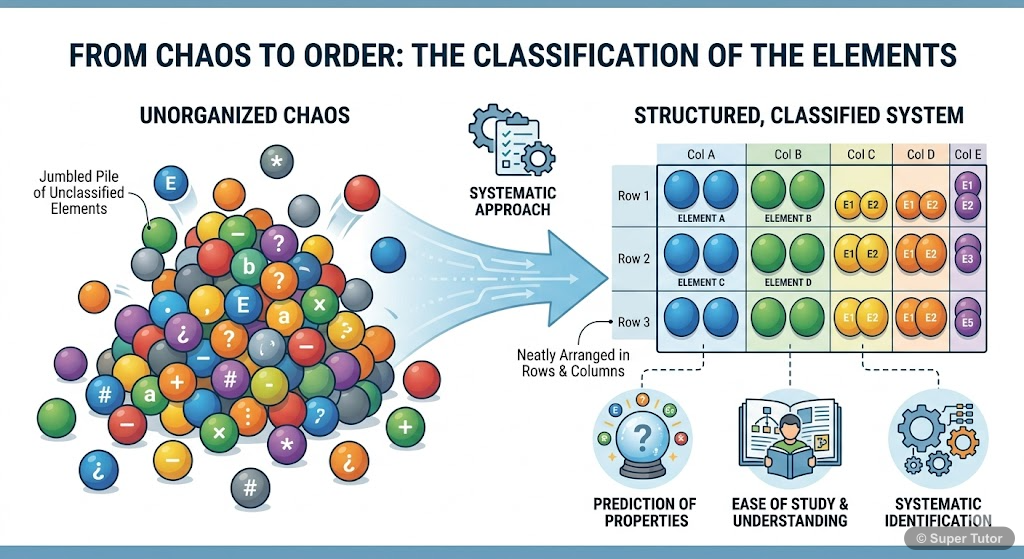
Learn better with visuals Super Tutor pairs illustrations like this with notes and quizzes for Classification of Elements and Periodicity in Properties.
Classification of Elements and Periodic Properties - Concept Overview
The map in words
- Periodic Table & Properties
- Early Classification Attempts
- Dobereiner Triads
- Newlands Octaves
- Lothar Meyer Curves
- Mendeleev's Periodic Law
- Based on Atomic Mass
- Predicted Elements
- Defects & Limitations
- Modern Periodic Law
- Based on Atomic Number
- Moseley's Work
- Long Form Table
- Periodic Properties
- Atomic Radii
- Decrease across period
- Increase down group
- Ionization Energy
- Increases across period
- Decreases down group
- Electron Gain Enthalpy
- Most negative for halogens
- Positive for noble gases
- Electronegativity
- Increases across period
- Decreases down group
- Atomic Radii
- Element Classification
- Groups 1-2
- Groups 13-18
- Groups 3-12
- Lanthanides & Actinides
- Trends in Groups
- Group 1 Alkali Metals
- Low ionization energy
- Highly reactive
- Group 17 Halogens
- High electronegativity
- Oxidizing agents
- Group 18 Noble Gases
- Filled valence shell
- Chemically inert
- Group 1 Alkali Metals
- Early Classification Attempts
Periodic Table Overview: Classification of Elements
The map in words
- Classification of Elements
- Historical Development
- Dobereiner Triads
- Groups of 3 elements
- Similar properties
- Newlands Octaves
- Every 8th element similar
- Pattern breaks for heavy elements
- Lothar Meyer
- Atomic volume curves
- Physical properties vary periodically
- Mendeleev Table
- Arranged by atomic mass
- Predicted unknown elements
- Dobereiner Triads
- Modern Periodic Table
- Based on Atomic Number
- Moseley X-ray data
- Resolves all anomalies
- Seven Periods
- n=1: 2 elements
- n=2,3: 8 elements each
- n=4,5: 18 elements each
- n=6: 32 elements
- n=7: 32 elements
- Four Blocks
- s-block Groups 1,2
- p-block Groups 13-18
- d-block Groups 3-12
- f-block Lanthanoids/Actinoids
- Based on Atomic Number
- Periodic Trends
- Atomic Radius
- Down group increases
- Across period decreases
- Ionization Energy
- Down group decreases
- Across period increases
- Exceptions at B,N and O
- Electron Gain Enthalpy
- Halogens most negative
- Noble gases positive
- Cl more negative than F
- Electronegativity
- Down group decreases
- Across period increases
- F highest 4.0
- Fr lowest 0.7
- Atomic Radius
- Element Classification
- s-block
- Alkali metals Group 1
- Alkaline earth metals Group 2
- Highly reactive
- p-block
- Metals, metalloids, nonmetals
- Halogens Group 17
- Noble gases Group 18
- d-block
- Transition metals
- Variable oxidation states
- Colored compounds
- f-block
- Lanthanoids rare earth
- Actinoids radioactive
- Similar chemistry within series
- s-block
- Historical Development
Development of Periodic Classification - Historical Overview
The map in words
- Classification of Elements
- Early Attempts
- Dobereiner Triads
- Li-Na-K
- Cl-Br-I
- Pattern: Middle element avg
- Newlands Octaves
- Every 8th element similar
- Like musical octaves
- Failed for heavy elements
- Lothar Meyer
- Atomic volume curves
- Physical properties periodic
- Dobereiner Triads
- Mendeleev's Table
- Periodic Law
- Properties depend on atomic mass
- Periodic function
- Key Features
- 7 periods, 8 groups
- Left gaps for unknowns
- Predicted Ga, Ge, Sc
- Contributions
- Systematic organization
- Element discovery guidance
- Corrected atomic masses
- Defects
- Hydrogen ambiguity
- Isotope issues
- Anomalous pairs
- Periodic Law
- Modern Periodic Table
- Modern Law
- Atomic number fundamental
- Moseley's X-ray work
- Replaces atomic mass
- Structure
- 7 periods, 18 groups
- Electronic configuration basis
- s, p, d, f blocks
- Advantages
- Resolves anomalies
- Explains isotopes
- Predicts properties
- Modern Law
- Early Attempts
Periodic classification of elements based on atomic number, electronic configuration, and repeating properties
The map in words
- Periodic classification of elements based on atomic number, electronic configuration, and repeating properties
- Need for classification
- Early attempts at classification
- Mendeleev's Periodic Law
- Defects of Mendeleev's table
- Modern Periodic Law
- Long form periodic table
- Electronic configuration and periodic table
- Blocks of the periodic table
Explore these maps interactively
Explore DiagramsFrequently Asked Questions
What are the important topics in Classification of Elements and Periodicity in Properties for ICSE Class 11 Chemistry?
What do the concept maps for Classification of Elements and Periodicity in Properties show?
How should I revise Classification of Elements and Periodicity in Properties for Class 11 exams?
Sources & Official References
Content is aligned to the official syllabus. Refer to the board website for the latest curriculum.
More resources for Classification of Elements and Periodicity in Properties
Practice Quiz
Test yourself with a quick quiz
Important Questions
Exam-style questions with answers
Revision Notes
Key points for last-minute revision
Formula Sheet
The chapter's formulas in one place
Chapter Summary
Understand the chapter at a glance
Study Plan
Step-by-step plan for this chapter
Flashcards
Quick-fire cards for active recall
Syllabus
What topics to cover
For serious students
Get the full Classification of Elements and Periodicity in Properties chapter — start free.
Quizzes, flashcards, an AI doubt solver and a study plan for ICSE Class 11 Chemistry. Free to start, no card needed.