Classification of Elements and Periodicity in Properties — Chapter Summary
ICSE · Class 11 · Chemistry
Summary of Classification of Elements and Periodicity in Properties for ICSE Class 11 Chemistry. Part of the ICSE Class 11 Chemistry syllabus.
Interactive on Super Tutor
Studying Classification of Elements and Periodicity in Properties? Get the full interactive chapter.
Quizzes, flashcards, AI doubt-solver and a step-by-step study plan — built for chapter summary and more.
Free trial, no card needed.
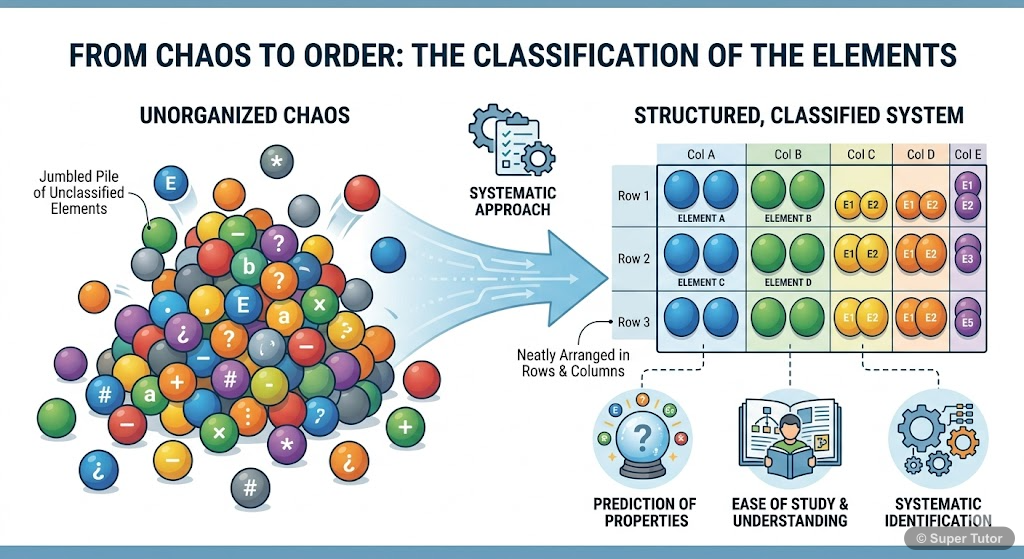
Learn better with visuals Super Tutor pairs illustrations like this with notes and quizzes for Classification of Elements and Periodicity in Properties.
Overview
Chemistry becomes systematic when elements are arranged according to a law that connects their properties. The periodic table organizes about 118 known elements so that elements with similar outer electronic configurations fall into the same group and show similar chemical behaviour. The modern form
Key Concepts
Elements form many compounds
Elements form many compounds, so a systematic arrangement is needed to make their study simpler. A good classification groups elements with similar pr
Prout proposed the unitary theory
Prout proposed the unitary theory. Döbereiner arranged elements in triads. Cooke grouped elements into homologous series. Newlands gave the law of oct
The physical and chemical properties
The physical and chemical properties of the elements and their compounds are periodic functions of their atomic weights. Mendeleev arranged known elem
The physical and chemical properties
The physical and chemical properties of the elements are periodic functions of their atomic numbers. Moseley showed that atomic number is the most fun
The long form periodic table has
The long form periodic table has seven periods and eighteen groups. It is arranged by increasing atomic number and is closely linked with electronic c
Learning Objectives
- Understand why classification of elements was needed
- Recall the major early attempts at classification
- State Mendeleev's Periodic Law and Modern Periodic Law
- Describe the structure of Mendeleev's table and the long form periodic table
- Identify s-block, p-block, d-block, and f-block elements
Frequently Asked Questions
What are the important topics in Classification of Elements and Periodicity in Properties for ICSE Class 11 Chemistry?
How should I revise Classification of Elements and Periodicity in Properties for Class 11 exams?
Sources & Official References
Content is aligned to the official syllabus. Refer to the board website for the latest curriculum.
More resources for Classification of Elements and Periodicity in Properties
Practice Quiz
Test yourself with a quick quiz
Important Questions
Exam-style questions with answers
Revision Notes
Key points for last-minute revision
Formula Sheet
The chapter's formulas in one place
Concept Maps
See how topics connect
Study Plan
Step-by-step plan for this chapter
Flashcards
Quick-fire cards for active recall
Syllabus
What topics to cover
For serious students
Get the full Classification of Elements and Periodicity in Properties chapter — start free.
Quizzes, flashcards, an AI doubt solver and a study plan for ICSE Class 11 Chemistry. Free to start, no card needed.