Hydrocarbons
ICSE · Class 11 · Chemistry
Most important questions from Hydrocarbons for ICSE Class 11 Chemistry board exam 2026. MCQs, short answer, and long answer questions with marks.
Interactive on Super Tutor
Studying Hydrocarbons? Get the full interactive chapter.
Quizzes, flashcards, AI doubt-solver and a step-by-step study plan — built for important questions and more.
1,000+ Class 11 students started this chapter today
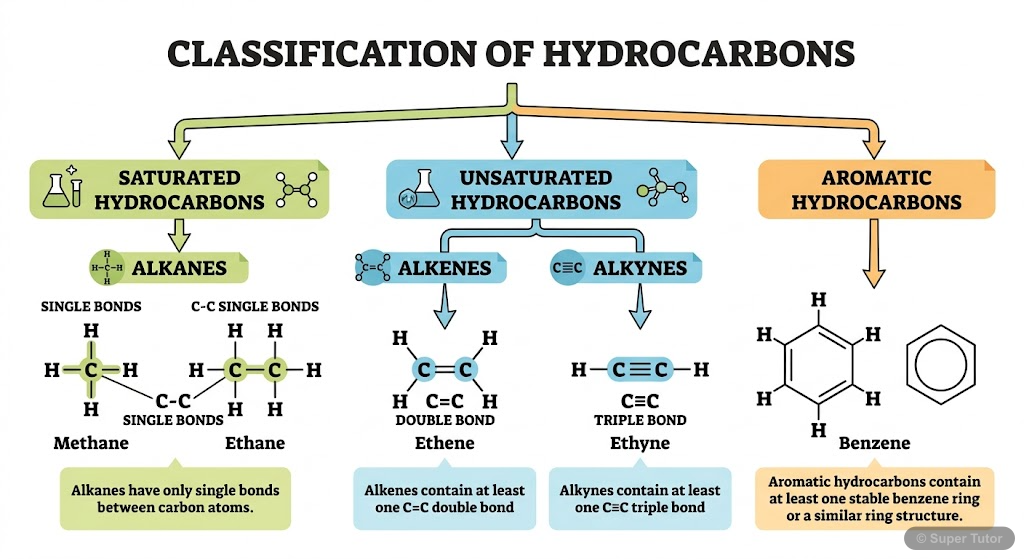
This is just one of 15+ visuals inside Super Tutor's Hydrocarbons chapter
Explore the full setSample Questions
When sodium benzoate (C₆H₅COONa) is heated with sodalime (NaOH + CaO), the product obtained is:
Show answer
Benzene
Step 1: This reaction is called decarboxylation — removal of CO₂ from a carboxyl group. Step 2: The reaction is: C₆H₅COONa + NaOH (sodalime) → C₆H₆ + Na₂CO₃. Step 3: The sodium benzoate reacts with NaOH. The carboxylate group (-COO⁻) loses CO₂, and the benzene ring acquires a hydrogen. Step 4: The product C₆H₆ is benzene. CaO in sodalime helps in fusion of the mixture but does not react. Toluene (C₇H₈) would require a longer chain. Phenol contains -OH group. Benzoic acid is the parent acid before salt formation.
Baeyer's test is used to detect unsaturation in organic compounds. The reagent used in Baeyer's test is:
Show answer
Cold dilute alkaline KMnO₄ solution
Step 1: Baeyer's reagent is a cold, dilute (1%) alkaline solution of potassium permanganate (KMnO₄). Step 2: When an alkene or alkyne is added, the purple colour of KMnO₄ gets decolourised — this indicates the presence of a C=C or C≡C bond. Step 3: The reaction involves hydroxylation: the alkene is oxidised to a 1,2-diol (glycol), and KMnO₄ is reduced to MnO₂. Step 4: Hot concentrated KMnO₄ causes oxidative cleavage, not the Baeyer's test. Bromine water (brown to colourless) is a different test for unsaturation. Ozone is used in ozonolysis to determine the position of double bonds.
Which of the following pairs of compounds are geometrical isomers of each other?
Show answer
cis-but-2-ene and trans-but-2-ene
Step 1: Geometrical isomers have the same molecular formula and connectivity but differ in the spatial arrangement of groups around a double bond. Step 2: For geometrical isomerism, a double bond must be present AND each carbon of the double bond must carry two different groups. Step 3: cis-but-2-ene (CH₃ groups on the same side) and trans-but-2-ene (CH₃ groups on opposite sides) satisfy this condition. Step 4: n-butane and isobutane are chain isomers (structural isomers). But-1-ene and but-2-ene are position isomers. Ethyne and but-2-yne are different compounds entirely (homologues). Only opt
During the free radical halogenation of methane with Cl₂, which step involves the breaking of the Cl-Cl bond to form chlorine free radicals?
Show answer
Initiation step
Step 1: The free radical chlorination of methane occurs in three steps: initiation, propagation, and termination. Step 2: In the initiation step, the Cl-Cl bond is broken homolytically by UV light or heat (520-670 K): Cl₂ → 2Cl• (two chlorine free radicals). Step 3: In the propagation step, Cl• attacks CH₄ to form CH₃• and HCl, and then CH₃• attacks Cl₂ to form CH₃Cl and another Cl•. These steps repeat in a chain. Step 4: In the termination step, two free radicals combine to stop the chain: Cl• + Cl• → Cl₂, or CH₃• + Cl• → CH₃Cl. Chain transfer is not a standard step in this mechanism.
+41 more questions available
Practice AllFrequently Asked Questions
What are the important topics in Hydrocarbons for ICSE Class 11 Chemistry?
How to score full marks in Hydrocarbons — ICSE Class 11 Chemistry?
How many important questions are there in Hydrocarbons?
Sources & Official References
Content is aligned to the official syllabus. Refer to the board website for the latest curriculum.
More resources for Hydrocarbons
Practice Quiz
Test yourself with a quick quiz
Revision Notes
Key points for last-minute revision
Formula Sheet
All formulas in one place
Chapter Summary
Understand the chapter at a glance
Concept Maps
See how topics connect visually
Study Plan
Step-by-step plan to ace this chapter
Flashcards
Quick-fire cards for active recall
Syllabus
What topics to cover
NCERT Solutions
Every textbook question solved step by step
For serious students
Get the full Hydrocarbons chapter — for free.
Quizzes, flashcards, AI doubt-solver and a step-by-step study plan for ICSE Class 11 Chemistry.