Hydrocarbons — Chapter Summary
ICSE · Class 11 · Chemistry
Summary of Hydrocarbons for ICSE Class 11 Chemistry. Key concepts: Hydrocarbons are classified as, Alkanes are saturated acyclic and Rotation about the C.
Interactive on Super Tutor
Studying Hydrocarbons? Get the full interactive chapter.
Quizzes, flashcards, AI doubt-solver and a step-by-step study plan — built for chapter summary and more.
Free trial, no card needed.
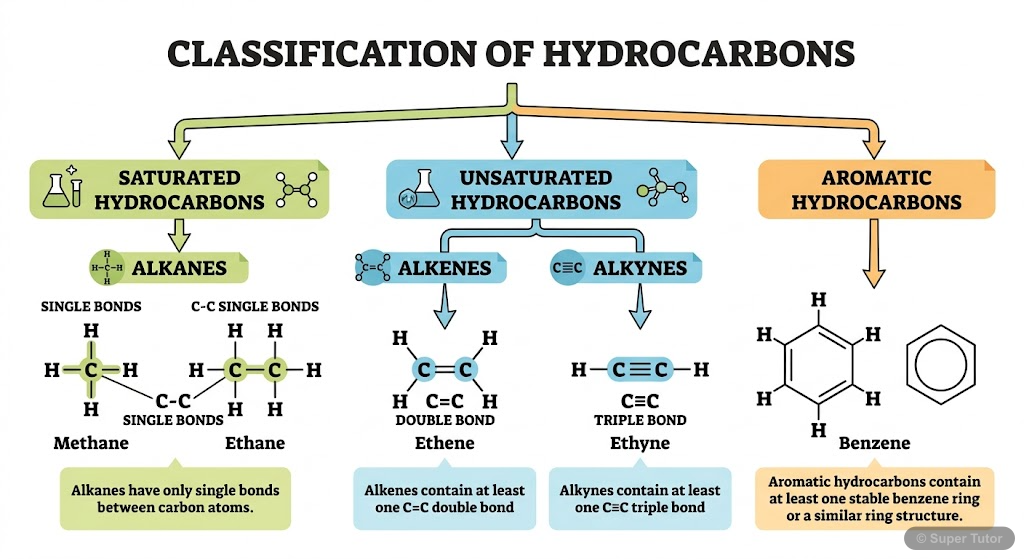
One of 15 illustrations for Hydrocarbons in Super Tutor — alongside flashcards, concept maps and practice questions.
Overview
Hydrocarbons are the simplest organic compounds and contain only carbon and hydrogen. They include open-chain and ring compounds, and are classified into saturated, unsaturated, and aromatic types. Their structures, reactions, properties, and uses form the basis for understanding many important orga
Key Concepts
Hydrocarbons are classified as acyclic
Hydrocarbons are classified as acyclic or cyclic. Acyclic hydrocarbons include alkanes, alkenes, and alkynes. Cyclic hydrocarbons include cycloalkanes
Alkanes are saturated acyclic hydrocarbons
Alkanes are saturated acyclic hydrocarbons with only C-C and C-H single bonds. Their general formula is CnH2n+2. They show chain isomerism, have sp3 h
Rotation about the C
Rotation about the C-C single bond gives different conformations. Ethane shows staggered and eclipsed conformations. The staggered form is more stable
Alkanes can be prepared from hydrogenation
Alkanes can be prepared from hydrogenation of alkenes and alkynes, Wurtz reaction, Corey-House reaction, reduction of alkyl halides, Grignard reagents
The first four alkanes are gases
The first four alkanes are gases, C5 to C17 are liquids, and higher members are solids. Boiling point increases with carbon number, branching lowers b
Learning Objectives
- Classify hydrocarbons into alkanes, alkenes, alkynes, cycloalkanes, and arenes
- Understand the structure and bonding in saturated, unsaturated, and aromatic hydrocarbons
- Explain isomerism in hydrocarbons, including chain, position, and geometrical isomerism
- Write and balance important reactions of hydrocarbons with states of matter
- Understand the preparation, properties, and uses of alkanes, alkenes, alkynes, benzene, and petroleum-derived fuels
Frequently Asked Questions
What are the important topics in Hydrocarbons for ICSE Class 11 Chemistry?
How should I revise Hydrocarbons for Class 11 exams?
Sources & Official References
Content is aligned to the official syllabus. Refer to the board website for the latest curriculum.
More resources for Hydrocarbons
Practice Quiz
Test yourself with a quick quiz
Important Questions
Exam-style questions with answers
Revision Notes
Key points for last-minute revision
Formula Sheet
The chapter's formulas in one place
Concept Maps
See how topics connect
Study Plan
Step-by-step plan for this chapter
Flashcards
Quick-fire cards for active recall
Syllabus
What topics to cover
For serious students
Get the full Hydrocarbons chapter — start free.
Quizzes, flashcards, an AI doubt solver and a study plan for ICSE Class 11 Chemistry. Free to start, no card needed.