Chemical Thermodynamics — Chapter Summary
ICSE · Class 11 · Chemistry
Summary of Chemical Thermodynamics for ICSE Class 11 Chemistry. Part of the ICSE Class 11 Chemistry syllabus. Chemical thermodynamics studies energy.
Interactive on Super Tutor
Studying Chemical Thermodynamics? Get the full interactive chapter.
Quizzes, flashcards, AI doubt-solver and a step-by-step study plan — built for chapter summary and more.
Free trial, no card needed.
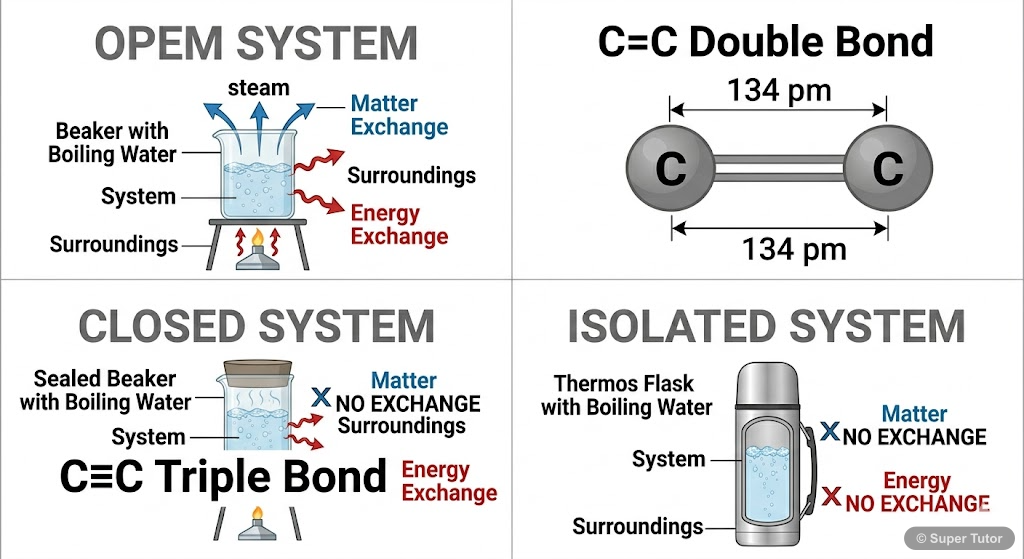
One of 4 illustrations for Chemical Thermodynamics in Super Tutor — alongside flashcards, concept maps and practice questions.
Overview
Chemical thermodynamics studies energy changes during physical and chemical changes and the quantitative relationship between different forms of energy. It explains how heat, work, internal energy, enthalpy, entropy, and free energy are related, and it helps in understanding the direction and feasib
Key Concepts
A system is the part
A system is the part of the universe under study with fixed boundaries. The surroundings are the rest of the universe outside the system. Systems may
A state function depends only on
A state function depends only on the initial and final states, not on the path. Temperature, pressure, volume, internal energy, enthalpy, entropy, and
The first law states that energy
The first law states that energy can neither be created nor destroyed. Mathematically, ΔU = q + w, where ΔU is the change in internal energy, q is hea
When a gas expands or contracts
When a gas expands or contracts against an external pressure, work is done. The general expression is w = -PΔV. For reversible isothermal expansion of
Internal energy is the total energy
Internal energy is the total energy associated with a fixed amount of substance under given conditions. It includes translational, rotational, vibrati
Learning Objectives
- Understand the meaning of system, surroundings, and different types of systems
- Identify intensive and extensive properties of a system
- Recognize state functions and non-state functions
- Apply the first law of thermodynamics to energy changes
- Use enthalpy, heat capacity, and related equations in calculations
Frequently Asked Questions
What are the important topics in Chemical Thermodynamics for ICSE Class 11 Chemistry?
How should I revise Chemical Thermodynamics for Class 11 exams?
Sources & Official References
Content is aligned to the official syllabus. Refer to the board website for the latest curriculum.
More resources for Chemical Thermodynamics
Practice Quiz
Test yourself with a quick quiz
Important Questions
Exam-style questions with answers
Revision Notes
Key points for last-minute revision
Formula Sheet
The chapter's formulas in one place
Concept Maps
See how topics connect
Study Plan
Step-by-step plan for this chapter
Flashcards
Quick-fire cards for active recall
Syllabus
What topics to cover
For serious students
Get the full Chemical Thermodynamics chapter — start free.
Quizzes, flashcards, an AI doubt solver and a study plan for ICSE Class 11 Chemistry. Free to start, no card needed.