Chemical Thermodynamics — Concept Maps
ICSE · Class 11 · Chemistry
4 concept maps of Chemical Thermodynamics for ICSE Class 11 Chemistry, each also written out as a text outline.
Interactive on Super Tutor
Studying Chemical Thermodynamics? Get the full interactive chapter.
Quizzes, flashcards, AI doubt-solver and a step-by-step study plan — built for concept maps and more.
Free trial, no card needed.
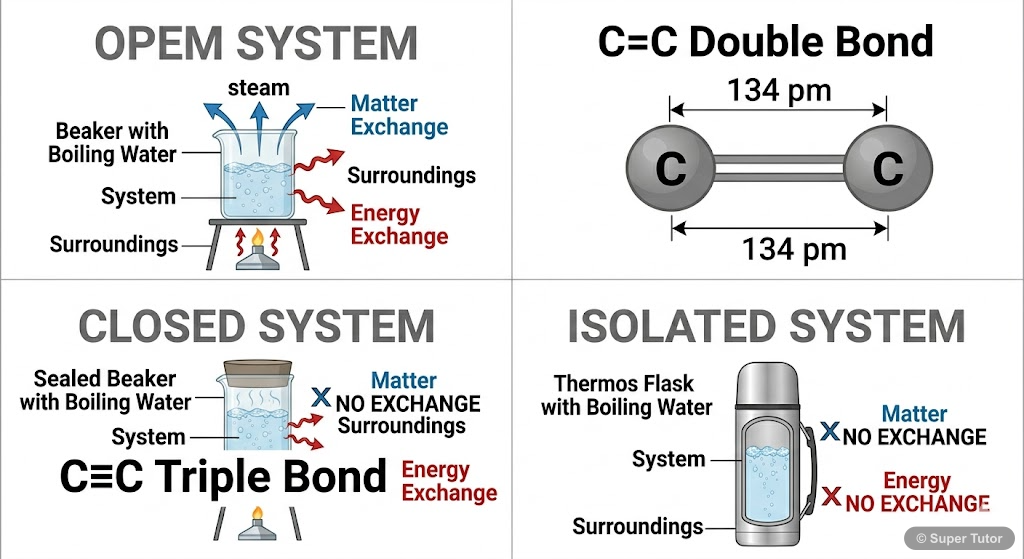
One of 4 illustrations for Chemical Thermodynamics in Super Tutor — alongside flashcards, concept maps and practice questions.
Thermodynamic Concepts Hierarchy
The map in words
- Chemical Thermodynamics
- Energy in Reactions
- Exothermic
- ΔH negative
- Products lower energy
- Endothermic
- ΔH positive
- Products higher energy
- Exothermic
- State Functions
- Internal Energy U
- ΔU = q + w
- Enthalpy H
- H = U + PV
- ΔH at constant P
- Entropy S
- ΔS = q_rev/T
- Disorder measure
- Gibbs Free Energy G
- G = H - TS
- Spontaneity criterion
- Internal Energy U
- Laws of Thermodynamics
- First Law
- Energy conservation
- Second Law
- Entropy increases
- Third Law
- S = 0 at absolute zero
- First Law
- Applications
- Hess's Law
- Calculate ΔH indirectly
- Bond Energy
- Molecular perspective
- Heat Calculations
- Formation combustion
- Neutralization
- Hess's Law
- Energy in Reactions
Thermodynamic Processes and Energy Flow
The map in words
- Thermodynamic Process
- Type of Process
- Constant T: Isothermal
- w_rev: w = -nRT ln V2/V1
- Maximum Work Extracted
- w_rev: w = -nRT ln V2/V1
- Constant P: Isobaric
- ΔH = q_p: Enthalpy Change
- Most Lab Conditions
- ΔH = q_p: Enthalpy Change
- Constant V: Isochoric
- ΔU = q_v: Internal Energy Change
- Calorimeter
- ΔU = q_v: Internal Energy Change
- No Heat Exchange: Adiabatic
- ΔU = w: No Heat Transfer
- Rapid Expansion/Compression
- ΔU = w: No Heat Transfer
- Returns to Initial State: Cyclic
- ΔU = 0: State Function Returns
- Heat = Negative Work
- ΔU = 0: State Function Returns
- Constant T: Isothermal
- Type of Process
Chemical Thermodynamics: Comprehensive Concept Map
The map in words
- Chemical Thermodynamics
- Basic Concepts
- System and Surroundings
- Open System
- Closed System
- Isolated System
- Properties
- Intensive Properties
- Extensive Properties
- State Variables
- Pressure
- Temperature
- Volume
- System and Surroundings
- Energy Concepts
- Internal Energy (U)
- State Function
- ΔU = q + w
- H
- H = U + PV
- ΔH at constant P
- Heat and Work
- q
- w
- PV Work
- Internal Energy (U)
- First Law
- Conservation of Energy
- ΔU = q + w
- ΔH = ΔU + ΔnRT
- Reaction Enthalpy
- Heat of Formation
- Heat of Combustion
- Hess's Law
- Bond Energy Method
- S
- Disorder Measure
- ΔS = qrev/T
- Standard Entropy
- Reaction Entropy
- Second Law
- ΔS_universe > 0
- Spontaneity
- Reversible Process
- Gibbs Free Energy (G)
- G = H - TS
- ΔG = ΔH - TΔS
- Spontaneity Criterion
- ΔG° and K relationship
- Applications
- Calorimetry
- Spontaneity Prediction
- Heat of Neutralization
- Calorific Values
- Basic Concepts
Chemical thermodynamics is the study of energy changes, heat, work, spontaneity, and equilibrium in chemical and physical processes.
The map in words
- Chemical thermodynamics is the study of energy changes, heat, work, spontaneity, and equilibrium in chemical and physical processes.
- System and surroundings
- Thermodynamic properties
- Thermodynamic processes
- Heat and work
- First law of thermodynamics
- Enthalpy
- Heat capacities
- Second law of thermodynamics
Explore these maps interactively
Explore DiagramsFrequently Asked Questions
What are the important topics in Chemical Thermodynamics for ICSE Class 11 Chemistry?
What do the concept maps for Chemical Thermodynamics show?
How should I revise Chemical Thermodynamics for Class 11 exams?
Sources & Official References
Content is aligned to the official syllabus. Refer to the board website for the latest curriculum.
More resources for Chemical Thermodynamics
Practice Quiz
Test yourself with a quick quiz
Important Questions
Exam-style questions with answers
Revision Notes
Key points for last-minute revision
Formula Sheet
The chapter's formulas in one place
Chapter Summary
Understand the chapter at a glance
Study Plan
Step-by-step plan for this chapter
Flashcards
Quick-fire cards for active recall
Syllabus
What topics to cover
For serious students
Get the full Chemical Thermodynamics chapter — start free.
Quizzes, flashcards, an AI doubt solver and a study plan for ICSE Class 11 Chemistry. Free to start, no card needed.