Growth of Nationalism Swadeshi Movement — Practice Quiz
ICSE · Class 11 · History
Try a 4-question quiz on Growth of Nationalism Swadeshi Movement for ICSE Class 11 History: tap an answer to check it and see why.
Interactive on Super Tutor
Studying Growth of Nationalism Swadeshi Movement? Get the full interactive chapter.
Quizzes, flashcards, AI doubt-solver and a step-by-step study plan — built for practice quiz and more.
Free trial, no card needed.
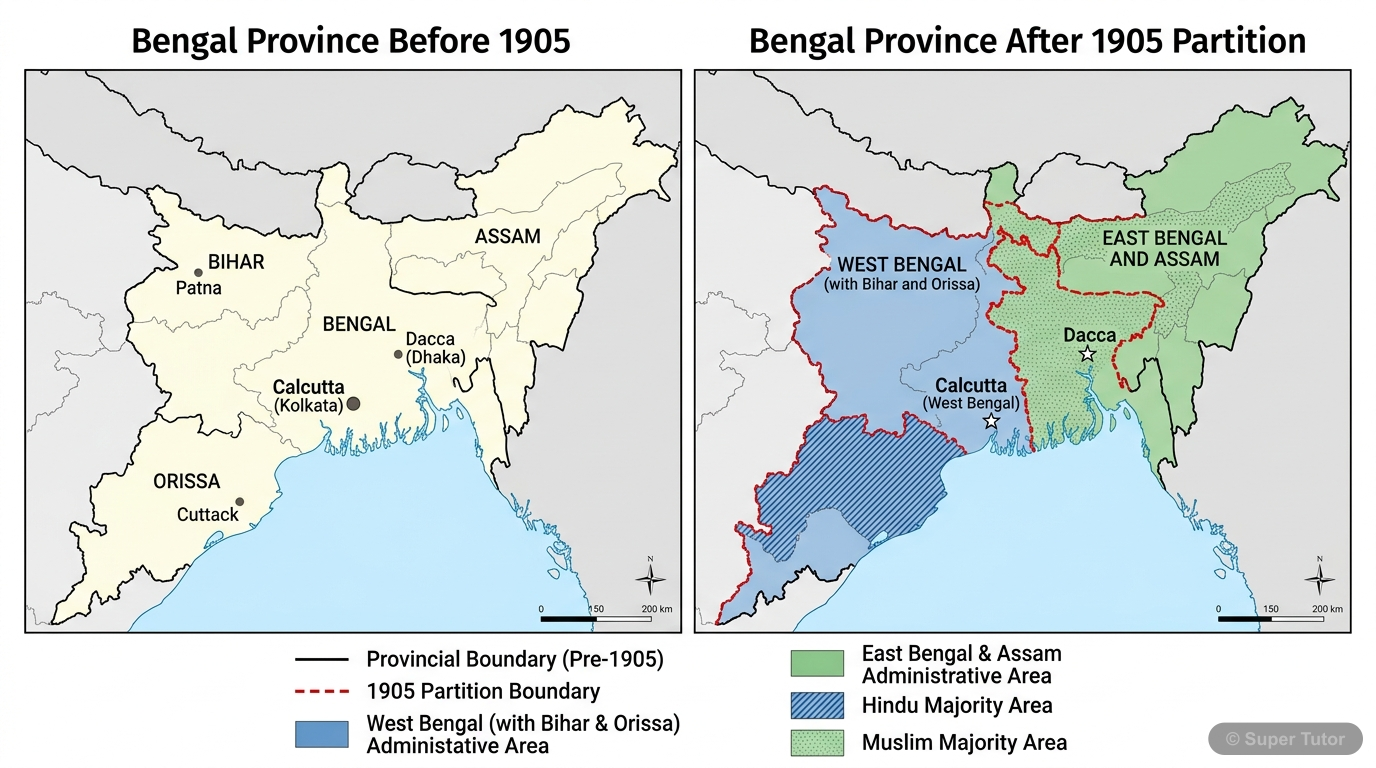
One of 4 illustrations for Growth of Nationalism Swadeshi Movement in Super Tutor — alongside flashcards, concept maps and practice questions.
Quick Quiz: Growth of Nationalism Swadeshi Movement
0/4Tap an answer to check it instantly. No sign-up needed for these 4.
Lord Curzon wrote to Hamilton on 18th November, 1900, expressing his wish regarding the Indian National Congress. Which of the following best represents his exact stated ambition?
The Risley Plan for the partition of Bengal was drafted in 1903. Who was H.H. Risley and what was his official position at that time?
Lord Curzon justified the partition of Bengal partly on the grounds of Muslim welfare. Which of the following statements ACCURATELY reflects Curzon's stated expectation about Dacca after partition?
The anti-partition movement crystallized into several phases. In the FIRST phase on 16th October 1905, which of the following was a specific song composed by Rabindranath Tagore for this occasion?
Sample Questions
Sumit Sarkar identifies a FUNDAMENTAL weakness of the Swadeshi Movement. Which of the following does he consider as that fundamental weakness?
Show answer
The movement's failure to involve peasants and the working class
Step 1: The chapter specifically attributes this view to Sumit Sarkar: 'Sumit Sarkar considers it as the fundamental weakness of the movement' — referring to the failure to involve peasants and workers. Step 2: The text explains that leaders never raised peasant issues like debts, evictions, forced labour, or exorbitant taxes. Step 3: Option A — the Surat split is mentioned as weakening the movement but not attributed to Sarkar as the 'fundamental' weakness. Step 4: Option C — the Hindu character causing Muslim alienation is cited as a separate cause of weakness, not identified as fundamental
According to the chapter, Lord George Hamilton suggested three means to counteract Congress activities in his letter to Lord Curzon on 1st May, 1899. Which of the following was NOT one of Hamilton's three suggested means?
Show answer
To ban all public meetings and assemblies organized by Congress members
Step 1: The text lists Hamilton's three means precisely: (1) Identify princes who fund Congress and warn them; (2) Prefer non-Congress members for honours and distinctions; (3) Exercise greater control over education and textbooks. Step 2: Option A is Hamilton's second suggestion — it is mentioned in the text. Step 3: Option B is Hamilton's third suggestion — also in the text. Step 4: Option D is Hamilton's first suggestion — directly from the text. Step 5: Option C — banning public meetings — was never suggested by Hamilton in his letter. This is a fabricated option designed to test careful r
The journal 'Sanjivani' first suggested the idea of boycott of British goods. Who was its editor and when was this suggestion made?
Show answer
Krishna Kumar Mitra, on 13th July 1905
Step 1: The text states: 'Krishna Kumar Mitra, the editor of the journal Sanjivani in its issue of 13th July, 1905, first suggested the idea of boycott of British goods, schools and colleges founded by the government.' Step 2: Option A is wrong — Bipin Chandra Pal edited 'New India' and is associated with criticism of Moderate policy, not the first boycott suggestion. Step 3: Option B is wrong — Aurobindo Ghose wrote in 'Bande Mataram' and declared in 1907 about ending British rule, but he did not first suggest boycott. Step 4: Option D confuses the person — Lal Mohan Ghosh expressed hope in A
The Bengal Technical Institute founded during the Swadeshi Movement is now known by which name?
Show answer
Jadavpur University
Step 1: The text explicitly states: 'During this time, the Bengal Technical Institute was founded. This is now known as the modern Jadavpur University.' Step 2: Option A — Presidency University evolved from Presidency College, which has a different historical origin unrelated to the Swadeshi Movement's technical education initiatives. Step 3: Option C — Calcutta University was established in 1857 and was actually attacked by Curzon's University Act of 1904; it is not the institution founded during Swadeshi. Step 4: Option D — IIT Kharagpur was established post-independence in 1951 and has no c
+41 more questions on Growth of Nationalism Swadeshi Movement (ICSE Class 11 History)
Practise AllFrequently Asked Questions
What are the important topics in Growth of Nationalism Swadeshi Movement for ICSE Class 11 History?
How many practice questions are there for Growth of Nationalism Swadeshi Movement?
Sources & Official References
Content is aligned to the official syllabus. Refer to the board website for the latest curriculum.
More resources for Growth of Nationalism Swadeshi Movement
Important Questions
Exam-style questions with answers
Revision Notes
Key points for last-minute revision
Chapter Summary
Understand the chapter at a glance
Concept Maps
See how topics connect
Study Plan
Step-by-step plan for this chapter
Flashcards
Quick-fire cards for active recall
Syllabus
What topics to cover
For serious students
Get the full Growth of Nationalism Swadeshi Movement chapter — start free.
Quizzes, flashcards, an AI doubt solver and a study plan for ICSE Class 11 History. Free to start, no card needed.