Gandhian Nationalism (1927-1937) — Practice Quiz
ICSE · Class 11 · History
Try a 4-question quiz on Gandhian Nationalism (1927-1937) for ICSE Class 11 History: tap an answer to check it and see why.
Interactive on Super Tutor
Studying Gandhian Nationalism (1927-1937)? Get the full interactive chapter.
Quizzes, flashcards, AI doubt-solver and a step-by-step study plan — built for practice quiz and more.
Free trial, no card needed.
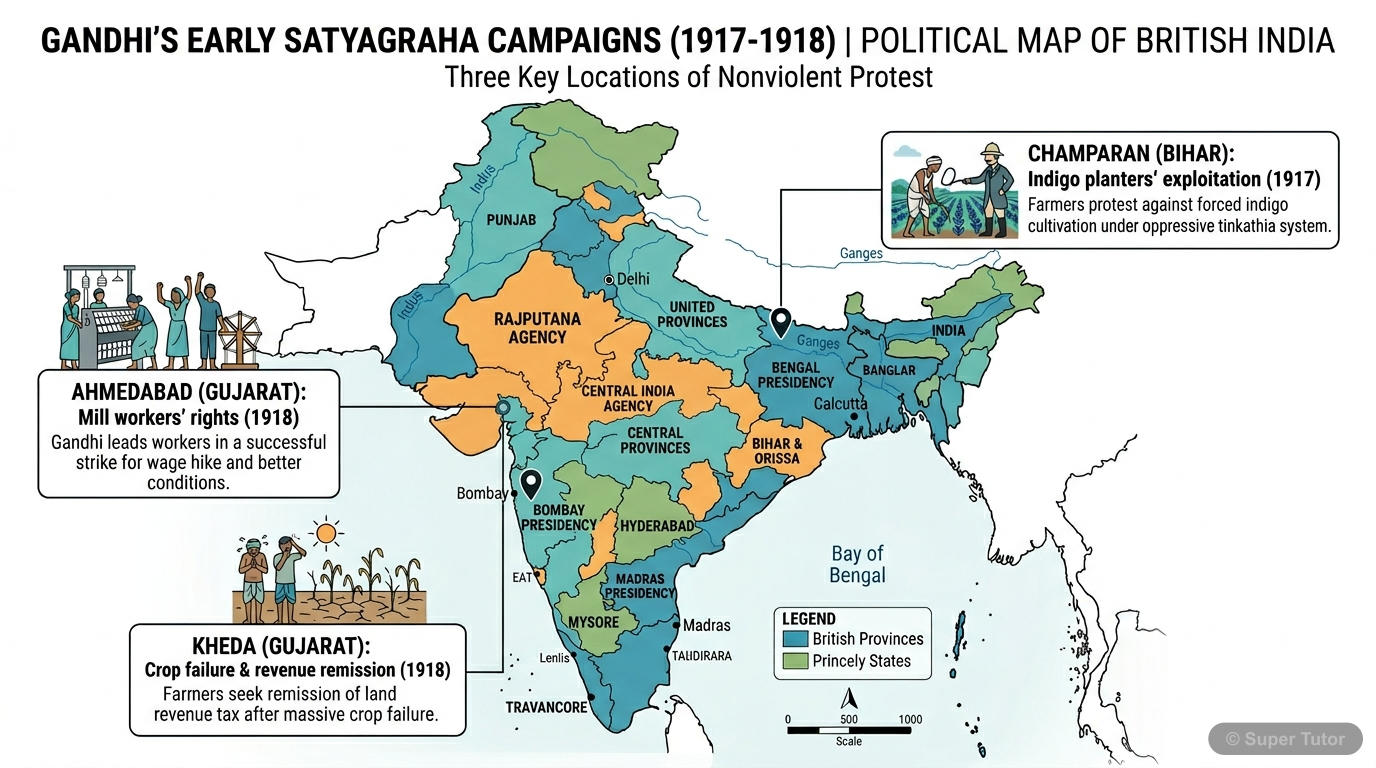
One of 3 illustrations for Gandhian Nationalism (1927-1937) in Super Tutor — alongside flashcards, concept maps and practice questions.
Quick Quiz: Gandhian Nationalism (1927-1937)
0/4Tap an answer to check it instantly. No sign-up needed for these 4.
Who was the President of the Simon Commission appointed in 1927?
Why was the Simon Commission boycotted by Indian political parties?
Which Indian leader died after being injured in a police lathi charge during the Simon Commission protests?
The Nehru Report was prepared under the chairmanship of which leader?
Sample Questions
What was the main demand of the Nehru Report (1928)?
Show answer
Dominion Status for India
Step 1: The Nehru Report was a draft constitution prepared by a committee headed by Motilal Nehru in 1928. Step 2: At this stage, the Congress was debating between Dominion Status and Complete Independence as the goal. Step 3: The Nehru Report demanded 'Dominion Status' for India, similar to Canada or Australia within the British Empire. Step 4: It was only later at the Lahore Session (1929) that the Congress officially shifted its demand to 'Poorna Swaraj' (Complete Independence). Step 5: Therefore, Dominion Status is the correct answer for what the Nehru Report demanded.
At which session of the Congress was 'Poorna Swaraj' (Complete Independence) declared as the goal?
Show answer
Lahore Session, 1929
Step 1: After the failure of the Gandhi-Irwin meeting in December 1929, where no assurance of Dominion Status was given, the Congress took a bold step. Step 2: At the Lahore Session of the Congress held in December 1929, presided over by Jawaharlal Nehru, a resolution was passed. Step 3: This resolution declared 'Poorna Swaraj' (Complete Independence) as the objective of the Congress. Step 4: Additionally, 26 January 1930 was fixed as the first Independence Day. Step 5: The Madras Session of 1927 had decided to boycott the Simon Commission, not declare Poorna Swaraj.
From which place did Gandhiji begin his historic Dandi March on 12 March 1930?
Show answer
Sabarmati Ashram
Step 1: After the Congress Working Committee authorised Gandhiji to launch Civil Disobedience, Gandhiji chose to break the Salt Law as the starting point of the movement. Step 2: On 12 March 1930, Gandhiji began his famous Dandi March from Sabarmati Ashram in Ahmedabad, Gujarat. Step 3: He marched to Dandi Beach on the seashore with 78 chosen followers. Step 4: On 6 April 1930, he reached Dandi and broke the Salt Law by making salt from seawater. Step 5: Wardha and Sevagram are also associated with Gandhiji but are located in Maharashtra — Sabarmati is in Gujarat.
Why did Gandhiji choose the Salt Law as the central issue of the Civil Disobedience Movement?
Show answer
The salt tax was a symbol of imperial exploitation that affected every Indian
Step 1: Gandhiji needed a cause that would unite all Indians — rich and poor, Hindu and Muslim, men and women. Step 2: Salt was something that every single Indian used daily, regardless of religion, caste, or class. Step 3: Gandhiji regarded the salt tax as a 'true index of inhuman oppression' because even the poorest Indian had to pay this tax on a basic necessity. Step 4: Under the Salt Laws, making salt was a government monopoly — Indians could not even make their own salt from the sea. Step 5: This made it a powerful symbol against British exploitation, making every Indian a potential part
+41 more questions on Gandhian Nationalism (1927-1937) (ICSE Class 11 History)
Practise AllFrequently Asked Questions
What are the important topics in Gandhian Nationalism (1927-1937) for ICSE Class 11 History?
How many practice questions are there for Gandhian Nationalism (1927-1937)?
Sources & Official References
Content is aligned to the official syllabus. Refer to the board website for the latest curriculum.
More resources for Gandhian Nationalism (1927-1937)
Important Questions
Exam-style questions with answers
Revision Notes
Key points for last-minute revision
Chapter Summary
Understand the chapter at a glance
Concept Maps
See how topics connect
Study Plan
Step-by-step plan for this chapter
Flashcards
Quick-fire cards for active recall
Syllabus
What topics to cover
For serious students
Get the full Gandhian Nationalism (1927-1937) chapter — start free.
Quizzes, flashcards, an AI doubt solver and a study plan for ICSE Class 11 History. Free to start, no card needed.