The First World War 1914-18 — Practice Quiz
ICSE · Class 11 · History
Try a 4-question quiz on The First World War 1914-18 for ICSE Class 11 History: tap an answer to check it and see why.
Interactive on Super Tutor
Studying The First World War 1914-18? Get the full interactive chapter.
Quizzes, flashcards, AI doubt-solver and a step-by-step study plan — built for practice quiz and more.
Free trial, no card needed.
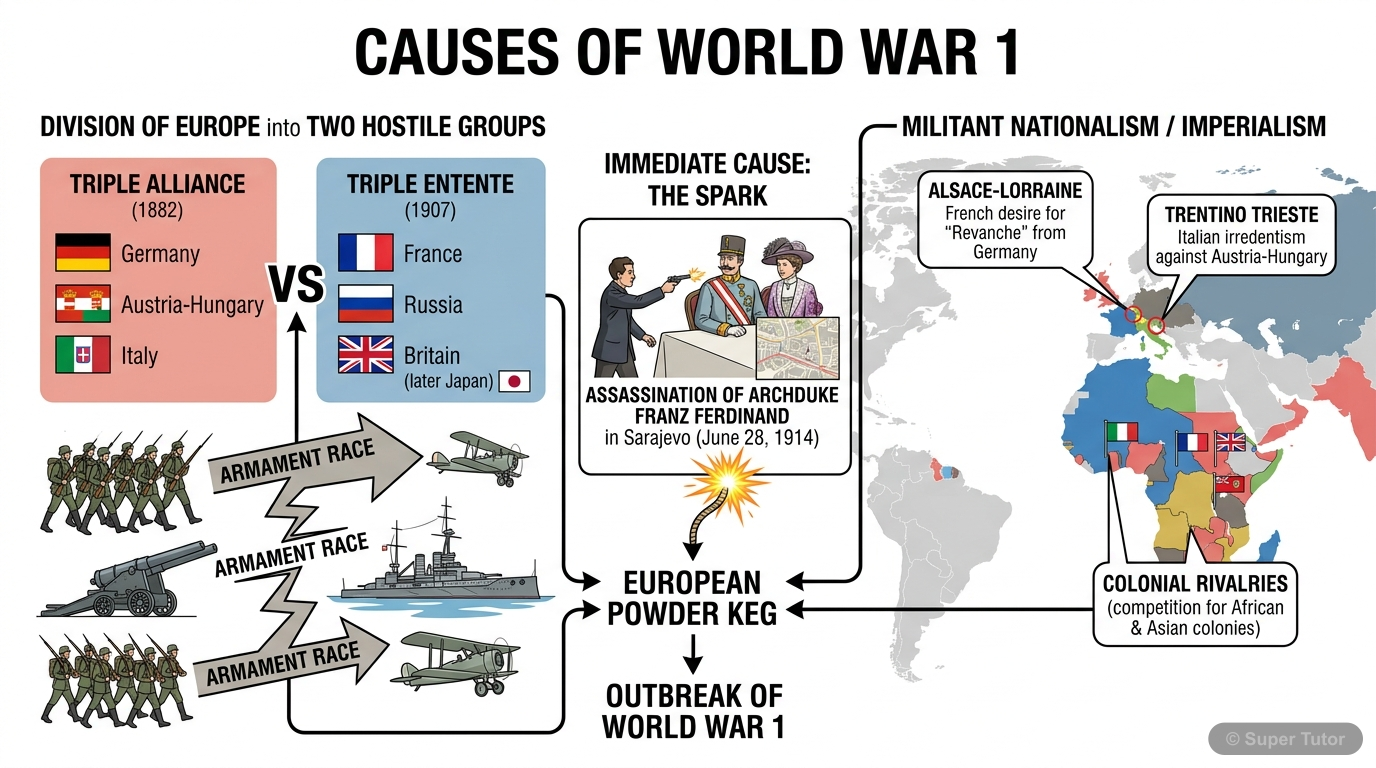
Learn better with visuals Super Tutor pairs illustrations like this with notes and quizzes for The First World War 1914-18.
Quick Quiz: The First World War 1914-18
0/4Tap an answer to check it instantly. No sign-up needed for these 4.
Which specific secret clause was included in the Anglo-French Convention (Entente Cordiale) of 1904 that was NOT openly declared?
The German gunboat 'Panther' was sent to which Moroccan port during the Agadir Crisis, which nearly triggered a war between France and Germany?
According to J.A. Hobson's theory of imperialism in his book 'Imperialism — A Study', what was the PRIMARY reason capitalists pushed governments to acquire colonies?
The Franco-Russian Military Convention of 1894 was negotiated by which French statesman, who later also played a key role in bringing England into the Entente?
Sample Questions
According to the Dual Alliance between Germany and Austria (mentioned in the chapter), what was Austria-Hungary's specific obligation if France attacked Germany with the help of a third power?
Show answer
Austria would remain neutral during a Franco-German conflict but would join Germany if France was helped by a third power
Step 1: The Dual Alliance was signed in 1878 between Germany and Austria-Hungary. Step 2: Under this alliance, Germany and Austria promised to help each other against Russia. Step 3: However, for a Franco-German conflict, Austria's role was conditional — Austria would REMAIN NEUTRAL in a direct Franco-German war. Step 4: BUT if France was helped by a THIRD POWER (meaning Russia), then Austria would join Germany in the war. Step 5: This is a nuanced distinction — Austria was not automatically obligated to fight France, only if a third power intervened on France's side. Options A, C, and D misre
Which historian, cited in the chapter, stated that 'what British industry took half a century to develop, Germany developed within a decade,' highlighting Germany's rapid industrial growth?
Show answer
Trebilcock
Step 1: The chapter describes Germany's extraordinary industrial growth in comparison to Britain. Step 2: To illustrate this, the historian Trebilcock is specifically quoted as saying 'what British industry took half a century to develop, Germany developed within a decade.' Step 3: This quote emphasizes how rapidly Germany industrialized, which also explains why Germany was so eager to find new colonial markets and resources. Step 4: David Thompson is mentioned as a scholar who partially rejected Marxian views on colonial rivalry. Trietschke was a German historian who preached Teutonic racial
Lenin's book 'Imperialism, the Highest Stage of Capitalism' argued that imperial expansion was inevitable in capitalist societies. According to the chapter, which scholar PARTIALLY rejected the Marxian view on colonial rivalry?
Show answer
David Thompson
Step 1: Lenin argued in his book that mill owners produce goods in excess, forcing governments to acquire colonies for surplus goods, labor, and raw materials. Step 2: J.A. Hobson had earlier presented a similar economic explanation of imperialism in 'Imperialism — A Study.' Step 3: However, the chapter specifically states that 'recently scholars like David Thompson partially reject the Marxian view.' Step 4: David Thompson's argument was that most colonial disputes were actually settled by 1907 — before the war broke out — and that colonial rivalry was merely a reflection of basic European gr
The 'Triple Entente' was formed through THREE separate treaties. Which of the following correctly lists ALL THREE treaties and their years in the right order of signing?
Show answer
Franco-Russian Convention (1894), Anglo-French Convention (1904), Anglo-Russian Convention (1907)
Step 1: The chapter explicitly states: 'Thus three treaties, the Franco-Russian Convention of 1894, the Anglo-French Convention of 1904 and the Anglo-Russian Convention of 1807 (1907) made the famous Triple Entente.' Step 2: The FIRST treaty was the Franco-Russian Convention of 1894, negotiated by French Minister Delcasse with Czarist Russia, forming a bloc against Germany. Step 3: The SECOND was the Anglo-French Convention (Entente Cordiale) of 1904, settling colonial disputes between England and France. Step 4: The THIRD was the Anglo-Russian Convention of 1907, which settled outstanding dis
+41 more questions on The First World War 1914-18 (ICSE Class 11 History)
Practise AllFrequently Asked Questions
What are the important topics in The First World War 1914-18 for ICSE Class 11 History?
How many practice questions are there for The First World War 1914-18?
Sources & Official References
Content is aligned to the official syllabus. Refer to the board website for the latest curriculum.
More resources for The First World War 1914-18
Important Questions
Exam-style questions with answers
Revision Notes
Key points for last-minute revision
Chapter Summary
Understand the chapter at a glance
Concept Maps
See how topics connect
Study Plan
Step-by-step plan for this chapter
Flashcards
Quick-fire cards for active recall
Syllabus
What topics to cover
For serious students
Get the full The First World War 1914-18 chapter — start free.
Quizzes, flashcards, an AI doubt solver and a study plan for ICSE Class 11 History. Free to start, no card needed.