Gandhian Nationalism (1916-1922) — Practice Quiz
ICSE · Class 11 · History
Try a 4-question quiz on Gandhian Nationalism (1916-1922) for ICSE Class 11 History: tap an answer to check it and see why.
Interactive on Super Tutor
Studying Gandhian Nationalism (1916-1922)? Get the full interactive chapter.
Quizzes, flashcards, AI doubt-solver and a step-by-step study plan — built for practice quiz and more.
Free trial, no card needed.
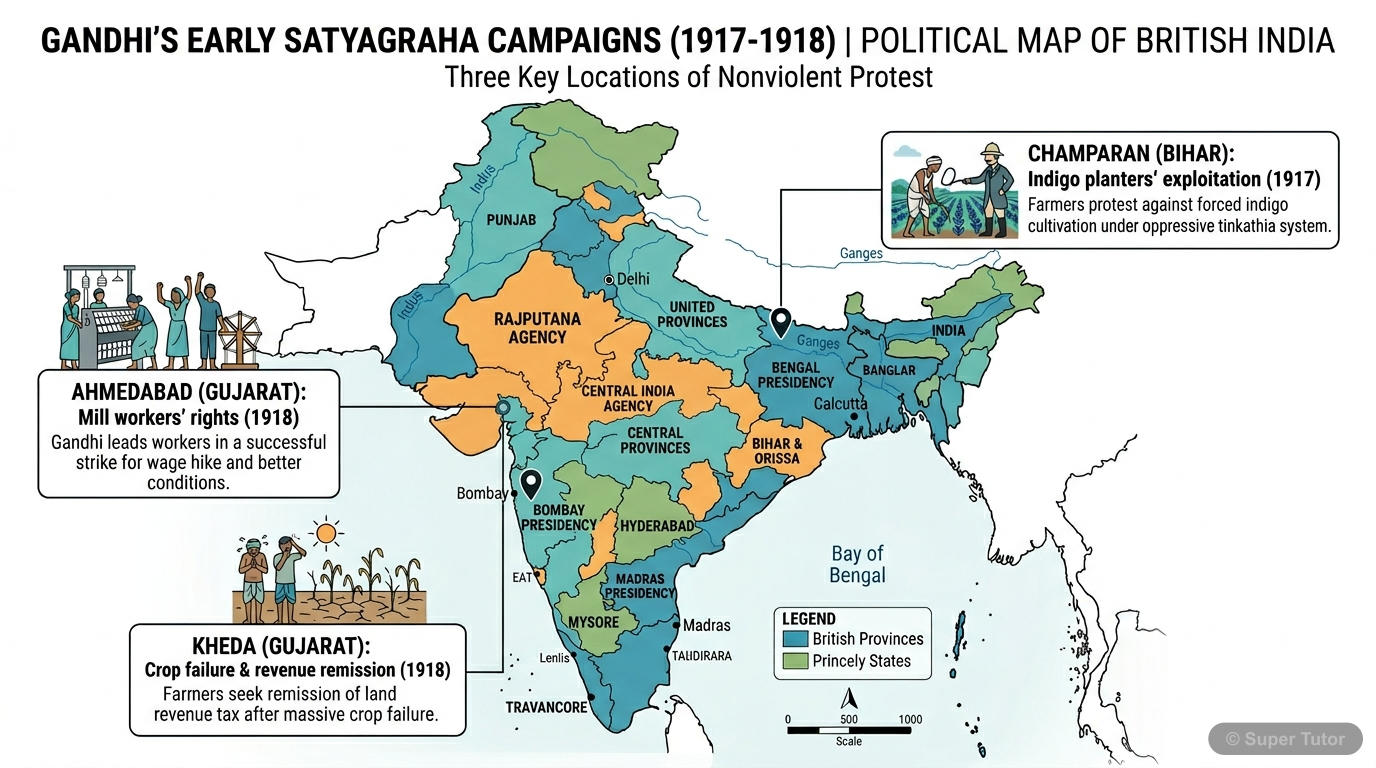
One of 4 illustrations for Gandhian Nationalism (1916-1922) in Super Tutor — alongside flashcards, concept maps and practice questions.
Quick Quiz: Gandhian Nationalism (1916-1922)
0/4Tap an answer to check it instantly. No sign-up needed for these 4.
In which year did Mahatma Gandhi return to India from South Africa?
The Rowlatt Act committee was chaired by which person?
Mahatma Gandhi described the Rowlatt Act as providing 'No appeal, No Vakil and No ___'.
On which date was the hartal observed all over India against the Rowlatt Act?
Sample Questions
The Jallianwala Bagh massacre took place on which date?
Show answer
13 April 1919
Step 1: This is one of the most important dates in India's freedom struggle. Step 2: The chapter clearly states that 'people defiantly assembled at Jallianwala Bagh on 13th April 1919.' Step 3: 10 April is wrong — that is the date when local leaders Dr. Kichlew and Dr. Satyapal were arrested, which triggered the protest. Step 4: 6 April is wrong — that is the date of the national hartal against the Rowlatt Act. Step 5: 13 March is completely unrelated to these events. General Dyer ordered troops to fire on the unarmed crowd on 13 April, killing 379 people officially (many more unofficially).
Who ordered the troops to fire on the unarmed crowd at Jallianwala Bagh?
Show answer
General Dyer
Step 1: The question tests knowledge of who directly gave the order for firing at Jallianwala Bagh. Step 2: The chapter states 'General Dyer ordered his troops to start firing without any warning on the unarmed crowd.' Step 3: Sir Michael O'Dwyer is wrong — he was the military governor of Punjab who had used brutal methods to recruit soldiers, but he did not give the order to fire at Jallianwala Bagh. Step 4: Lord Chelmsford is wrong — he was the Viceroy, and Rabindranath Tagore wrote his famous letter to him. Step 5: Justice Rowlatt is wrong — he was involved with the repressive law, not the
Which famous poet renounced his Knighthood in protest against the Jallianwala Bagh massacre?
Show answer
Rabindranath Tagore
Step 1: The question tests knowledge of who protested the Jallianwala Bagh massacre by giving up a British honour. Step 2: The chapter states 'The great poet Rabindranath Tagore renounced his honourable title of Knighthood in protest against this barbarous act.' Step 3: Tagore wrote a powerful letter to Viceroy Lord Chelmsford explaining his reasons, which was published in The Statesman on June 3, 1919. Step 4: Bankim Chandra Chatterjee is wrong — he had died in 1894, long before this event. Step 5: Subramania Bharati and Sarojini Naidu, though great poets and nationalists, did not renounce a
What was the main demand of the Khilafat Movement?
Show answer
Restoration of the Khalifa's position and control over Muslim holy places
Step 1: The Khilafat Movement was a Muslim religious-political movement that arose after World War I. Step 2: The chapter states the main demands were: '(1) Khalifa's control should be retained over the Muslim sacred places and (2) In territorial adjustments after war, the Khalifa should be left with sufficient territories.' Step 3: Independence of India was the goal of the broader national movement, not specifically the Khilafat Movement. Step 4: A separate Muslim homeland (Pakistan) was demanded much later in 1940 under the Lahore Resolution. Step 5: Removal of the Rowlatt Act was Gandhi's d
+41 more questions on Gandhian Nationalism (1916-1922) (ICSE Class 11 History)
Practise AllFrequently Asked Questions
What are the important topics in Gandhian Nationalism (1916-1922) for ICSE Class 11 History?
How many practice questions are there for Gandhian Nationalism (1916-1922)?
Sources & Official References
Content is aligned to the official syllabus. Refer to the board website for the latest curriculum.
More resources for Gandhian Nationalism (1916-1922)
Important Questions
Exam-style questions with answers
Revision Notes
Key points for last-minute revision
Chapter Summary
Understand the chapter at a glance
Concept Maps
See how topics connect
Study Plan
Step-by-step plan for this chapter
Flashcards
Quick-fire cards for active recall
Syllabus
What topics to cover
For serious students
Get the full Gandhian Nationalism (1916-1922) chapter — start free.
Quizzes, flashcards, an AI doubt solver and a study plan for ICSE Class 11 History. Free to start, no card needed.