Growth of Nationalism Swadeshi Movement — Revision Notes
ICSE · Class 11 · History
Growth of Nationalism Swadeshi Movement revision notes for ICSE Class 11 History: 4 topics in quick points. Part of the ICSE Class 11 History syllabus.
Interactive on Super Tutor
Studying Growth of Nationalism Swadeshi Movement? Get the full interactive chapter.
Quizzes, flashcards, AI doubt-solver and a step-by-step study plan — built for revision notes and more.
Free trial, no card needed.
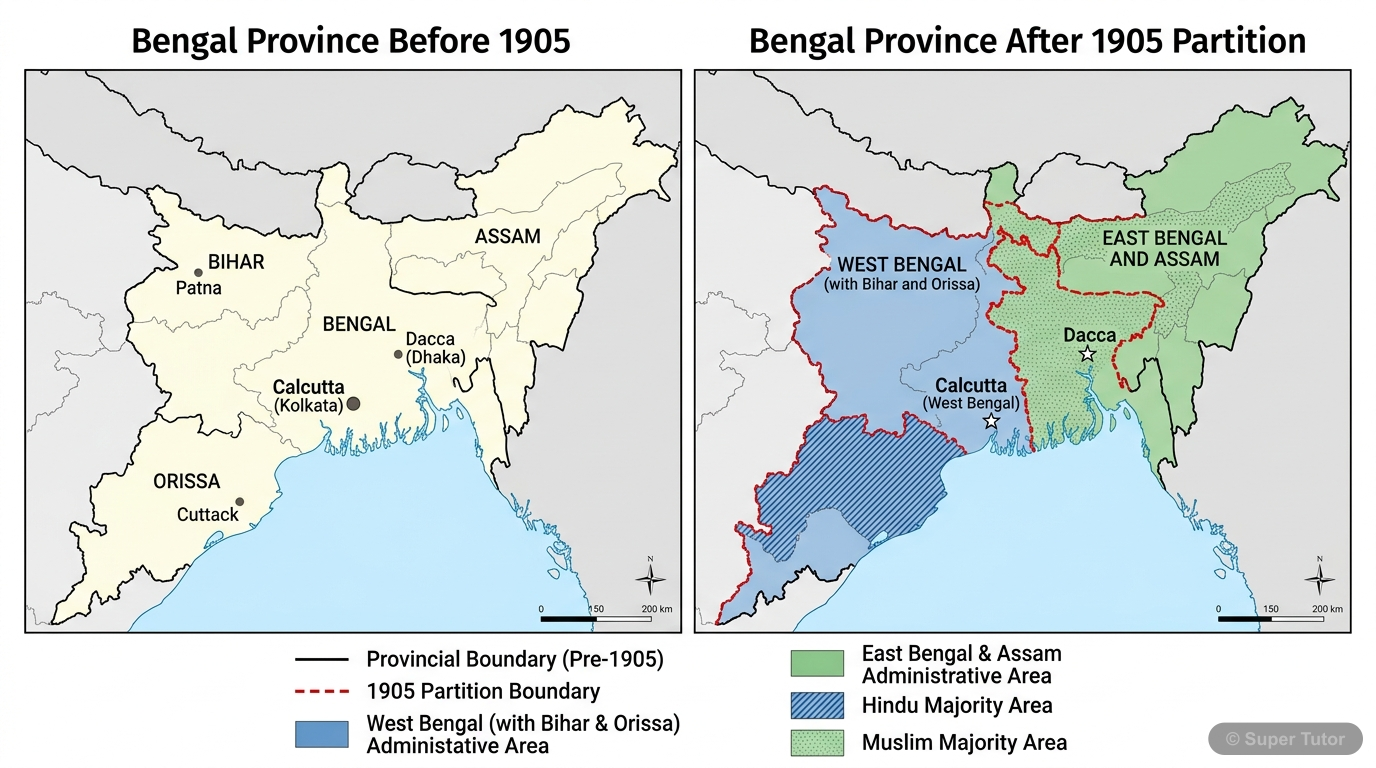
One of 4 illustrations for Growth of Nationalism Swadeshi Movement in Super Tutor — alongside flashcards, concept maps and practice questions.
Key Topics to Revise
Background of Indian Nationalism
- The Indian Renaissance of the nineteenth century created a new spirit and vigour among Indians.
- It first influenced literature, education, and thinking, and later affected religion and society.
- R.C. Majumder linked the growth of nationalism with personalities such as Surendranath Banerjee, Ranade, and Gokhale.
Curzon’s Policies and the Partition of Bengal
- Lord Curzon was a staunch imperialist and had no respect for Congress.
- Lord George Hamilton wrote to Curzon on 1 May 1899 suggesting three means to counteract Congress activities.
- Curzon replied in 1900 that his ambition was to assist the Congress to peaceful demise.
Anti-Partition Movement: Main Phases
- The anti-partition movement developed in four phases, later described as five phases.
- The first phase began with protest, hartal, and public demonstrations.
- On 16 October, people observed hartal, took bath in the Ganga, sang Banglar Mati, Banglar Jal, and tied raksha bandhan threads.
Spread, Leadership, and Constructive Work
- The movement spread beyond speeches into social and economic life.
- Students became active volunteers and helped in picketing and propaganda.
- Many organisations were formed to spread nationalist work.
Get complete notes with diagrams and examples
Full NotesKey Concepts
Frequently Asked Questions
What are the important topics in Growth of Nationalism Swadeshi Movement for ICSE Class 11 History?
How should I revise Growth of Nationalism Swadeshi Movement for Class 11 exams?
Sources & Official References
Content is aligned to the official syllabus. Refer to the board website for the latest curriculum.
More resources for Growth of Nationalism Swadeshi Movement
For serious students
Get the full Growth of Nationalism Swadeshi Movement chapter — start free.
Quizzes, flashcards, an AI doubt solver and a study plan for ICSE Class 11 History. Free to start, no card needed.