Growth of Nationalism Swadeshi Movement — Chapter Summary
ICSE · Class 11 · History
Summary of Growth of Nationalism Swadeshi Movement for ICSE Class 11 History. Part of the ICSE Class 11 History syllabus.
Interactive on Super Tutor
Studying Growth of Nationalism Swadeshi Movement? Get the full interactive chapter.
Quizzes, flashcards, AI doubt-solver and a step-by-step study plan — built for chapter summary and more.
Free trial, no card needed.
One of 4 illustrations for Growth of Nationalism Swadeshi Movement in Super Tutor — alongside flashcards, concept maps and practice questions.
Overview
The rise of nationalism in India gained strength through political awakening, constitutional agitation, and public protest against Curzon’s policies. Lord Curzon’s attack on self-government, education, and the proposed Partition of Bengal created a strong anti-partition response. The movement develo
Key Concepts
Indian nationalism grew through the work
Indian nationalism grew through the work of political leaders, social reformers, writers, and journalists. Figures like Surendranath Banerjee, Ranade,
Raja Rammohan Roy began a line
Raja Rammohan Roy began a line of political protest based on petitions, memorials, and legal opposition. This early method influenced later political
Congress leaders in the early phase
Congress leaders in the early phase followed prayer and petition. They used constitutional methods and hoped to persuade the British government throug
Lord Curzon reduced elected members
Lord Curzon reduced elected members in the Calcutta Corporation through the Municipality Act of 1899 and reduced elected Senate members in Calcutta Un
The partition was announced on 20
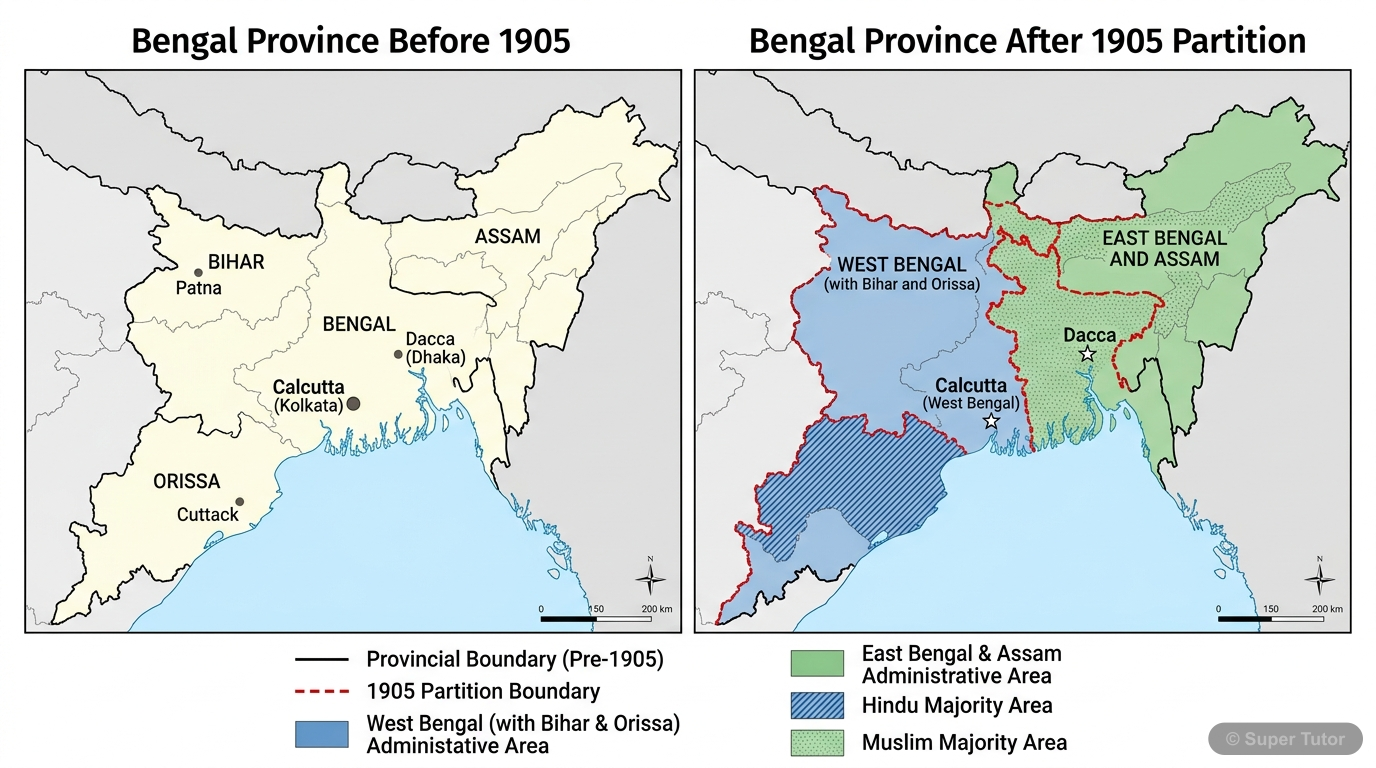
The partition was announced on 20 July 1905 and implemented on 16 October 1905. Bengal was divided into Bengal and Eastern Bengal and Assam. The state
Learning Objectives
- Understand the growth of Indian nationalism before and during the Swadeshi Movement
- Explain Curzon’s policies and the motives behind the Partition of Bengal
- Describe the different phases of the anti-partition movement
- Distinguish between boycott and swadeshi as negative and constructive methods
- Identify major leaders, organizations, and journals connected with the movement
Frequently Asked Questions
What are the important topics in Growth of Nationalism Swadeshi Movement for ICSE Class 11 History?
How should I revise Growth of Nationalism Swadeshi Movement for Class 11 exams?
Sources & Official References
Content is aligned to the official syllabus. Refer to the board website for the latest curriculum.
More resources for Growth of Nationalism Swadeshi Movement
For serious students
Get the full Growth of Nationalism Swadeshi Movement chapter — start free.
Quizzes, flashcards, an AI doubt solver and a study plan for ICSE Class 11 History. Free to start, no card needed.