The First World War 1914-18 — Study Plan
ICSE · Class 11 · History
A step-by-step study plan for The First World War 1914-18, ICSE Class 11 History: what to learn first, what to practise and when to revise.
Interactive on Super Tutor
Studying The First World War 1914-18? Get the full interactive chapter.
Quizzes, flashcards, AI doubt-solver and a step-by-step study plan — built for study plan and more.
Free trial, no card needed.
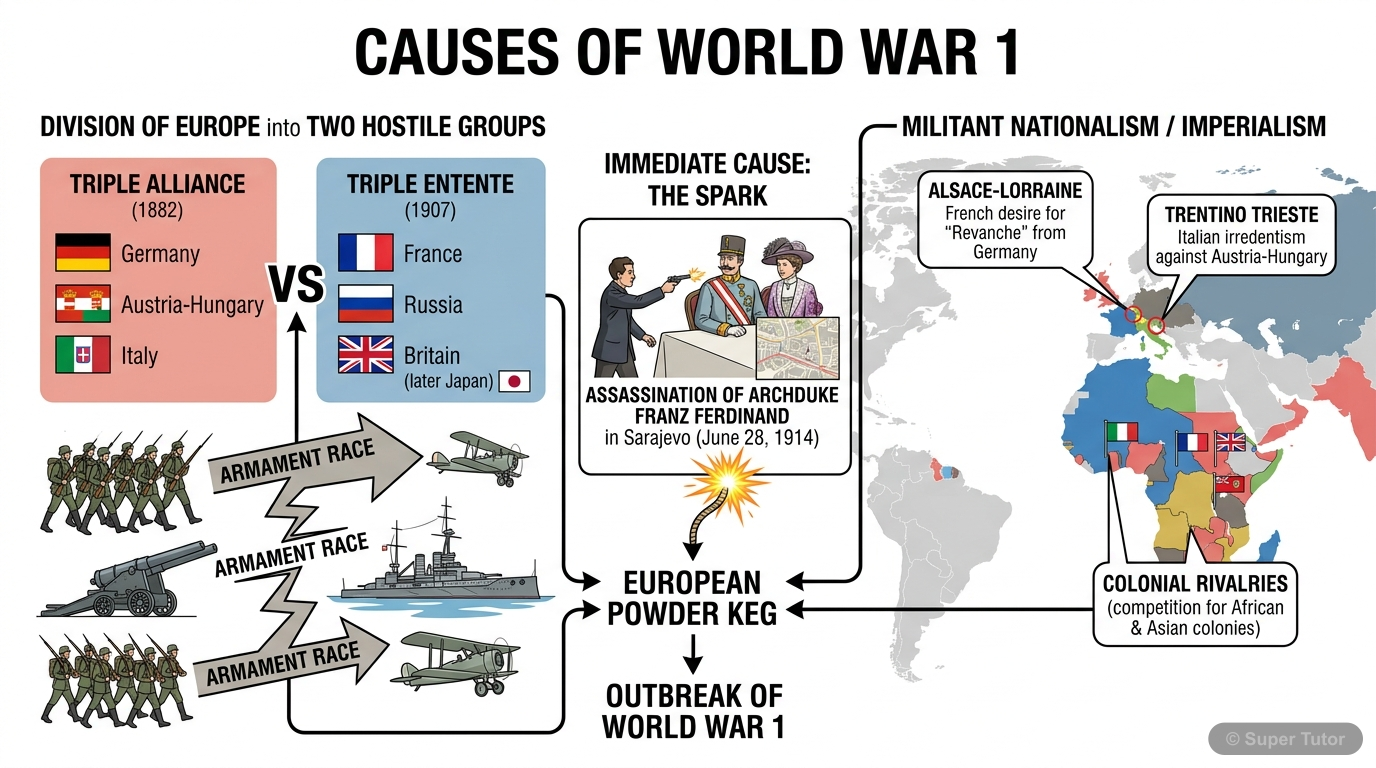
Learn better with visuals Super Tutor pairs illustrations like this with notes and quizzes for The First World War 1914-18.
Study Plan
Learn the Theory
Read the textbook chapter carefully. Note down definitions, formulas and key ideas. Focus on: Europe on the Eve of the War, Rise of Triple Entente, Balkan Tensions and the Immediate Outbreak of War.
Practise
Solve the textbook exercises and extra practice questions. There are 45 questions available for this chapter.
Revise & Test
Revise key points without looking at your notes. Take a practice quiz and mark weak areas for another pass.
Spaced Revision
Come back to The First World War 1914-18 after a week. Use flashcards for quick recall and try past exam questions on this chapter.
What to Focus On
- Europe had twenty independent states in 1900, and seven were great powers.
- Britain was the strongest power because of its navy, trade, and empire.
- Germany and Italy were new powers seeking colonies and greater influence.
- Aggressive nationalism made nations feel superior to others.
- War was often glorified as a noble duty of the state.
- Insurgent nationalism grew from the French Revolution and the suppression of national movements.
- Bismarck built the Dual Alliance in 1878 to keep France isolated and protect Germany and Austria.
- Kaiser William II turned Bismarck’s defensive alliance into a more aggressive policy.
- The Triple Alliance included Germany, Austria-Hungary, and Italy, with support from Turkey, Rumania, and Bulgaria.
Common Mistakes to Avoid
The assassination of Ferdinand and Sophia was only a minor incident and not the real trigger of the war.
The Triple Entente was the same as the Triple Alliance, just another name for the two camps in Europe.
The Triple Entente was formed only in 1904 with Britain, France, and Russia at the same time.
Memory Tips
Europe in 1900 had twenty independent states and seven great powers
England followed splendid isolation after the Crimean War
Kaiser William II changed Bismarck's defensive Triple Alliance into an aggressive one
Triple Entente was formed by Franco-Russian Convention, Anglo-French Convention, and Anglo-Russian Convention
Want a personalised study plan?
Super Tutor builds a day-by-day plan for ICSE Class 11 History that fits your exam date and pace.
Create My Study PlanFrequently Asked Questions
What are the important topics in The First World War 1914-18 for ICSE Class 11 History?
How should I revise The First World War 1914-18 for Class 11 exams?
Sources & Official References
Content is aligned to the official syllabus. Refer to the board website for the latest curriculum.
More resources for The First World War 1914-18
Practice Quiz
Test yourself with a quick quiz
Important Questions
Exam-style questions with answers
Revision Notes
Key points for last-minute revision
Chapter Summary
Understand the chapter at a glance
Concept Maps
See how topics connect
Flashcards
Quick-fire cards for active recall
Syllabus
What topics to cover
For serious students
Get the full The First World War 1914-18 chapter — start free.
Quizzes, flashcards, an AI doubt solver and a study plan for ICSE Class 11 History. Free to start, no card needed.