Chapter 7 of 13
Revision Notes
The First World War 1914-18 — Revision Notes
ICSE · Class 11 · History
The First World War 1914-18 revision notes for ICSE Class 11 History: 4 topics in quick points. Part of the ICSE Class 11 History syllabus.
45 questions40 flashcards5 concepts
Interactive on Super Tutor
Studying The First World War 1914-18? Get the full interactive chapter.
Quizzes, flashcards, AI doubt-solver and a step-by-step study plan — built for revision notes and more.
Free trial, no card needed.
Super Tutor
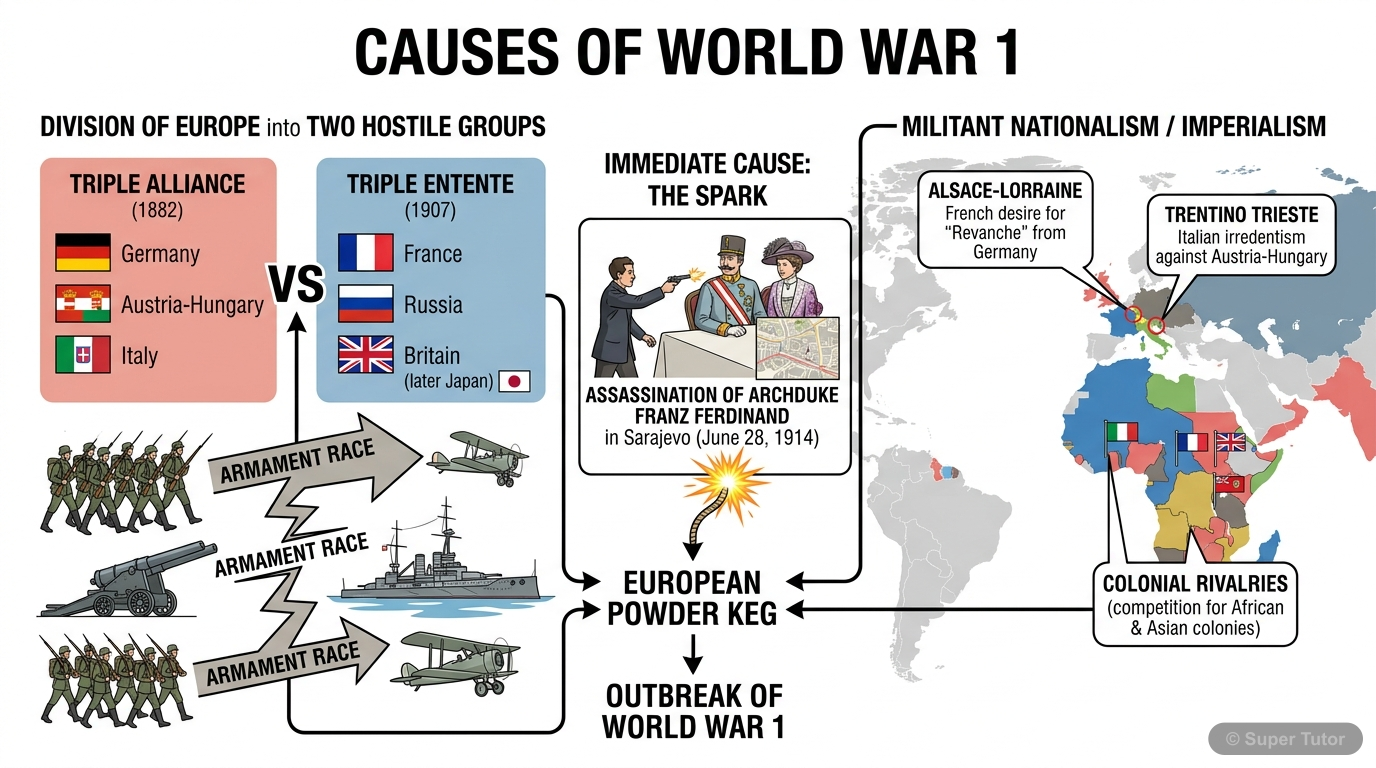
Learn better with visuals Super Tutor pairs illustrations like this with notes and quizzes for The First World War 1914-18.
Key Topics to Revise
1
Europe on the Eve of the War
- In 1900 Europe had twenty independent states, and seven were great powers.
- The seven great powers were Russia, Germany, Austria-Hungary, England, France, Italy, and the Turkish empire.
- England was the strongest power and followed splendid isolation since the end of the Crimean War.
2
Rise of Triple Entente
- Kaiser William II renounced Bismarck's defensive Triple Alliance and converted it into an aggressive alliance.
- Kaiser William II pursued naval expansion and colonial ambitions and made provocative remarks about Germany needing colonies.
- Bismarck had originally built the Triple Alliance as a defensive arrangement and had kept France isolated.
3
Balkan Tensions and the Immediate Outbreak of War
- Balkan nationalism was a major issue in the Eastern Question.
- Balkan nationalists wanted freedom from Turkish rule.
- Slav nationalists wanted merger with Serbia.
4
Underlying Causes of the War
- The war had four underlying causes: aggressive nationalism, economic rivalry and neo-imperialism, formation of alliances, and armament race.
- Aggressive nationalism made people proud of their own nation and hostile to others.
- In Germany, thinkers preached the superiority of the Teutonic race.
Get complete notes with diagrams and examples
Full NotesKey Concepts
Europe had twenty independent statesEngland followed a policy of splendidMilitant nationalism encouraged pride in oneIndustrial powers competed for coloniesThe Triple Entente brought together France
Frequently Asked Questions
What are the important topics in The First World War 1914-18 for ICSE Class 11 History?
Key topics in The First World War 1914-18 include Europe on the Eve of the War, Rise of Triple Entente, Balkan Tensions and the Immediate Outbreak of War, Underlying Causes of the War. Study these first, then practise questions on each for Class 11 exams.
How should I revise The First World War 1914-18 for Class 11 exams?
Learn the core ideas first, then work through the 45 practice questions on The First World War 1914-18. Revise definitions regularly and use flashcards for quick recall before the exam.
Sources & Official References
Content is aligned to the official syllabus. Refer to the board website for the latest curriculum.
More resources for The First World War 1914-18
For serious students
Get the full The First World War 1914-18 chapter — start free.
Quizzes, flashcards, an AI doubt solver and a study plan for ICSE Class 11 History. Free to start, no card needed.