Gandhian Nationalism (1916-1922) — Study Plan
ICSE · Class 11 · History
A step-by-step study plan for Gandhian Nationalism (1916-1922), ICSE Class 11 History: what to learn first, what to practise and when to revise.
Interactive on Super Tutor
Studying Gandhian Nationalism (1916-1922)? Get the full interactive chapter.
Quizzes, flashcards, AI doubt-solver and a step-by-step study plan — built for study plan and more.
Free trial, no card needed.
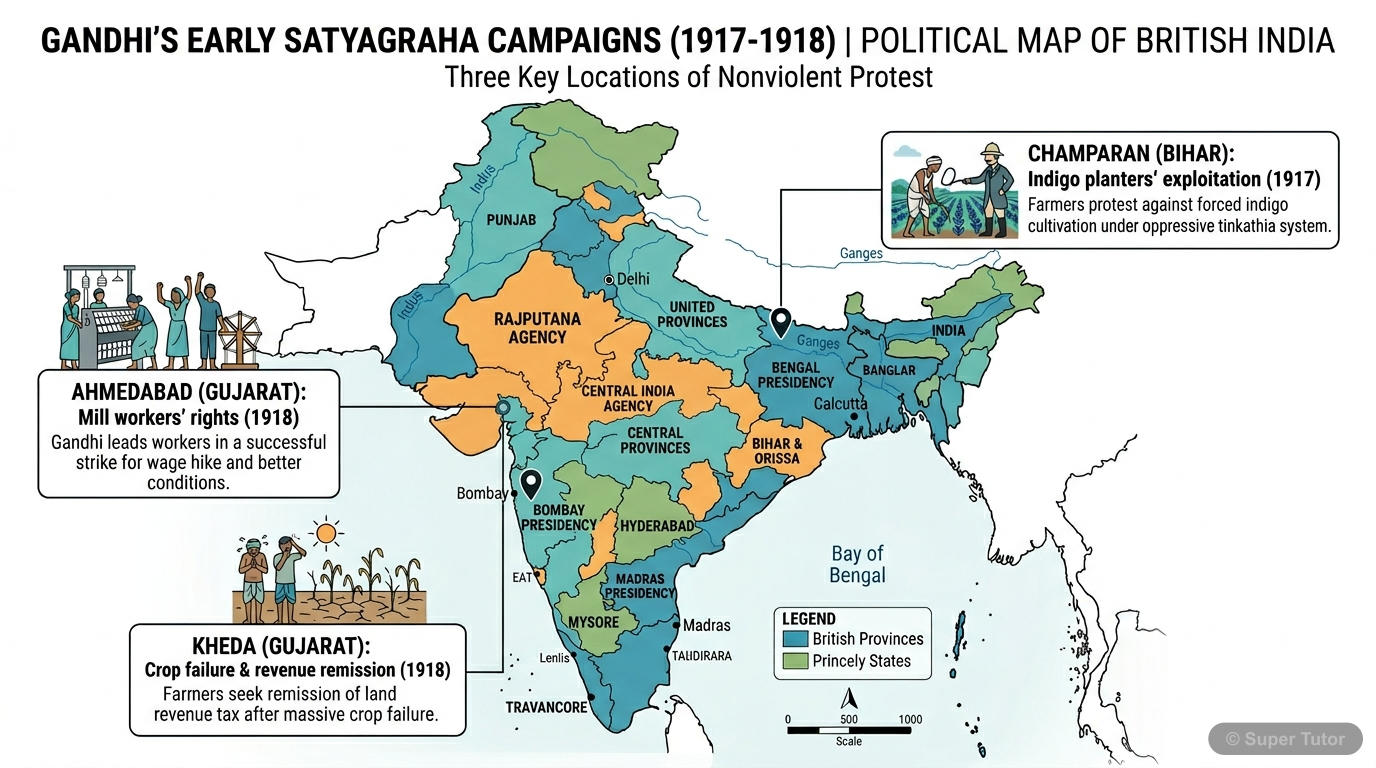
One of 4 illustrations for Gandhian Nationalism (1916-1922) in Super Tutor — alongside flashcards, concept maps and practice questions.
Study Plan
Learn the Theory
Read the textbook chapter carefully. Note down definitions, formulas and key ideas. Focus on: 1. Gandhiji's Entry and Satyagraha, 2. Rowlatt Act and Rowlatt Satyagraha, 1919, 3. Jallianwala Bagh Massacre and Its Impact.
Practise
Solve the textbook exercises and extra practice questions. There are 45 questions available for this chapter.
Revise & Test
Revise key points without looking at your notes. Take a practice quiz and mark weak areas for another pass.
Spaced Revision
Come back to Gandhian Nationalism (1916-1922) after a week. Use flashcards for quick recall and try past exam questions on this chapter.
What to Focus On
- Gandhi introduced passive resistance and Satyagraha from South Africa.
- Satyagraha was based on truth, suffering, and non-violence.
- The Satyagraha Sabha was formed in Bombay on 24 February 1919.
- The Rowlatt Committee worked under Justice Sydney Rowlatt in 1917.
- The Rowlatt Act allowed detention without trial for up to two years.
- The hartal date changed from 30 March to 6 April 1919.
- Dr. Kichlew and Dr. Satyapal were arrested on 10 April 1919.
- The Jallianwala Bagh massacre took place on 13 April 1919.
- General Dyer ordered firing without warning on an unarmed crowd.
Common Mistakes to Avoid
The Rowlatt Act was a normal reform law that gave Indians more freedom after the war.
The Rowlatt agitation started only after the Jallianwala Bagh massacre.
The Jallianwala Bagh crowd was armed and fought back against the British troops.
Memory Tips
Justice Sydney Rowlatt and the Rowlatt Committee
Rowlatt Act provisions
Detention without trial up to two years
Gandhiji formed the Satyagraha Sabha in Bombay on 24 February 1919
Want a personalised study plan?
Super Tutor builds a day-by-day plan for ICSE Class 11 History that fits your exam date and pace.
Create My Study PlanFrequently Asked Questions
What are the important topics in Gandhian Nationalism (1916-1922) for ICSE Class 11 History?
How should I revise Gandhian Nationalism (1916-1922) for Class 11 exams?
Sources & Official References
Content is aligned to the official syllabus. Refer to the board website for the latest curriculum.
More resources for Gandhian Nationalism (1916-1922)
Practice Quiz
Test yourself with a quick quiz
Important Questions
Exam-style questions with answers
Revision Notes
Key points for last-minute revision
Chapter Summary
Understand the chapter at a glance
Concept Maps
See how topics connect
Flashcards
Quick-fire cards for active recall
Syllabus
What topics to cover
For serious students
Get the full Gandhian Nationalism (1916-1922) chapter — start free.
Quizzes, flashcards, an AI doubt solver and a study plan for ICSE Class 11 History. Free to start, no card needed.