The First World War 1914-18 — Syllabus
ICSE · Class 11 · History
What The First World War 1914-18 covers in ICSE Class 11 History: 4 topics, for the 2026-27 session. Part of the ICSE Class 11 History syllabus.
Interactive on Super Tutor
Studying The First World War 1914-18? Get the full interactive chapter.
Quizzes, flashcards, AI doubt-solver and a step-by-step study plan — built for syllabus and more.
Free trial, no card needed.
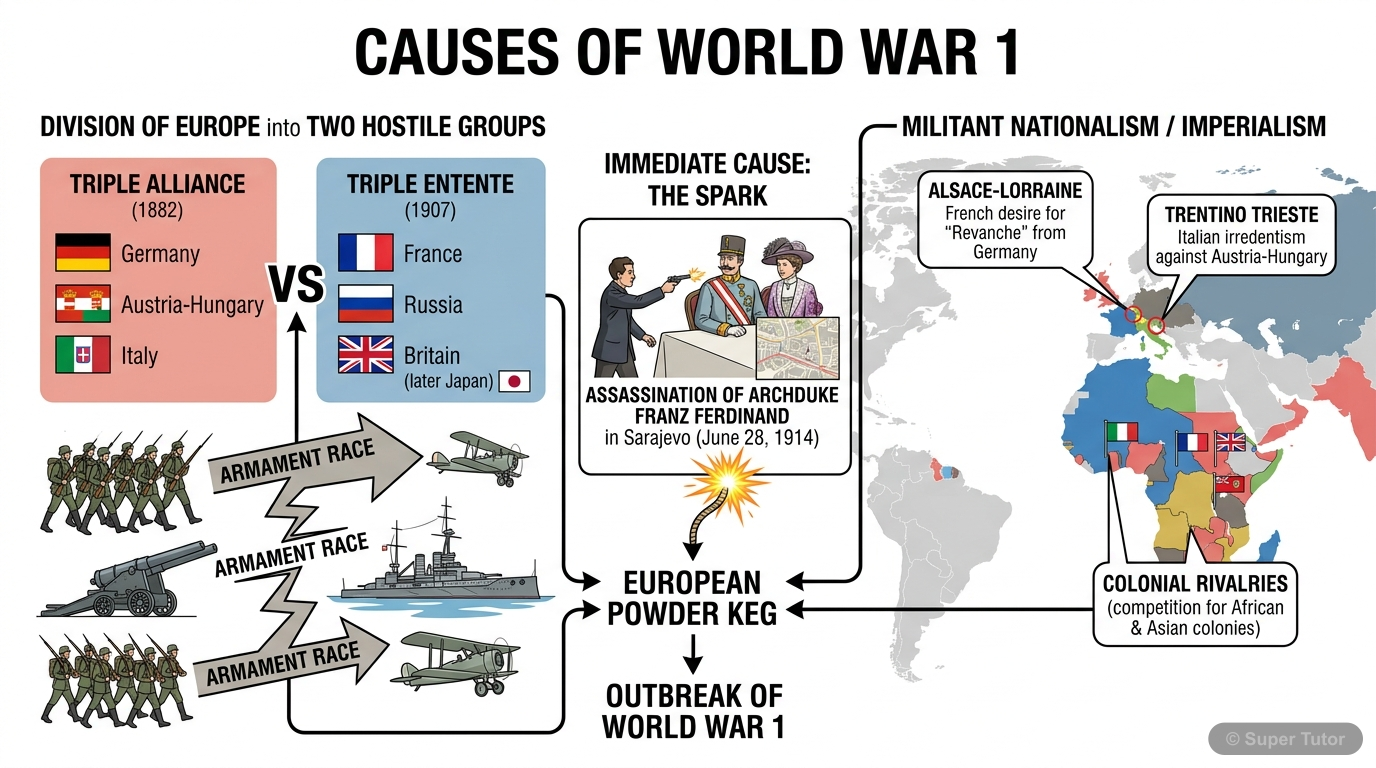
Learn better with visuals Super Tutor pairs illustrations like this with notes and quizzes for The First World War 1914-18.
Topics in The First World War 1914-18
Europe on the Eve of the War
- In 1900 Europe had twenty independent states, and seven were great powers.
- The seven great powers were Russia, Germany, Austria-Hungary, England, France, Italy, and the Turkish empire.
- England was the strongest power and followed splendid isolation since the end of the Crimean War.
Rise of Triple Entente
- Kaiser William II renounced Bismarck's defensive Triple Alliance and converted it into an aggressive alliance.
- Kaiser William II pursued naval expansion and colonial ambitions and made provocative remarks about Germany needing colonies.
- Bismarck had originally built the Triple Alliance as a defensive arrangement and had kept France isolated.
Balkan Tensions and the Immediate Outbreak of War
- Balkan nationalism was a major issue in the Eastern Question.
- Balkan nationalists wanted freedom from Turkish rule.
- Slav nationalists wanted merger with Serbia.
Underlying Causes of the War
- The war had four underlying causes: aggressive nationalism, economic rivalry and neo-imperialism, formation of alliances, and armament race.
- Aggressive nationalism made people proud of their own nation and hostile to others.
- In Germany, thinkers preached the superiority of the Teutonic race.
Key Concepts
Central concept: The First World War 1914-18
Work through every topic in The First World War 1914-18 with notes and quizzes
Start This ChapterFrequently Asked Questions
What are the important topics in The First World War 1914-18 for ICSE Class 11 History?
How should I revise The First World War 1914-18 for Class 11 exams?
Sources & Official References
Content is aligned to the official syllabus. Refer to the board website for the latest curriculum.
More resources for The First World War 1914-18
Practice Quiz
Test yourself with a quick quiz
Important Questions
Exam-style questions with answers
Revision Notes
Key points for last-minute revision
Chapter Summary
Understand the chapter at a glance
Concept Maps
See how topics connect
Study Plan
Step-by-step plan for this chapter
Flashcards
Quick-fire cards for active recall
For serious students
Get the full The First World War 1914-18 chapter — start free.
Quizzes, flashcards, an AI doubt solver and a study plan for ICSE Class 11 History. Free to start, no card needed.