Human Evolution — Chapter Summary
ICSE · Class 12 · Biology
Summary of Human Evolution for ICSE Class 12 Biology. Key concepts: Man belongs to the order, Dryopithecus was an earliest and Ramapithecus was a fossil.
Interactive on Super Tutor
Studying Human Evolution? Get the full interactive chapter.
Quizzes, flashcards, AI doubt-solver and a step-by-step study plan — built for chapter summary and more.
Free trial, no card needed.
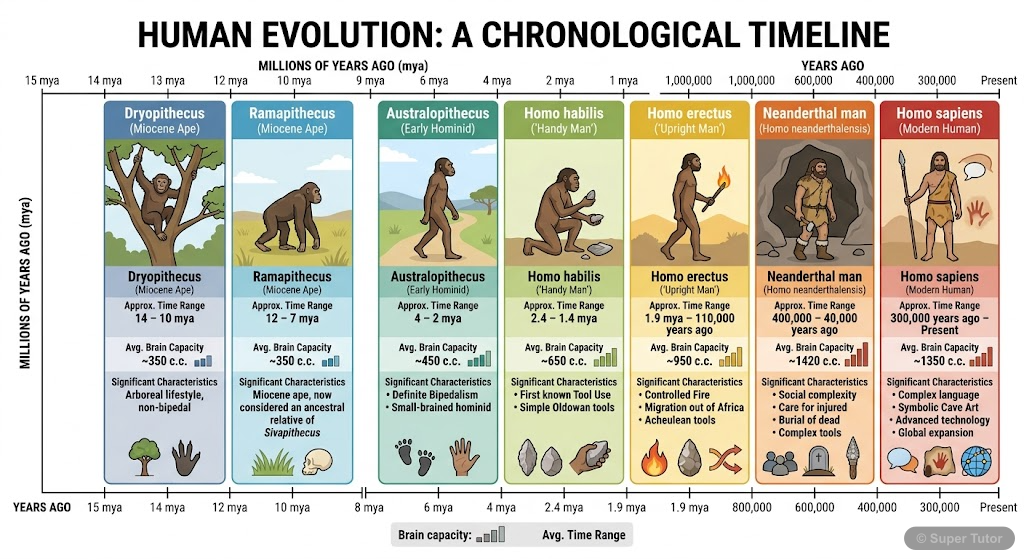
One of 2 illustrations for Human Evolution in Super Tutor — alongside flashcards, concept maps and practice questions.
Overview
Human evolution explains the origin and development of man through a series of fossil forms and biological changes. The evolutionary history of man is built from fossils and molecular homology, and it shows that no known direct line of ancestors of man exists. Man belongs to the order Primates of th
Key Concepts
Man belongs to the order Primates
Man belongs to the order Primates of the class Mammalia and shares a common ancestry with monkeys and apes. The evolutionary history of man is studied
Dryopithecus was an earliest fossil ape
Dryopithecus was an earliest fossil ape, about 20 million years old, found in Middle Miocene and early Pliocene rocks. It was more ape-like, prognatho
Ramapithecus was a fossil hominid from
Ramapithecus was a fossil hominid from 12 to 14 million years ago. It was more man-like than Dryopithecus, had a short face and small brain, and is re
Australopithecus
Australopithecus, also called African ape man, had ape-like brain structure but was described as the immediate ancestor of man. It was about 150 cm ta
Homo habilis
Homo habilis, the Handy man and tool-maker, was discovered by Louis Leakey in 1960 at Olduvai Gorge. It was 120 to 150 cm tall, had cranial capacity a
Learning Objectives
- Understand the place of man in the animal kingdom
- Identify the major fossil ancestors of man in correct sequence
- Compare ape-like, ape-man, and early man forms
- Recall key discoveries, discoverers, and approximate ages
- Understand the major physical and social changes in human evolution
Frequently Asked Questions
What are the important topics in Human Evolution for ICSE Class 12 Biology?
How should I revise Human Evolution for the ICSE Class 12 board exam?
Sources & Official References
Content is aligned to the official syllabus. Refer to the board website for the latest curriculum.
More resources for Human Evolution
For serious students
Get the full Human Evolution chapter — start free.
Quizzes, flashcards, an AI doubt solver and a study plan for ICSE Class 12 Biology. Free to start, no card needed.