Organisms and Populations — Chapter Summary
ICSE · Class 12 · Biology
Summary of Organisms and Populations for ICSE Class 12 Biology. Part of the ICSE Class 12 Biology syllabus. Ecology studies the interactions among.
Interactive on Super Tutor
Studying Organisms and Populations? Get the full interactive chapter.
Quizzes, flashcards, AI doubt-solver and a step-by-step study plan — built for chapter summary and more.
Free trial, no card needed.
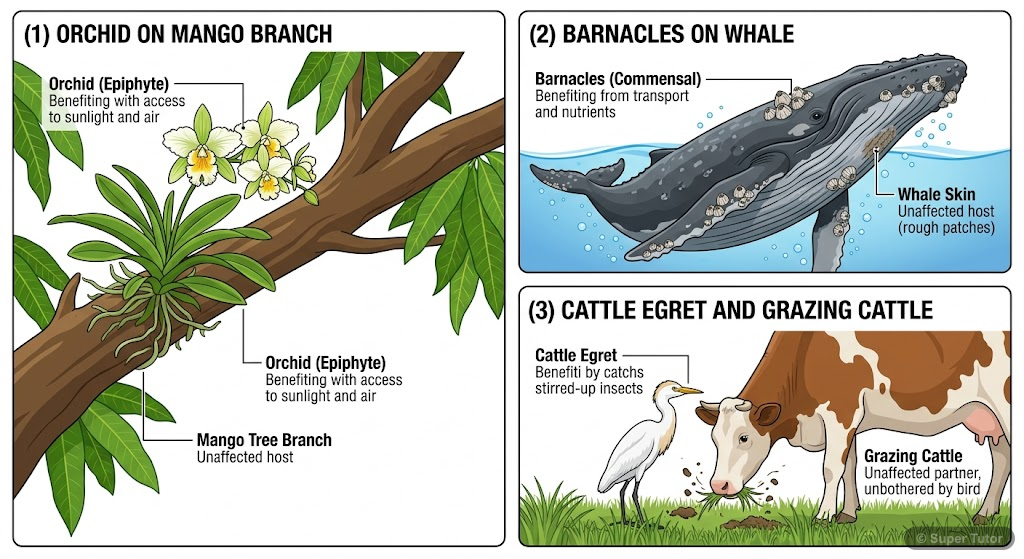
Learn better with visuals Super Tutor pairs illustrations like this with notes and quizzes for Organisms and Populations.
Overview
Ecology studies the interactions among organisms and between organisms and their environment. The chapter builds from the five levels of ecological organization—organism, population, community, ecosystem, and biosphere—and then explains how organisms interact with one another through commensalism, p
Key Concepts
Ecology is the branch of biological
Ecology is the branch of biological science that deals with complex interactions among organisms and between organisms and their environment. The five
A population is a group
A population is a group of interacting individuals of the same species living in a specific physical place called a habitat. Local populations or deme
A community consists of all populations
A community consists of all populations of different species living together in an area. An ecosystem is the interaction of communities with their non
Commensalism benefits one species and does
Commensalism benefits one species and does not affect the other. Proto-cooperation benefits both species but is not obligatory. Mutualism benefits bot
Commensalism is an association in
Commensalism is an association in which one organism is benefited and the other is neither benefited nor harmed. Examples include epiphytes, lianas, e
Learning Objectives
- Define ecology and the main levels of ecological organization.
- Distinguish between organism, population, community, ecosystem, biome, and biosphere.
- Explain the different types of interspecific interactions with examples.
- Compare positive interactions and negative interactions among species.
- Describe population density, birth rate, death rate, biotic potential, and environmental resistance.
Frequently Asked Questions
What are the important topics in Organisms and Populations for ICSE Class 12 Biology?
How should I revise Organisms and Populations for the ICSE Class 12 board exam?
Sources & Official References
Content is aligned to the official syllabus. Refer to the board website for the latest curriculum.
More resources for Organisms and Populations
Practice Quiz
Test yourself with a quick quiz
Important Questions
Exam-style questions with answers
Revision Notes
Key points for last-minute revision
Formula Sheet
The chapter's formulas in one place
Concept Maps
See how topics connect
Study Plan
Step-by-step plan for this chapter
Flashcards
Quick-fire cards for active recall
Syllabus
What topics to cover
For serious students
Get the full Organisms and Populations chapter — start free.
Quizzes, flashcards, an AI doubt solver and a study plan for ICSE Class 12 Biology. Free to start, no card needed.