Human Evolution — Flashcards
ICSE · Class 12 · Biology
36 flashcards for Human Evolution (ICSE Class 12 Biology) to test yourself on key terms and facts. Sample: "What is the scientific place of man"
Interactive on Super Tutor
Studying Human Evolution? Get the full interactive chapter.
Quizzes, flashcards, AI doubt-solver and a step-by-step study plan — built for flashcards and more.
Free trial, no card needed.
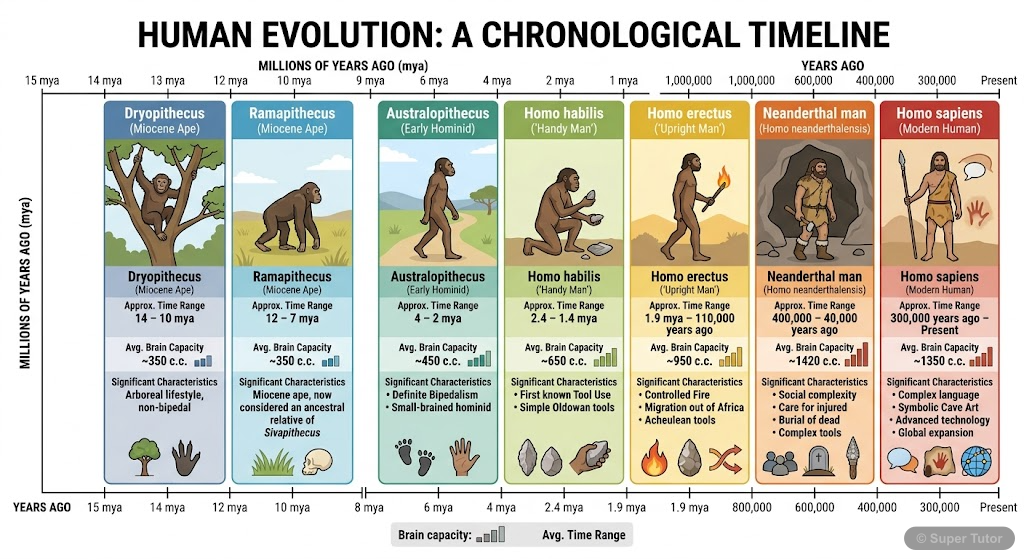
One of 2 illustrations for Human Evolution in Super Tutor — alongside flashcards, concept maps and practice questions.
What is the scientific place of man in the animal kingdom?
Answer
Man, Homo sapiens, belongs to the order Primates and the class Mammalia. Humans share common ancestry with monkeys and apes.
Who made the first scientific attempt to explain the origin of man?
Answer
Thomas Henry Huxley made the first scientific attempt to explain man's origin in 1863 in his book Evidence as to Man's Place in Nature.
What important idea did Charles Darwin give about the origin of man?
Answer
Charles Darwin stated in 1871 that men, monkeys, and apes have a common ancestor.
Who gave the scientific name Homo sapiens to man?
Answer
Carolus Linnaeus gave man the scientific name Homo sapiens and placed him among monkeys and apes.
What does the chapter state about the direct line of human ancestors?
Answer
There is no known direct line of ancestors of man. Human evolution is reconstructed mainly from fossils and molecular homology.
Compare Dryopithecus and Ramapithecus.
Answer
Dryopithecus was more ape-like, while Ramapithecus was more man-like. Dryopithecus is placed as a prior-to-ape-man fossil ape, whereas Ramapithecus is a more man-like early hominid ancestor.
What were the main features of Dryopithecus?
Answer
Dryopithecus was the earliest fossil ape. It lived about 20 million years ago, had a cranial capacity of 500 to 700 cc, was about four feet tall, had prognathous jaws, large canines, almost equal-leng…
What were the main features of Ramapithecus?
Answer
Ramapithecus lived about 12 to 14 million years ago. It had a short face, small brain, relatively small and delicate jaws, semi-circular teeth line, and a more upright face. It is regarded as an earli…
+28 more flashcards
Practise AllFrequently Asked Questions
What are the important topics in Human Evolution for ICSE Class 12 Biology?
How many flashcards are available for Human Evolution?
How should I revise Human Evolution for the ICSE Class 12 board exam?
Sources & Official References
Content is aligned to the official syllabus. Refer to the board website for the latest curriculum.
More resources for Human Evolution
Practice Quiz
Test yourself with a quick quiz
Important Questions
Exam-style questions with answers
Revision Notes
Key points for last-minute revision
Chapter Summary
Understand the chapter at a glance
Concept Maps
See how topics connect
Study Plan
Step-by-step plan for this chapter
Syllabus
What topics to cover
For serious students
Get the full Human Evolution chapter — start free.
Quizzes, flashcards, an AI doubt solver and a study plan for ICSE Class 12 Biology. Free to start, no card needed.