Organisms and Populations — Flashcards
ICSE · Class 12 · Biology
54 flashcards for Organisms and Populations (ICSE Class 12 Biology) to test yourself on key terms and facts. Sample: "What is ecology?"
Interactive on Super Tutor
Studying Organisms and Populations? Get the full interactive chapter.
Quizzes, flashcards, AI doubt-solver and a step-by-step study plan — built for flashcards and more.
Free trial, no card needed.
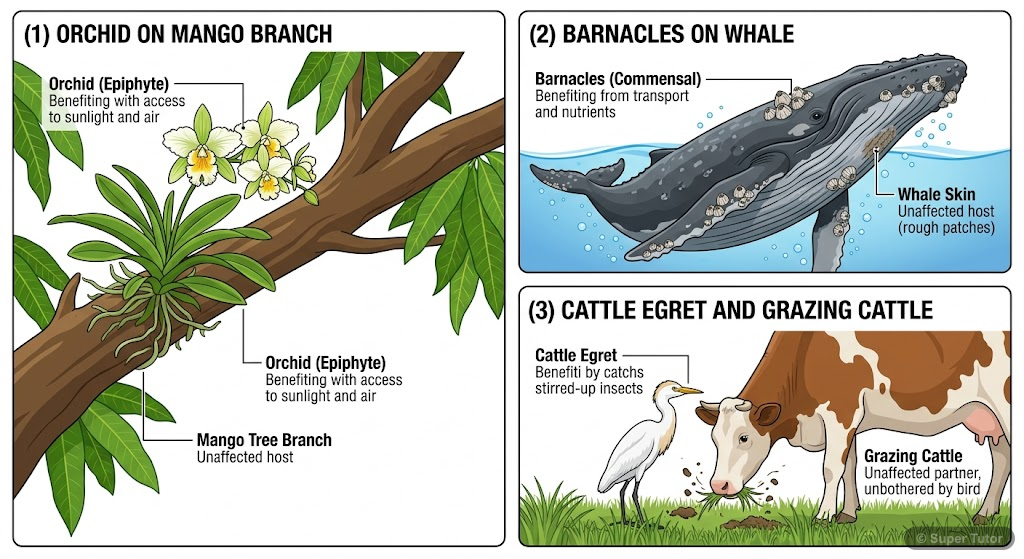
Learn better with visuals Super Tutor pairs illustrations like this with notes and quizzes for Organisms and Populations.
What is ecology?
Answer
Ecology is a branch of biological science that deals with complex interactions among organisms and between organisms and their environment. The term comes from Greek words meaning house and study of.
Why is Ernst Haeckel important in the history of ecology?
Answer
Ernst Haeckel, a German biologist, is generally credited as the first to use the term ecology in 1886 to describe the sum of the relations of organisms to the surrounding outer world.
What are the five levels of ecological organization?
Answer
The five levels are organism, population, community, ecosystem, and biosphere. Each higher level includes more complexity and new interactions.
What is a population?
Answer
A population is a group of interacting individuals of the same species living in a specific physical place, called the habitat. Members share the same gene pool and ecological requirements.
How is a community different from a population?
Answer
A population includes individuals of one species in a given area, while a community consists of all populations of different species living together in an area.
What is an ecosystem?
Answer
An ecosystem is the interaction of communities with their non-living environment, allowing orderly flow of matter and energy. It is the basic functional unit of ecology.
What is the biosphere?
Answer
All the ecosystems together form the biosphere. It is the giant ecosystem of the Earth where life exists and interacts with the physical environment.
What is autecology?
Answer
Autecology studies the relation of a single species with its environment. It focuses on one species and its adaptations, requirements, and responses.
+46 more flashcards
Practise AllFrequently Asked Questions
What are the important topics in Organisms and Populations for ICSE Class 12 Biology?
How many flashcards are available for Organisms and Populations?
How should I revise Organisms and Populations for the ICSE Class 12 board exam?
Sources & Official References
Content is aligned to the official syllabus. Refer to the board website for the latest curriculum.
More resources for Organisms and Populations
Practice Quiz
Test yourself with a quick quiz
Important Questions
Exam-style questions with answers
Revision Notes
Key points for last-minute revision
Formula Sheet
The chapter's formulas in one place
Chapter Summary
Understand the chapter at a glance
Concept Maps
See how topics connect
Study Plan
Step-by-step plan for this chapter
Syllabus
What topics to cover
For serious students
Get the full Organisms and Populations chapter — start free.
Quizzes, flashcards, an AI doubt solver and a study plan for ICSE Class 12 Biology. Free to start, no card needed.