Chemical Kinetics — Concept Maps
ICSE · Class 12 · Chemistry
4 concept maps of Chemical Kinetics for ICSE Class 12 Chemistry, each also written out as a text outline. Covers Molecularity, Mechanism, and Catalysis.
Interactive on Super Tutor
Studying Chemical Kinetics? Get the full interactive chapter.
Quizzes, flashcards, AI doubt-solver and a step-by-step study plan — built for concept maps and more.
Free trial, no card needed.
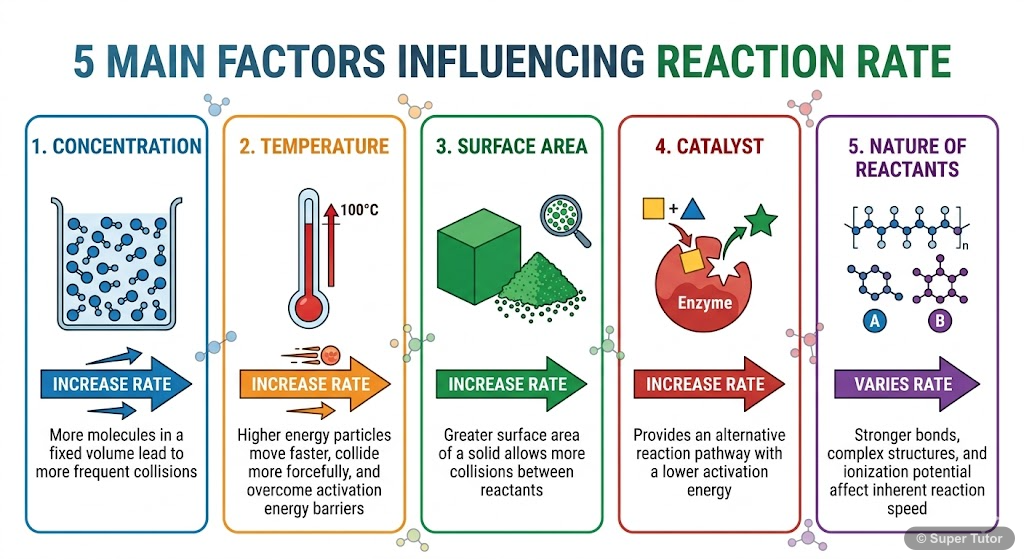
Learn better with visuals Super Tutor pairs illustrations like this with notes and quizzes for Chemical Kinetics.
Determining Reaction Order from Rate Constant Units
The map in words
- Given: Rate Constant k with Units
- What are the units?
- time⁻¹ (s⁻¹, min⁻¹): Order = 1 (First-Order)
- Use Integrated Rate Law: k = 2.303/t × log₁₀(A₀/A) t₁/₂ = 0.693/k
- conc⁻¹ time⁻¹ (mol⁻¹L s⁻¹): Order = 2 (Second-Order)
- Use Integrated Rate Law: k = 1/t × (A₀-A)/(A₀×A) t₁/₂ = 1/(k×A₀)
- conc time⁻¹ (mol L⁻¹ s⁻¹): Order = 0 (Zero-Order)
- Use Integrated Rate Law: k = (A₀-A)/t t₁/₂ = A₀/(2k)
- conc⁻² time⁻¹ (mol⁻²L² s⁻¹): Order = 3 (Third-Order)
- Use Integrated Rate Law: k = 1/t × expression t₁/₂ = 3/(2k×A₀²)
- conc^(1-n) time⁻¹: Order = n (General)
- time⁻¹ (s⁻¹, min⁻¹): Order = 1 (First-Order)
- What are the units?
Flowchart showing the decision process for calculating reaction rates with different stoichiometric coefficients
The map in words
- Reaction Rate Calculation
- Measure concentration change of reactant or product
- Same stoichiometric coefficients?
- Yes: Rate = |Δ[conc
- Final Rate Value
- No: Divide by stoichiometric coefficient
- Rate = |Δ[conc
- Yes: Rate = |Δ[conc
- Same stoichiometric coefficients?
- Measure concentration change of reactant or product
Comparison of average and instantaneous rate calculations and their characteristics
The map in words
- Measuring Reaction Rate
- Average Rate Large Time Interval
- Δt = t₂ - t₁
- Rate = ΔC/Δt
- Decreases with time
- Rate = ΔC/Δt
- Used for intervals
- Δt = t₂ - t₁
- Instantaneous Rate Infinitesimal Time
- Δt → 0
- Rate = dC/dt Tangent Slope
- True rate at moment
- Rate = dC/dt Tangent Slope
- Used for analysis
- Δt → 0
- Average Rate Large Time Interval
Chemical Kinetics: the study of reaction rates, rate laws, mechanisms, and the factors that control how fast reactions occur
The map in words
- Chemical Kinetics: the study of reaction rates, rate laws, mechanisms, and the factors that control how fast reactions occur
- Reaction rate
- Average rate of reaction
- Instantaneous rate of reaction
- Experimental measurement of rate
- Factors affecting reaction rate
- Nature of reactants
- Law of mass action
- Rate law
Explore these maps interactively
Explore DiagramsFrequently Asked Questions
What are the important topics in Chemical Kinetics for ICSE Class 12 Chemistry?
What do the concept maps for Chemical Kinetics show?
How should I revise Chemical Kinetics for the ICSE Class 12 board exam?
Sources & Official References
Content is aligned to the official syllabus. Refer to the board website for the latest curriculum.
More resources for Chemical Kinetics
Practice Quiz
Test yourself with a quick quiz
Important Questions
Exam-style questions with answers
Revision Notes
Key points for last-minute revision
Formula Sheet
The chapter's formulas in one place
Chapter Summary
Understand the chapter at a glance
Study Plan
Step-by-step plan for this chapter
Flashcards
Quick-fire cards for active recall
Syllabus
What topics to cover
For serious students
Get the full Chemical Kinetics chapter — start free.
Quizzes, flashcards, an AI doubt solver and a study plan for ICSE Class 12 Chemistry. Free to start, no card needed.