Chemical Kinetics — Flashcards
ICSE · Class 12 · Chemistry
40 flashcards for Chemical Kinetics (ICSE Class 12 Chemistry) to test yourself on key terms and facts. Sample: "What is chemical kinetics?"
Interactive on Super Tutor
Studying Chemical Kinetics? Get the full interactive chapter.
Quizzes, flashcards, AI doubt-solver and a step-by-step study plan — built for flashcards and more.
Free trial, no card needed.
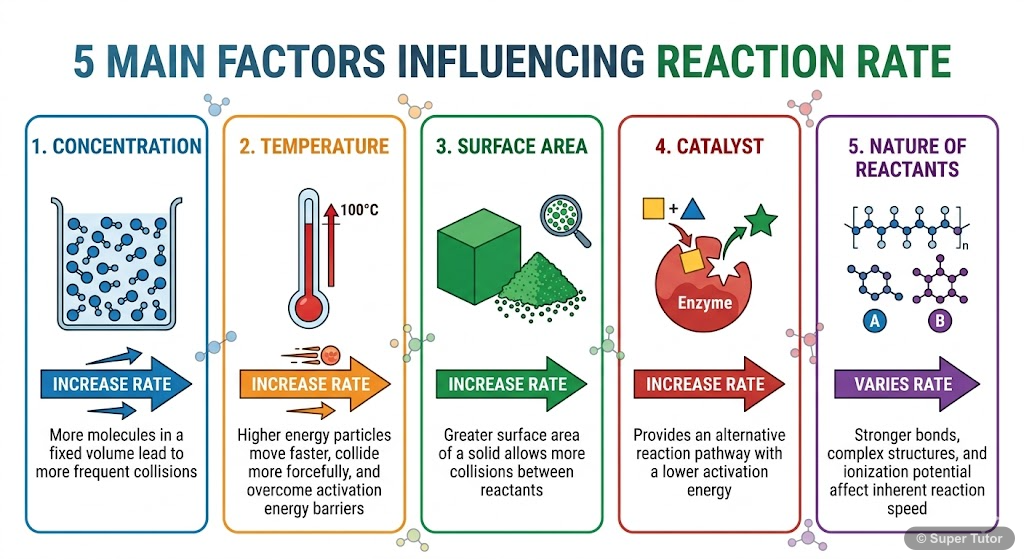
Learn better with visuals Super Tutor pairs illustrations like this with notes and quizzes for Chemical Kinetics.
What is chemical kinetics?
Answer
Chemical kinetics is the branch of chemistry which deals with the study of reaction rates and the mechanism by which reactions occur.
What is the rate of a chemical reaction?
Answer
Rate of reaction = change in concentration of a reactant or product per unit time. It can be written as decrease in reactant concentration or increase in product concentration per unit time. General…
Why are average rate and instantaneous rate different?
Answer
Average rate is the change in concentration over a finite time interval Δt, so it is not the true rate at a particular moment. Instantaneous rate is the rate at a particular instant of time and is wri…
How is the rate of reaction expressed for the reaction aA + bB → cC + dD?
Answer
For the reaction aA + bB → cC + dD: Average rate of reaction = -(1/a) Δ[A]/Δt = -(1/b) Δ[B]/Δt = (1/c) Δ[C]/Δt = (1/d) Δ[D]/Δt Instantaneous rate = -(1/a) d[A]/dt = -(1/b) d[B]/dt = (1/c) d[C]/dt = …
Why do ionic reactions often occur very fast?
Answer
Ionic reactions are fast because ions react directly in solution and products are obtained as soon as the reactants are mixed together. Example: Ag+(aq) + NO3-(aq) + Na+(aq) + Cl-(aq) → AgCl(s) + Na+…
Why are reactions involving covalent compounds usually slower?
Answer
Reactions involving covalent compounds are slower because old bonds must break and new bonds must form. This bond rearrangement needs energy and takes time. Reactions involving polar and ionic substan…
What happens in the rusting of iron?
Answer
Rusting of iron is a very slow reaction. It may take several months to complete, so it is classified as a very slow reaction.
What is the law of mass action?
Answer
At constant temperature, the rate of a chemical reaction is directly proportional to the product of active masses of reacting species, with each active mass term raised to the power equal to the stoic…
+32 more flashcards
Practise AllFrequently Asked Questions
What are the important topics in Chemical Kinetics for ICSE Class 12 Chemistry?
How many flashcards are available for Chemical Kinetics?
How should I revise Chemical Kinetics for the ICSE Class 12 board exam?
Sources & Official References
Content is aligned to the official syllabus. Refer to the board website for the latest curriculum.
More resources for Chemical Kinetics
Practice Quiz
Test yourself with a quick quiz
Important Questions
Exam-style questions with answers
Revision Notes
Key points for last-minute revision
Formula Sheet
The chapter's formulas in one place
Chapter Summary
Understand the chapter at a glance
Concept Maps
See how topics connect
Study Plan
Step-by-step plan for this chapter
Syllabus
What topics to cover
For serious students
Get the full Chemical Kinetics chapter — start free.
Quizzes, flashcards, an AI doubt solver and a study plan for ICSE Class 12 Chemistry. Free to start, no card needed.