Coordination Compounds — Concept Maps
ICSE · Class 12 · Chemistry
4 concept maps of Coordination Compounds for ICSE Class 12 Chemistry, each also written out as a text outline.
Interactive on Super Tutor
Studying Coordination Compounds? Get the full interactive chapter.
Quizzes, flashcards, AI doubt-solver and a step-by-step study plan — built for concept maps and more.
Free trial, no card needed.
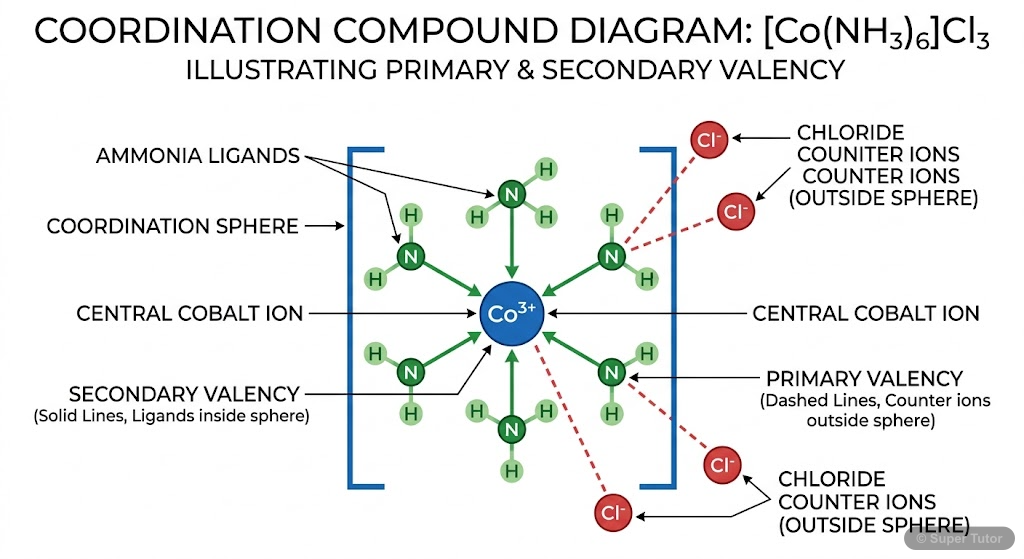
Learn better with visuals Super Tutor pairs illustrations like this with notes and quizzes for Coordination Compounds.
Comprehensive Overview of Coordination Compounds
The map in words
- Coordination Compounds
- Definition & Structure
- Central Metal Atom/Ion
- Ligands
- Coordinate Bonds
- Coordination Sphere
- Ionic Sphere
- Important Terms
- Coordination Number
- Oxidation State
- Charge on Complex
- Chelating Ligands
- Bridging Ligands
- Classification of Ligands
- By Charge
- Neutral
- Anionic
- Cationic
- By Denticity
- Monodentate
- Bidentate
- Polydentate
- By Charge
- Nomenclature
- IUPAC Rules
- Naming Ligands
- Naming Metal
- Cationic Complexes
- Anionic Complexes
- Isomerism
- Structural
- Ionization
- Hydrate
- Linkage
- Coordination
- Stereoisomerism
- Geometrical
- Optical
- Structural
- Bonding Theories
- Valence Bond Theory
- Hybridization
- Geometry
- Magnetic Properties
- Crystal Field Theory
- Orbital Splitting
- CFSE
- Color
- Magnetism
- Valence Bond Theory
- Stability
- Stability Constant K
- Factors Affecting
- Ligand Field Strength
- Applications
- Analytical Chemistry
- Metal Extraction
- Electroplating
- Medicine
- Biology
- Catalysis
- Definition & Structure
Mind map showing relationship between key terms in coordination chemistry
The map in words
- Coordination Chemistry Terms
- Central Metal Atom Ion
- Lewis acid
- Accepts electron pairs
- Transition metals common
- Ligands
- Electron pair donors
- Lewis bases
- Monodentate Polydentate
- Complex Ion
- Charged species
- Metal plus ligands
- Cationic Anionic
- Coordination Number
- Maximum ligands
- Usually 4 or 6
- Determines geometry
- Coordination Sphere
- Central metal plus ligands
- In square brackets
- Ionic Sphere
- Ionizable groups
- Outside brackets
- Central Metal Atom Ion
Flowchart comparing dissolution behavior of double salts and coordination compounds
The map in words
- Molecular Addition Compounds
- In Aqueous Solution
- Identity Lost: Double Salts
- Dissociate into constituent ions
- Example: Mohr's salt
- All ions give characteristic tests
- Dissociate into constituent ions
- Identity Retained: Coordination Compounds
- Complex ion remains intact
- Example: K₄Fe(CN)₆
- Only counter ion gives tests
- Complex ion remains intact
- Identity Lost: Double Salts
- In Aqueous Solution
Coordination compounds as metal-ligand systems with special bonding, naming, isomerism, stability, and applications
The map in words
- Coordination compounds as metal-ligand systems with special bonding, naming, isomerism, stability, and applications
- Basic definition
- Important terms
- Classification of complexes
- Ligands
- Werner's theory
- Nomenclature
- Isomerism
- Valence bond theory
Explore these maps interactively
Explore DiagramsFrequently Asked Questions
What are the important topics in Coordination Compounds for ICSE Class 12 Chemistry?
What do the concept maps for Coordination Compounds show?
How should I revise Coordination Compounds for the ICSE Class 12 board exam?
Sources & Official References
Content is aligned to the official syllabus. Refer to the board website for the latest curriculum.
More resources for Coordination Compounds
Practice Quiz
Test yourself with a quick quiz
Important Questions
Exam-style questions with answers
Revision Notes
Key points for last-minute revision
Chapter Summary
Understand the chapter at a glance
Study Plan
Step-by-step plan for this chapter
Flashcards
Quick-fire cards for active recall
Syllabus
What topics to cover
For serious students
Get the full Coordination Compounds chapter — start free.
Quizzes, flashcards, an AI doubt solver and a study plan for ICSE Class 12 Chemistry. Free to start, no card needed.