Chemical Kinetics — Practice Quiz
ICSE · Class 12 · Chemistry
Try a 4-question quiz on Chemical Kinetics for ICSE Class 12 Chemistry: tap an answer to check it and see why. 99 questions in the full chapter test.
Interactive on Super Tutor
Studying Chemical Kinetics? Get the full interactive chapter.
Quizzes, flashcards, AI doubt-solver and a step-by-step study plan — built for practice quiz and more.
Free trial, no card needed.
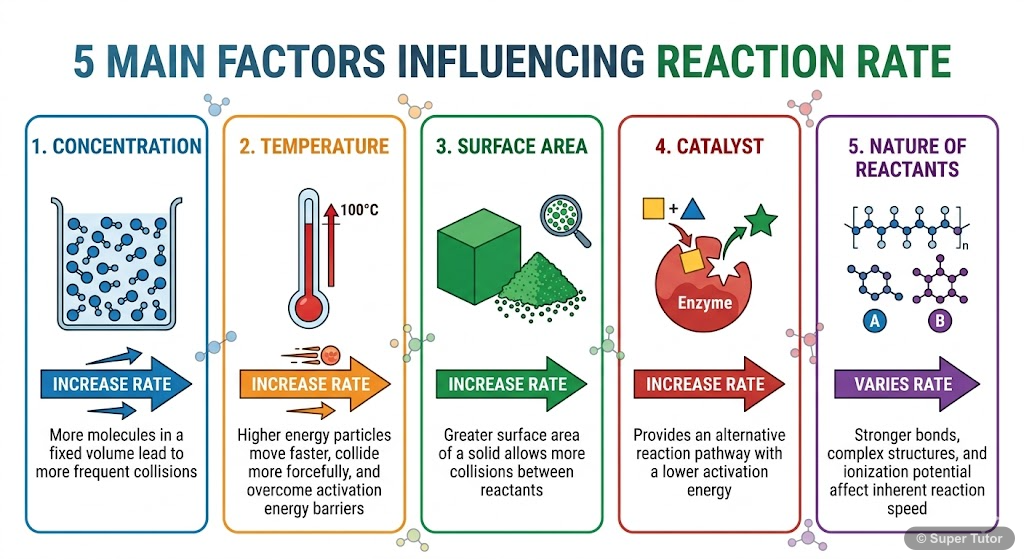
Learn better with visuals Super Tutor pairs illustrations like this with notes and quizzes for Chemical Kinetics.
Quick Quiz: Chemical Kinetics
0/4Tap an answer to check it instantly. No sign-up needed for these 4.
The branch of chemistry that deals with the study of reaction rates is called:
The units of rate of reaction are:
The units of rate constant for a first-order reaction are:
Which of the following reactions is likely to be the fastest?
Sample Questions
For the reaction N₂ + 3H₂ → 2NH₃, if rate of disappearance of N₂ is 2 × 10⁻⁴ mol L⁻¹ s⁻¹, the rate of disappearance of H₂ is:
Show answer
6 × 10⁻⁴ mol L⁻¹ s⁻¹
Rate = -d[N₂]/dt = -(1/3)d[H₂]/dt. So d[H₂]/dt = 3 × d[N₂]/dt = 3 × 2 × 10⁻⁴ = 6 × 10⁻⁴ mol L⁻¹ s⁻¹
The rate constant k of a reaction increases with increasing concentration of reactants.
Show answer
False
Rate constant k is independent of concentration. k only changes with temperature.
For the reaction A + 2B → 3C + 2D with Rate = k[A][B]², the overall order of reaction is:
Show answer
3
Overall order = sum of powers in rate law = 1 + 2 = 3 (third order). Not related to stoichiometric coefficients.
The half-life of a first-order reaction with rate constant k = 6.93 × 10⁻² s⁻¹ is:
Show answer
10 s
t½ = 0.693/k = 0.693 / (6.93 × 10⁻²) = 0.693/0.0693 = 10 s
+95 more questions on Chemical Kinetics (ICSE Class 12 Chemistry)
Practise AllFrequently Asked Questions
What are the important topics in Chemical Kinetics for ICSE Class 12 Chemistry?
How many practice questions are there for Chemical Kinetics?
Sources & Official References
Content is aligned to the official syllabus. Refer to the board website for the latest curriculum.
More resources for Chemical Kinetics
Important Questions
Exam-style questions with answers
Revision Notes
Key points for last-minute revision
Formula Sheet
The chapter's formulas in one place
Chapter Summary
Understand the chapter at a glance
Concept Maps
See how topics connect
Study Plan
Step-by-step plan for this chapter
Flashcards
Quick-fire cards for active recall
Syllabus
What topics to cover
For serious students
Get the full Chemical Kinetics chapter — start free.
Quizzes, flashcards, an AI doubt solver and a study plan for ICSE Class 12 Chemistry. Free to start, no card needed.