Organic Compounds Containing Nitrogen — Revision Notes
ICSE · Class 12 · Chemistry
Organic Compounds Containing Nitrogen revision notes for ICSE Class 12 Chemistry: 4 topics in quick points. Part of the ICSE Class 12 Chemistry syllabus.
Interactive on Super Tutor
Studying Organic Compounds Containing Nitrogen? Get the full interactive chapter.
Quizzes, flashcards, AI doubt-solver and a step-by-step study plan — built for revision notes and more.
Free trial, no card needed.
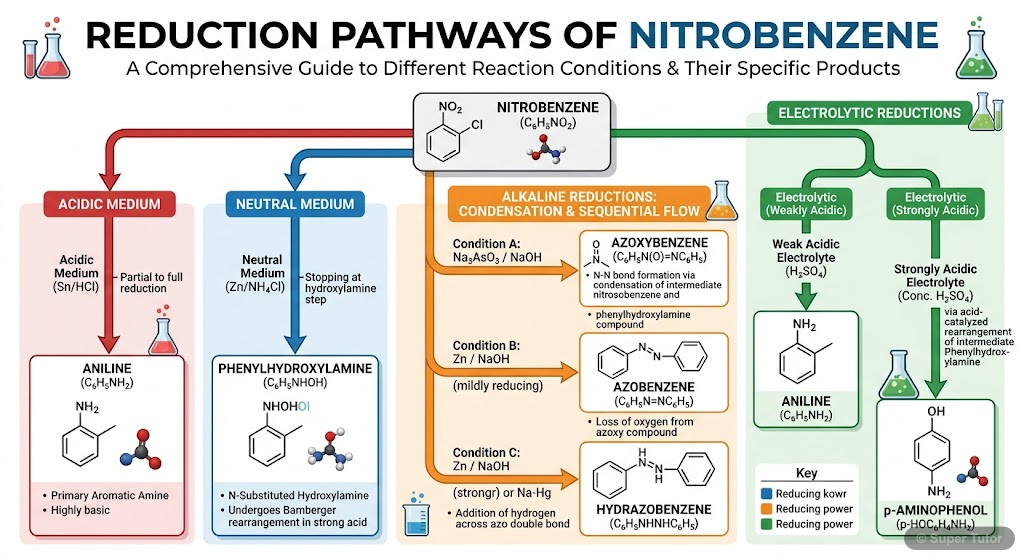
Learn better with visuals Super Tutor pairs illustrations like this with notes and quizzes for Organic Compounds Containing Nitrogen.
Key Topics to Revise
1. Amines and Aniline: Core Behaviour
- Amines are alkyl or aryl derivatives of ammonia.
- Amines are classified as primary, secondary and tertiary depending on the number of hydrogen atoms of ammonia replaced by alkyl or aryl groups.
- Primary amines contain the -NH2 group, secondary amines contain -NH-, and tertiary amines contain a nitrogen atom bonded to three carbon groups.
2. Tests and Distinguishing Reactions of Aniline and Amines
- Aniline gives the carbylamine test with chloroform and alcoholic KOH or NaOH on heating, producing phenyl carbylamine with a very offensive smell.
- Aniline gives an orange red dye on diazotisation followed by coupling with alkaline beta-naphthol.
- Aniline with sodium hypochlorite solution gives a violet colouration that changes to brown.
3. Diazotisation and Diazonium Salts
- Diazonium salts have the general formula Ar-N2+X-, where Ar is an aryl group and X- is an anion such as Cl-, Br- or HSO4-.
- Diazonium salts are prepared from arylamines by diazotisation using ice-cold NaNO2 solution added to a cold aniline-HCl solution.
- Diazotisation is carried out at 273-278 K.
4. Reactions of Diazonium Salts
- Diazonium salts undergo replacement reactions with liberation of nitrogen gas.
- Replacement by hydrogen occurs with hypophosphorous acid in the presence of cuprous ion catalyst.
- Replacement by hydroxyl group occurs on boiling aqueous diazonium salt solution with sulphuric acid or by steam distillation.
Get complete notes with diagrams and examples
Full NotesKey Concepts
Frequently Asked Questions
What are the important topics in Organic Compounds Containing Nitrogen for ICSE Class 12 Chemistry?
How should I revise Organic Compounds Containing Nitrogen for the ICSE Class 12 board exam?
Sources & Official References
Content is aligned to the official syllabus. Refer to the board website for the latest curriculum.
More resources for Organic Compounds Containing Nitrogen
Practice Quiz
Test yourself with a quick quiz
Important Questions
Exam-style questions with answers
Formula Sheet
The chapter's formulas in one place
Chapter Summary
Understand the chapter at a glance
Concept Maps
See how topics connect
Study Plan
Step-by-step plan for this chapter
Flashcards
Quick-fire cards for active recall
Syllabus
What topics to cover
For serious students
Get the full Organic Compounds Containing Nitrogen chapter — start free.
Quizzes, flashcards, an AI doubt solver and a study plan for ICSE Class 12 Chemistry. Free to start, no card needed.