Chapter 5 of 10
Revision Notes
Coordination Compounds — Revision Notes
ICSE · Class 12 · Chemistry
Coordination Compounds revision notes for ICSE Class 12 Chemistry: 4 topics in quick points. Part of the ICSE Class 12 Chemistry syllabus.
105 questions40 flashcards5 concepts
Interactive on Super Tutor
Studying Coordination Compounds? Get the full interactive chapter.
Quizzes, flashcards, AI doubt-solver and a step-by-step study plan — built for revision notes and more.
Free trial, no card needed.
Super Tutor
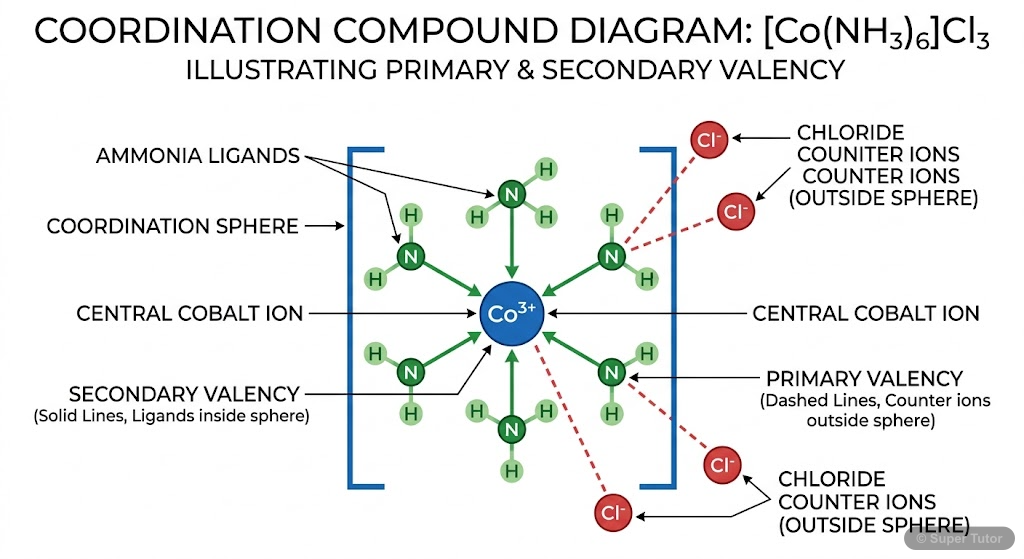
Learn better with visuals Super Tutor pairs illustrations like this with notes and quizzes for Coordination Compounds.
Key Topics to Revise
1
1. Basic Concepts and Definitions
- A coordination compound contains a central metal atom or ion permanently attached to ligands.
- Ligands are atoms, ions, or molecules that donate at least one lone pair of electrons to the metal.
- Coordination compounds retain their identity in aqueous solution, unlike double salts.
2
2. Ligands and Their Classification
- Ligands may be neutral, anionic, or rarely cationic.
- Neutral ligands include H2O, NH3, CO, NO, pyridine, and ethylenediamine.
- Anionic ligands include F-, Cl-, Br-, I-, CN-, OH-, CH3COO-, NO2-, SCN-, and others.
3
3. Werner's Theory and Modern View of Coordination Compounds
- Alfred Werner prepared cobalt-ammine chloride complexes in 1892.
- Werner proposed that metals show two kinds of valency: primary and secondary.
- Primary valency is ionisable and corresponds to oxidation state.
4
4. Nomenclature of Coordination Compounds
- In cationic complexes, the complex cation is named first and then the anion.
- In anionic complexes, the cation is named first and then the complex anion.
- Neutral complexes are written as single words.
Get complete notes with diagrams and examples
Full NotesKey Concepts
These are compounds in whichDouble salts exist in the solidLigands are atomsA polydentate ligand that attaches throughWerner proposed that metals show primary
Frequently Asked Questions
What are the important topics in Coordination Compounds for ICSE Class 12 Chemistry?
Key topics in Coordination Compounds include Basic Concepts and Definitions, Ligands and Their Classification, Werner's Theory and Modern View of Coordination Compounds, Nomenclature of Coordination Compounds. Study these first, then practise questions on each for the ICSE Class 12 board exam.
How should I revise Coordination Compounds for the ICSE Class 12 board exam?
Learn the core ideas first, then work through the 105 practice questions on Coordination Compounds. Revise definitions regularly and use flashcards for quick recall before the exam.
Sources & Official References
Content is aligned to the official syllabus. Refer to the board website for the latest curriculum.
More resources for Coordination Compounds
For serious students
Get the full Coordination Compounds chapter — start free.
Quizzes, flashcards, an AI doubt solver and a study plan for ICSE Class 12 Chemistry. Free to start, no card needed.