Organic Compounds Containing Nitrogen — Chapter Summary
ICSE · Class 12 · Chemistry
Summary of Organic Compounds Containing Nitrogen for ICSE Class 12 Chemistry. Part of the ICSE Class 12 Chemistry syllabus.
Interactive on Super Tutor
Studying Organic Compounds Containing Nitrogen? Get the full interactive chapter.
Quizzes, flashcards, AI doubt-solver and a step-by-step study plan — built for chapter summary and more.
Free trial, no card needed.
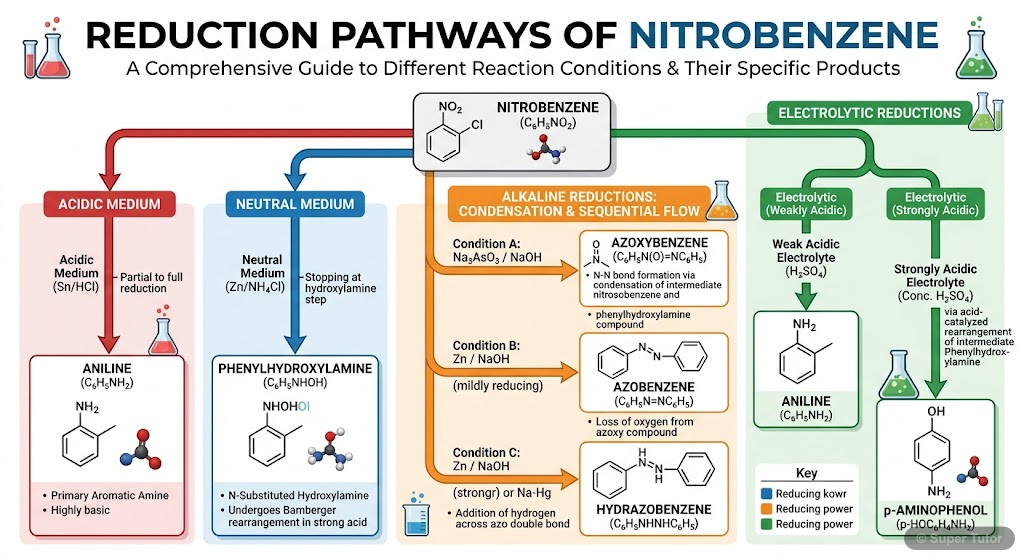
Learn better with visuals Super Tutor pairs illustrations like this with notes and quizzes for Organic Compounds Containing Nitrogen.
Overview
Organic compounds containing nitrogen include amines, nitro compounds, cyanides, isocyanides, and diazonium salts. Their chemistry is governed by the position of nitrogen in the molecule, the effect of substituents on electron density, and the stability of intermediates such as diazonium ions. Aroma
Key Concepts
Aniline contains the NH2 group attached
Aniline contains the NH2 group attached to a benzene ring. The NH2 group releases electron density into the ring, so aniline undergoes electrophilic s
Aniline is converted to acetanilide by
Aniline is converted to acetanilide by acetylation of the NH2 group. The acetyl group withdraws electron density from nitrogen, reducing activation of
All amines are basic because nitrogen
All amines are basic because nitrogen has a lone pair. Among aliphatic amines, the general order of basic strength is 2° amine > 1° amine > 3° amine.
Aromatic primary amines undergo diazotisation
Aromatic primary amines undergo diazotisation with NaNO2 and HCl at 273-278 K to form diazonium salts. These salts are unstable and are used as freshl
The diazonium group can be replaced
The diazonium group can be replaced by H, OH, Cl, Br, I, F, CN, NO2, and aryl groups under suitable conditions. Important named reactions include Sand
Learning Objectives
- Understand the structure, classification, and reactions of amines, nitro compounds, cyanides, isocyanides, and diazonium salts
- Explain why aniline is o- and p-directing and why acetylation is used as a protection step
- Compare the basic strength, boiling points, and solubility of different classes of amines
- Describe the preparation, properties, and reactions of nitrobenzene
- Distinguish between nitroalkanes and alkyl nitrites, and between cyanides and isocyanides
Frequently Asked Questions
What are the important topics in Organic Compounds Containing Nitrogen for ICSE Class 12 Chemistry?
How should I revise Organic Compounds Containing Nitrogen for the ICSE Class 12 board exam?
Sources & Official References
Content is aligned to the official syllabus. Refer to the board website for the latest curriculum.
More resources for Organic Compounds Containing Nitrogen
Practice Quiz
Test yourself with a quick quiz
Important Questions
Exam-style questions with answers
Revision Notes
Key points for last-minute revision
Formula Sheet
The chapter's formulas in one place
Concept Maps
See how topics connect
Study Plan
Step-by-step plan for this chapter
Flashcards
Quick-fire cards for active recall
Syllabus
What topics to cover
For serious students
Get the full Organic Compounds Containing Nitrogen chapter — start free.
Quizzes, flashcards, an AI doubt solver and a study plan for ICSE Class 12 Chemistry. Free to start, no card needed.