d- and f-Block Elements — Practice Quiz
ICSE · Class 12 · Chemistry
Try a 4-question quiz on d- and f-Block Elements for ICSE Class 12 Chemistry: tap an answer to check it and see why. 60 questions in the full chapter test.
Interactive on Super Tutor
Studying d- and f-Block Elements? Get the full interactive chapter.
Quizzes, flashcards, AI doubt-solver and a step-by-step study plan — built for practice quiz and more.
Free trial, no card needed.
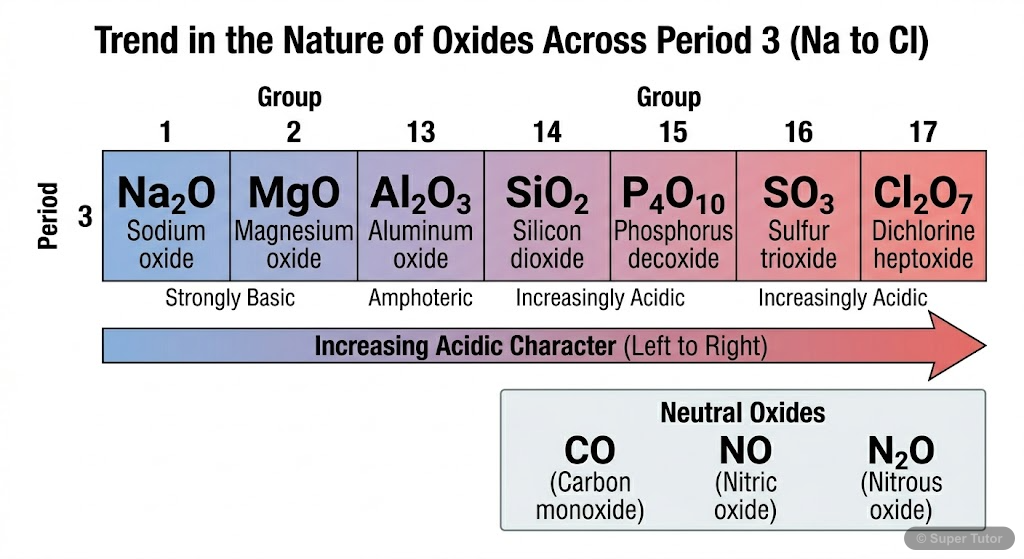
One of 17 illustrations for d- and f-Block Elements in Super Tutor — alongside flashcards, concept maps and practice questions.
Quick Quiz: d- and f-Block Elements
0/4Tap an answer to check it instantly. No sign-up needed for these 4.
Which of the following is the correct electronic configuration of Chromium (Z=24)?
Why is Zinc (Zn) NOT considered a transition element?
What is the colour of KMnO₄ (potassium permanganate) in aqueous solution?
What is the oxidation state of Mn in KMnO₄?
Sample Questions
The colour of CuSO₄ solution is:
Show answer
Blue
CuSO₄ solution is blue because Cu²⁺ (3d⁹) has one unpaired electron and one d-orbital vacancy. The d-d transition absorbs orange-red light, and the complementary colour (blue) is observed.
All d-block elements are transition elements.
Show answer
False
Zn, Cd, and Hg are d-block elements but are NOT transition elements because they have completely filled d¹⁰ orbitals in their ground state and in all their stable ions. Transition elements require incomplete d-orbitals in atom or ion.
Magnetic moment of an ion with 3 unpaired electrons is:
Show answer
√15 BM
μ = √(n(n+2)) BM. For n=3: μ = √(3×5) = √15 ≈ 3.87 BM. This corresponds to ions like Cr³⁺ (3d³).
Which of the following is used as a catalyst in the Haber process for synthesis of ammonia?
Show answer
Iron (Fe)
Iron is the catalyst in the Haber-Bosch process: N₂ + 3H₂ ⇌ 2NH₃ (450°C, 200 atm). Molybdenum (Mo) is used as a promoter. V₂O₅ is for the Contact process; Pt is for the Ostwald process.
+56 more questions on d- and f-Block Elements (ICSE Class 12 Chemistry)
Practise AllFrequently Asked Questions
What are the important topics in d- and f-Block Elements for ICSE Class 12 Chemistry?
How many practice questions are there for d- and f-Block Elements?
Sources & Official References
Content is aligned to the official syllabus. Refer to the board website for the latest curriculum.
More resources for d- and f-Block Elements
Important Questions
Exam-style questions with answers
Revision Notes
Key points for last-minute revision
Chapter Summary
Understand the chapter at a glance
Concept Maps
See how topics connect
Study Plan
Step-by-step plan for this chapter
Flashcards
Quick-fire cards for active recall
Syllabus
What topics to cover
For serious students
Get the full d- and f-Block Elements chapter — start free.
Quizzes, flashcards, an AI doubt solver and a study plan for ICSE Class 12 Chemistry. Free to start, no card needed.