d- and f-Block Elements — Flashcards
ICSE · Class 12 · Chemistry
45 flashcards for d- and f-Block Elements (ICSE Class 12 Chemistry) to test yourself on key terms and facts. Sample: "What are transition elements?"
Interactive on Super Tutor
Studying d- and f-Block Elements? Get the full interactive chapter.
Quizzes, flashcards, AI doubt-solver and a step-by-step study plan — built for flashcards and more.
Free trial, no card needed.
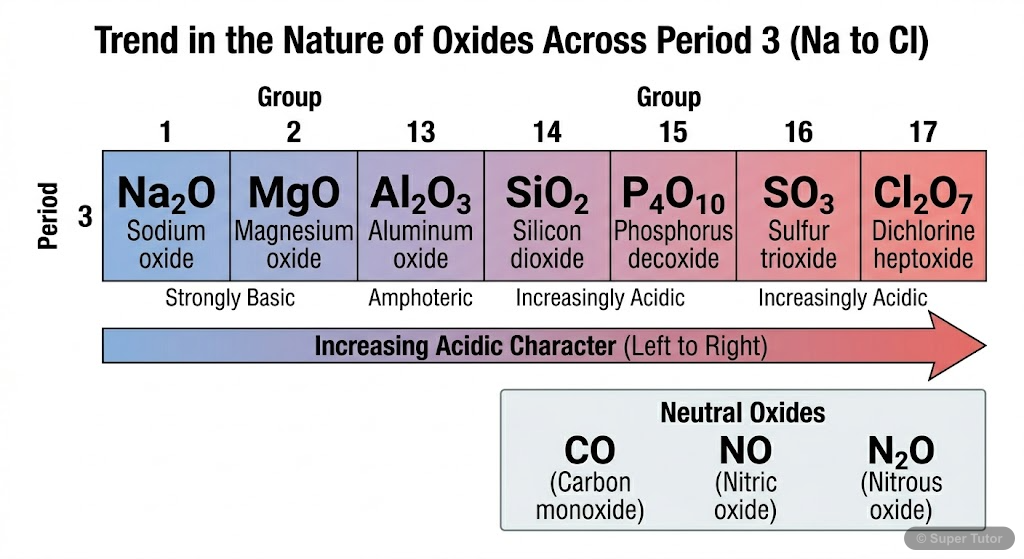
One of 17 illustrations for d- and f-Block Elements in Super Tutor — alongside flashcards, concept maps and practice questions.
What are transition elements?
Answer
Transition elements are those elements in which the differentiating electron enters the (n-1)d subshell. They belong to groups 3 to 12 of the periodic table.
What are inner transition elements?
Answer
Inner transition elements are those elements in which the differentiating electron enters the (n-2)f subshell. They form the lanthanoid and actinoid series placed separately at the bottom of the perio…
Why are d-block elements called transition elements?
Answer
They lie between the highly electropositive s-block elements and the electronegative p-block elements, so they show transitional behaviour between ionic and covalent character.
Write the first transition series, second transition series, third transition series, and fourth transition series.
Answer
First transition series: Sc to Zn. Second transition series: Y to Cd. Third transition series: La and Hf to Hg. Fourth transition series: Ac and elements with atomic number 104 and above.
Why is chromium an exception in electronic configuration?
Answer
Chromium has [Ar] 3d5 4s1 instead of the expected [Ar] 3d4 4s2. Half-filled and completely filled subshells are extra stable, so one 4s electron shifts to 3d to give a more stable arrangement.
Why is copper an exception in electronic configuration?
Answer
Copper has [Ar] 3d10 4s1 instead of the expected [Ar] 3d9 4s2. One 4s electron shifts to 3d to give a completely filled d subshell, which is extra stable.
Why are Zn, Cd, and Hg not true transition elements?
Answer
Zn, Cd, and Hg do not have partially filled d orbitals in their atoms or in their common ions. Zn and Zn2+ are 3d10, Cd and Cd2+ are 4d10, and Hg and Hg2+ are 5d10.
What is the general electronic configuration of transition elements?
Answer
The general electronic configuration is (n-1)d1-10 ns1-2.
+37 more flashcards
Practise AllFrequently Asked Questions
What are the important topics in d- and f-Block Elements for ICSE Class 12 Chemistry?
How many flashcards are available for d- and f-Block Elements?
How should I revise d- and f-Block Elements for the ICSE Class 12 board exam?
Sources & Official References
Content is aligned to the official syllabus. Refer to the board website for the latest curriculum.
More resources for d- and f-Block Elements
Practice Quiz
Test yourself with a quick quiz
Important Questions
Exam-style questions with answers
Revision Notes
Key points for last-minute revision
Chapter Summary
Understand the chapter at a glance
Concept Maps
See how topics connect
Study Plan
Step-by-step plan for this chapter
Syllabus
What topics to cover
For serious students
Get the full d- and f-Block Elements chapter — start free.
Quizzes, flashcards, an AI doubt solver and a study plan for ICSE Class 12 Chemistry. Free to start, no card needed.